On a busy site in Kariobangi North, the working day begins with the sound of glass.
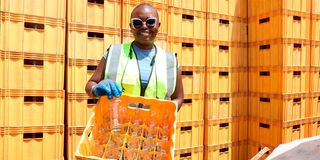
Rows of women bend over basins of water, stripping labels, removing caps and stacking bottles into crates with the steady, practised efficiency of people who have done this a thousand times before.
The clink of glass against glass fills the air, and overseeing it all is 27-year-old Purity Akhembi, who is quietly turning what most people throw away into a thriving livelihood while keeping the environment clean.
Starting with just Sh20,000 and a bet on an overlooked industry, Purity has built a glass bottle recycling enterprise that now processes up to 690,000 bottles a month and employs 45 people. She calls it Purity Waste Recycling.
“Recycling doesn’t require a lot of capital,” she says. “You can start with as little as Sh100”.
“If you look at what is happening here, a good percentage of the people working are women,” she says. “Washing at home, washing utensils—these are things women do. Men won’t like this.
She first became involved in the industry in 2023, when she worked for a bottling recycling company.
What struck her most was not the process itself, but the people doing the work and the difference between the current situation and what could be achieved.
Across Nairobi’s informal economy, the business of returning used materials to production was becoming serious from a commercial perspective, yet it remained largely unorganised and dominated by small collectors and individual traders who had little visibility or market access.
Broken pieces of recycled glass pictured at the Purie Wa Recycling facility in Nairobi on April 23, 2026.
Photo credit: Bonface Bogita | Nation Media Group
In 2024, Purity stepped up to fill this gap. She sources used glass bottles directly from bars, clubs and small vendors across the country. She then cleans and crates them before returning them to East African Breweries Limited (EABL), the manufacturer behind brands including Triple S, Ken Extra and Chrome. Purity has a contract with EABL.
Purity’s core business involves collecting, cleaning and recycling the glass bottles. She sources the bottles directly from bars, clubs, and small vendors across the country.
The cleaning process is thorough. First, workers remove stickers and then pop off the caps to ensure no ring seal remains on the bottle mouth. The bottles are then washed in water, rinsed, and stacked into crates. Purity calls this pre-cleaning.
“EBL is going to do the final cleaning,” she explains. “They clean with hydrogen peroxide. Once the bottles are in the crates, they are collected and returned to the factory, where they are sanitised and refilled, thus completing the cycle,” she explains.
However, not all bottles make it back intact. The broken pieces are sorted by colour—clear, brown and green, and then crushed and sent back to EBL under a separate programme, where they are melted down to make fresh bottles.
These broken pieces, known as cullet, are handled at the Njiru site, where the team processes around 60 tonnes per month.
Each worker is paid Sh1 per bottle cleaned. On a good day, someone handling simple paper-labelled bottles can clean up to 2,000, earning Sh2,000. Bottles with tougher stickers slow the pace to roughly 1,000 per day.
Purity estimates her monthly earnings to be between Sh50,000 and Sh1 million, depending on the season. She acknowledges that TikTok has helped her reach more clients by posting short videos of the washing, sorting and stacking processes.
“The moment I introduced this to TikTok, it made a huge difference to what I was doing in December compared to what I’m doing right now,” she says.
Bottle suppliers who previously had no outlet began calling her directly. Truck volumes climbed. A business that had relied on ground-level sourcing found a national audience.
Operating in an urban-informal setting comes with its share of difficulties. Purity says that, due to the density of Kariobangi North, whenever there is unrest in the area, workers cannot access the yard and production stops.
Despite mandatory gloves, cuts from broken glass remain a daily risk, as it is hard to fully eliminate this hazard when workers handle millions of fragments a month.
Purity has also experienced social stigma. “Sometimes I’m out collecting bottles and people ask, ‘What are you doing?’” she says.
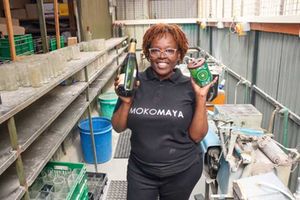
Purie Wa Recycling CEO Purity Priscah Akhembi at the Purie Wa Recycling facility in Nairobi on April 23, 2026, holding recycled green glass bottles while standing atop a pile of collected bottles at the site.
Photo credit: Bonface Bogita | Nation Media Group
“People who don’t understand what’s going on stigmatise you. But if you meet people who work in the industry, they are understanding.”
Financially, she says that cash flow can be challenging. “EBL’s payments are made on 90-day terms, but when you’re buying from clients, you have to pay immediately. Sometimes you run out of capital,” she admits.
However, on the sourcing side, she acknowledges that the supply of used bottles is unlimited.
Kenya’s recycling sector is growing, but it is still largely informal. Government restrictions on single-use plastics and manufacturers’ interest in reusing materials have made recycling a serious business beyond its traditional small-scale roots.
Beyond the economics, Purity is deliberate about the environmental dimension of her work. Glass does not decompose and cannot be incinerated safely, so irresponsible disposal poses a real challenge to communities. She has started working with small villages to educate residents about the value of bottle waste.
Purity has her sights set on expansion. She plans to set up Purity Waste Recycling in other counties: “There are lots of things that can be recycled in the market. You step on nylons, paper, and so much more that can be recycled into something more meaningful. The market is huge.”
In her own words, borrowed fittingly from the streets: “Chupa ni pesa”, a Swahili phrase that means “a bottle is money”.