When two sisters began looking for pieces that could give a living space character without overwhelming it, they found themselves drawn to objects with natural textures and visible traces of the maker’s hand.
Joan Kariuki and Njeri Murage became increasingly interested in the grain of wood, the texture of woven fibres and the variations that come with handcrafted work.
As they searched for décor for the spaces they were creating, their focus turned from finished products to the materials, techniques and skills behind them. The interest eventually took them across Kenya, where they explored traditional craft practices and local production.
They founded Lucidity Artisanals in June 2021, a Nairobi-based handmade décor business that works with craftspeople across the country to produce pieces from locally and regionally sourced natural and recyclable materials.
The business grew out of Lucidity Africa Events, their event décor and production company, where they faced challenges sourcing distinctive accessories locally. With the market heavily reliant on imported pieces, they began designing and producing the items in-house.
Wooden animal sculptures, including a zebra, giraffe and lion, are displayed at Lucidity Artisanals Shop along Murishu Road, near Bomas of Kenya, Nairobi, on September 11, 2026.
Photo credit: Bonface Bogita | Nation Media Group
Launched with an initial Sh50,000 investment, the first collection featured the Neutral Lion Mane Mirror, Caramel Pouffe Ottoman, Round Sisal Rope Rug and Raffia Fringe Placemats. Ms Njeri says they had no formal roadmap and made several mistakes in production, labour and skills sourcing, as well as quality control.
“But when orders started streaming in, we knew we had to take it seriously. So, the first thing we did was launch a website to upload and showcase products as we produced them, and then everything just sort of advanced from there,” she says.
The duo combines traditional craftsmanship with contemporary design to create bespoke décor collections.
“We believe the objects you surround yourself with should do more than fill a space. They should add warmth, tell a story and create a sense of connection,” Njeri says.
Lucidity Artisanals works with more than 26 artisans across Kenya, including clusters in Voi, Makueni, Machakos, Kwale, Bamburi, Kisii, Kisumu and Oloolua.
Handcrafted terracotta jugs are displayed at Lucidity Artisanals Shop along Murishu Road, near Bomas of Kenya, Nairobi, on September 11, 2026.
Photo credit: Bonface Bogita | Nation Media Group
The network is integral to production, requiring continuous relationship management and coordination. The sisters remain closely involved in the development process, from material selection and design refinement to adapting traditional techniques for contemporary interiors.
Managing a dispersed network across regions requires a structured, multi-tier pay model to balance working capital with artisan financial stability.
The enterprise provides upfront material advances, typically 30 to 50 percent of the total order value, allowing weavers and carvers to purchase inputs without taking on personal debt. The balance is paid on a piece-rate basis after the finished work passes quality inspection at the Nairobi workshop.
“This structured payout schedule guarantees predictable cash flow for our artisans while protecting the firm’s liquidity against unfulfilled orders or defective pieces,” she notes.
She adds that it is important to the business that its craftspeople work from spaces where they are comfortable and remain close to their families, communities and farms. The company also has an in-house team of about five artisans who handle critical value-addition processes.
Their product palette spans sisal, raffia, local timber, beads, soapstone and other natural fibres plus some recyclables such as rubber tires, with production organised across different artisan communities.
Joan explains that materials are sourced through regional supplier networks and matched with artisans based on their skills, including hand-weaving, stone carving and woodwork.
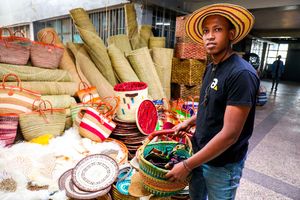
Handcrafted décor products, including woven wall hangings, baskets, mats, mirrors and decorative ornaments, are displayed at Lucidity Artisanals Shop along Murishu Road, near Bomas of Kenya, Nairobi, on September 11, 2026.
Photo credit: Bonface Bogita | Nation Media Group
The resulting collection, available through retail and bulk orders, spans rugs, lighting solutions, wall art, furniture and sculptural pieces, with prices ranging from as little as Sh300 to about Sh81,000.
She says the preparation of sisal and raffia for weaving involves several stages. After harvesting, sisal is decorticated, combed and air-dried, while raffia strands are stripped and softened before being prepared for weaving.
For wooden products, the process begins with sourcing suitable timber, with the size of the trunk determining the type of product that can be produced. Larger trunks, for instance, are used for carved log stools, while smaller pieces are shaped into vases and bowls.
Once a design is settled, markings are made on the wood to guide the shape before it is chiselled by hand. The timber then goes through sanding, shaping and drying before finishing.
Lucidity currently relies on sun-drying, a process that can take between three and six months depending on the piece.
“You have to know how to work with the wood. You have to ensure it is dry before you go to the next stage because the problem with wood is that sometimes it cracks when it is not dried properly,” says Joan.
Once the pieces are dry, they undergo centralised finishing and quality control, with artisans applying stains or varnish depending on the desired finish. The products are then custom-fitted and prepared for delivery.
The company also reuses production waste. Raffia offcuts from lampshade production are repurposed into miniature decorations, while timber offcuts are used to make smaller accent pieces.
Handcrafted wooden utensils are displayed at Lucidity Artisanals Shop along Murishu Road, near Bomas of Kenya, Nairobi, on September 11, 2026.
Photo credit: Bonface Bogita | Nation Media Group
Dried banana fibre and other wood waste are also put to use, including in small sculptural structures under the Handcarved Home Decor Collection.
“We also work with interior decorators, and our peers in the event decor sector seeking custom pieces, extending the reach of local craftsmanship across a range of spaces,” says Ms Njeri, adding that custom work allows clients to influence the design, size and dimensions of a piece to suit a particular space, while giving the business room to develop its own designs.
“The good thing about handcraft is that you can do your sketch, come up with your own designs and shape the piece to what you want. Even with the dimensions, you can create a size that is ideal for the space,” she explains.
The company sells through its e-commerce platform and social media channels, including Facebook and Instagram, where customers and interior specialists can view its range, make enquiries and place orders remotely. Its workshop on Murishu Road serves as the production base.
The business faces operational challenges associated with handmade production and its distributed artisan network, including a limited pool of skilled workers, variations in quality and lead times across locations, and the unpredictability of working with natural materials.
Seasonal weather also affects the availability and movement of raw materials across the company’s rural artisan network.
During the rains, some craftspeople return to their farms for planting, making production schedules more difficult to manage and requiring the company to adjust client expectations.
Drought can reduce supplies of sisal and raffia, while heavy rains can disrupt harvesting and transport. Timber processing is particularly vulnerable because wood is sun-dried before carving.
To cushion production against these fluctuations, the company stocks seasoned wood and dried fibres during the drier months for use during wetter periods.
Research and development is also constrained by limited funding. She says the company plans to expand its production capacity, invest in skills development and pursue opportunities in regional markets through the EAC, AfCFTA, Comesa and other trade blocs.
“We have a large and creative youth demographic, as well as an active older generation, that can boost production and grow this nascent sector if equipped with the right skills, tools and machinery,” she says.