The Kenya Ports Authority (KPA) has expressed confidence in handling crude oil exportation from the South Lokichar fields in Turkana County through the Mombasa Port, as the country readies for the exercise from December.
During public participation on the proposed Field Development Plan (FDP) and Production Sharing Contracts (PSCs) in Mombasa, a Joint Parliamentary Committee on Energy was informed that the port is already equipped with adequate infrastructure capable of receiving, storing, and exporting crude oil.
Port officials, led by KPA Harbour Master and General Manager for Marine Operations Patrick Onyango, said the existing infrastructure at the port, already in use for handling imported petroleum products including petrol, diesel, jet fuel, and liquefied petroleum gas, is in good condition and suitable for crude oil operations.
The authority added that adequate safety and emergency response measures are in place to manage potential oil spills or fire incidents, supported by investments in modern equipment and trained personnel to meet international crude oil handling standards.
“The authority has adequate operational capacity to handle oil and related cargo at the port,” Mr Onyango told the committee.
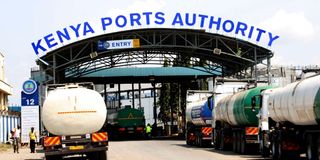
Kenya Ports Authority yard in Mombasa.
Photo credit: Kevin Odit | Nation Media Group
According to the plan, crude oil for export will be trucked from Turkana to the Kenya Pipeline Refineries Limited (KPRL) facility in Changamwe and exported through Mombasa port. It will be handled through the Kipevu Oil Terminal, where vessels will dock for loading.
KPA gave an assurance on the operational efficiency of the Kipevu Oil Terminal, which has four berths with a combined length of 770 metres. According to the authority, three berths are currently operational, while the fourth is reserved for future expansion.
The oil will be transported from the KPRL storage facilities in Changamwe to the terminal through heated pipelines designed to maintain optimal flow conditions. At KPRL, where trucks ferrying the crude oil will be offloaded, officials said existing storage capacity is sufficient, but major renovations are needed.
According to the FDP submitted to Parliament by Gulf Energy, which took over fromthe Tullow Oil company, a truck reheating facility will be required to reheat crude oil that may have cooled below optimal temperatures during transit. In addition, a steam supply will be necessary to heat crude oil within road tankers when low temperatures prevent free flow.
"Kenyan crude oil solidifies at about 45°C and wax begins to form at approximately 69°C, making temperature control critical. As a result, crude oil storage tanks must be fitted with heating coils using steam or hot oil as the heating medium.
"The tanks must also be insulated on their walls and roofs to reduce heat loss and maintain required temperatures," the document states, adding that currently, six tanks at the Changamwe facility have been converted for crude oil storage, with insulation and steam heating coils installed.
Beyond storage tanks, the company noted that KPRL will need functional heating systems. It added that the facility has three boilers previously used to maintain crude temperatures during the Early Oil Pilot Scheme (EOPS), which tested the commercialisation of the Turkana oil in 2019.
"However, the boilers have been idle since September 2022 and will require inspection, maintenance and overhaul. Boiler feed treatment systems will also be needed, alongside integrity checks of the steam, condensate and boiler systems," the FDP states.
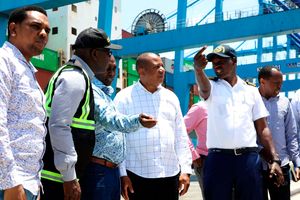
Officials who toured the facility with legislators last week acknowledged that it has suffered corrosion and mechanical deterioration due to prolonged inactivity. They said reviving it would require decommissioning outdated infrastructure and replacing it with a modern one with advanced technology.
Additionally, Gulf Energy proposed a dedicated entry of trucks delivering crude oil and two dedicated weighbridge units because handling of crude oil shall be simultaneous to the existing business. A segregated truck parking bay to accommodate at least 50 trucks was also suggested.
"There are currently five offloading gantry bays in place. Two were used for EOPS, whilst three are yet to be commissioned; two have sheds, one will require a shed to be constructed. Though the five gantries can work (24/7), it is prudent to provide an additional two crude oil off-loading gantries to ensure continuous operations," it explained.
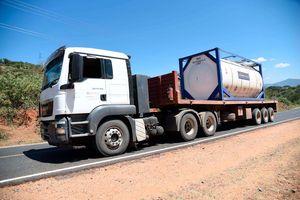
In its planned trucking of crude oil, the company envisages that on any given day at any point along the intended route from Lokichar to Mombasa, 200 trucks will pass – 100 headed to Mombasa and 100 destined for Lokichar. About 600 trucks will be needed.
A truck loaded with crude oil at Ortum on the Kainuk-Kapenguria road heading to Mombasa on October 5, 2018.
Photo credit: Jared Nyataya | Nation Media Group
"Of the total fleet, at least 200 trucks (equivalent to 33 per cent) will be allocated to County-based suppliers. These suppliers will be organised through a cooperative structure that incorporates stakeholders from Turkana East, Turkana West, and Turkana North," it states.
However, the FDP reveals that road transportation will be used in the first phase of crude oil commercialisation, expected to begin in December, with expectations that a railway will be available in the near future for the project's second phase of implementation.
Phase 1 is meant to run for four years, and "the project requires the completion of construction of Kitale-Kapenguria-Marich Pass Road and maintenance of the Eldoret-Lokichar road."
The document explains that in Phase 2, Kenya’s crude oil transportation will shift to a combined truck-and-rail system, if the government can construct a Meter Gauge Railway (MGR) line. The line should run from Lokichar to the main MGR line at Kitale, Eldoret, Nakuru, Nyahururu, Nanyuki or any other location.
"Usage of the MGR will optimise an existing facility and increase the MGR business by over 100 per cent," it says.
Alternatively, it is proposed that the government can extend the Standard Gauge Railway (SGR) line to Lokichar and connect to the proposed extension of the SGR line from Naivasha to Lokichar.
"Usage of the SGR will enable haulage of 561 barrels per wagon hence increase efficiency. Despite being a modern rail infrastructure, the SGR's current configuration presents significant challenges for Turkana crude oil evacuation. The challenges include lack of direct connection since the SGR line currently terminates in Naivasha and is not directly connected to the KPRL terminal in Mombasa," it adds.
Senator Mungatana said the joint parliamentary committee will compile and review all feedback received from stakeholders, local leaders, and the public to identify common concerns, recommendations, and areas of disagreement. The meetings were part of a wider national public participation exercise covering Turkana, West Pokot, Trans Nzoia, Uasin Gishu, Mombasa, and Lamu counties.
"This report will be debated by both houses to approve, reject or approve with amendments the proposed Turkana oil deal before commercial extraction can begin," he stated.