Leaders in the Coast region are divided on which port, between Mombasa and Lamu, should handle the exportation of oil extracted from Turkana when the exercise officially begins.
This comes as the country advances the oil project after Tullow Oil plc sold its assets in Kenya to Auron Energy E&P Limited, an affiliate of Gulf Energy Ltd, for $120 million (Sh15.48 billion in 2025).
Gulf Energy has already initiated plans to implement full-scale production of the approximately 463 million barrels of oil reserves in Turkana by December this year.
As leaders in Mombasa call for the revival of the defunct Changamwe oil refinery to be used in the Turkana oil commercialisation plan, their counterparts in Lamu are demanding that the initial plan of constructing a pipeline from the oil fields in Lokichar to Lamu Port be fully implemented.
Speaking at a public participation forum organised by the Joint Parliamentary Committee on Energy in Mombasa County, the leaders, with support from residents, said reopening the refinery would also support value addition to crude oil.
The facility, which began operations in the 1960s, handled crude oil refining, laboratory services and fuel loading until it shut down in 2013.
The Kenya Pipeline Company closed the facility, citing high operating costs relative to profits, and has since considered plans to repurpose it.
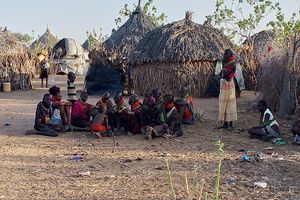
Nakukulas village residents with Energy and Petroleum Cabinet Secretary Opiyo Wandayi and local leaders engage in a jig on November 7, 2025, when he toured the South Lokichar Basin to introduce top management of Gulf Energy to the community.
Photo credit: Sammy Lutta | Nation Media Group
“If we keep on killing these industries we are denying our people opportunities. If people do not have employment, the rates of crime go up, idleness increases and people become lazy,” said area MP Omar Mwinyi.
Mombasa Lands Executive Mohamed Hussein said the county government supports the residents. However, leaders and residents urged caution, stressing the need for strong environmental and health safeguards, recalling past challenges such as the emission of toxic gases that corroded iron sheets and caused respiratory problems.
“I want to assure you that I have noted your concerns, and with my single vote, if I notice that the revival of the Changamwe oil refinery and employment for the people of Changamwe is not in the proposal, I will be against it,” said Nairobi Senator Edwin Sifuna.
The lawmakers were asked to allocate adequate resources for the modernisation of the refinery, including upgrading machinery, improving efficiency and adopting cleaner technologies, should Parliament approve the extraction and transportation of oil from Turkana.
In Lamu County, local leaders called for the full implementation of the Lamu Port-South Sudan-Ethiopia Transport (Lapsset) corridor project, saying delays have limited its economic potential and its role in evacuating oil from Turkana to the international market.
“We have not fully exploited our natural resources, but we must not miss this oil pipeline opportunity,” he said.
The initial Field Development Plan (FDP) for the Turkana oil project proposed construction of a pipeline to evacuate crude oil from Lokichar to Lamu Port for onward exportation.
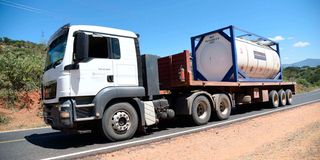
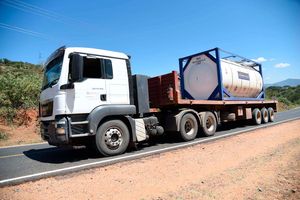
However, an updated plan submitted to Parliament by Gulf Energy in September 2025 proposed trucking to Mombasa as the primary evacuation option.
The company cited the high costs and time required to construct a pipeline, as well as the lack of a railway line from Turkana, which would have offered the best alternative.
According to the document, a pre-feasibility study by IHS Kenya found that building a 70,000-barrels-per-day oil refinery in Lokichar, estimated to cost more than $2 billion (Sh258 billion), would deliver higher economic returns than constructing an export pipeline projected at $1.5 billion (193.5 billion).
Gulf Energy explained that the Lokichar refinery option faces major hurdles, including difficulties in securing financing, high capital costs, uncertain resource volumes and tough global oil and gas market conditions. It therefore proposed a phased development plan starting with production of 20,000 barrels per day to be trucked to Mombasa, “to reduce risk and fast-track commercialisation.”
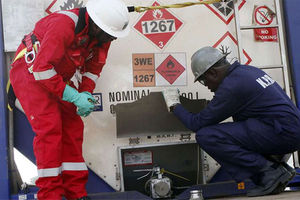
“In the initial phase, crude oil will be transported by road to the Kenya Petroleum Refineries Limited (KPRL) facility in Changamwe for export through the New Kipevu Oil Terminal. Under the plan, production is expected to begin on December 1, 2026, using two modular leased early production facilities at the Ngamia and Amosing fields.
“Output will remain at 20,000 barrels per day for the first four years, before rising to up to 50,000 barrels per day once the necessary rail infrastructure is in place,” the FDP document states.
Workers walk past storage tanks at Tullow Oil's Ngamia 8 drilling site in Lokichar, Turkana County on February 8, 2018.
Photo credit: Reuters
Apart from the costs, the density of oil drilled in Turkana was also mentioned as a challenge in transporting it by a pipeline.
The document explained that the crude oil solidifies at 45°C and begins to form wax at 69°C, meaning it must be kept above these temperatures during transportation.
By using road transport, Gulf Energy proposed that the oil will be loaded into insulated road tankers at the Lokichar production site at about 80°C and is expected to arrive in Mombasa at no less than 69°C.
"This represents a temperature drop of 11°C during transit, which is considered the worst-case scenario. Previous transport tests using insulated tanktainers showed a heat loss of only about 1°C per day," it stated.
Kenya tested crude oil trucking from Lokichar to Mombasa in 2018, commissioned by President Uhuru Kenyatta. The Ministry of Energy recently disclosed that the oil was sold for $28.34 million (Sh3.65 billion) to Glencore Singapore Pte Ltd and ChemChina UK Ltd.
Lamu East MP Ruweida Obo told the parliamentary joint committee that pipelines are more cost effective for transporting oil, cautioning that altering the initial FDP would be costly to the county.
“Transporting oil through a pipeline costs about five dollars per barrel, compared to twenty dollars by road. Removing any component risks mistrust among marginalised communities in Lamu and other East African countries,” she said.
Embakasi South MP Julius Mawathe, a member of the committee, clarified that the purpose of the public participation was to listen and not to decide on the South Lokichar Oilfield Development Plan. He, however, added that Kenya must continue pushing for completion of the corridor, with Ethiopia and South Sudan as key partners for the oil pipeline component.
Tullow Oil facility at Ngamia 8 in Lokichar, Turkana County, on February 18, 2020.
Photo credit: File | Nation Media Group
Officials from the Lapsset Corridor Development Authority led by the chief executive Stephen Ikua said 821 kilometres of pipeline mapping and design have been completed, with construction pending.
“The pipeline will not only serve South Lokichar crude oil. We can earn about 35 dollars per barrel by transporting oil from South Sudan, which produces 110,000 barrels per day but cannot currently export due to the war,” said Mr Ikua.
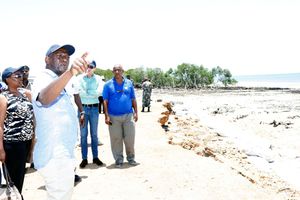
Lapsset Regional Manager in charge of Coast Salim Bunu told the Nation that significant progress had been made, especially at Lamu Port and on roads, which are a key component of the corridor. He cited Lamu Port, an anchor project of the Lapsset corridor, which is now fully functional, especially after the three berths were officially opened in 2021.
Mr Bunu added that active construction is ongoing on the Lamu-Ijara-Garissa-Isiolo Lapsset Access Road, with at least 55 per cent of works completed. He said the Isiolo-Modogashe road is also under active construction and is over 50 per cent complete.
“These roads are crucial. Murraming of roads like Lamu-Ijara-Garissa is complete, with tarmacking to blacktop ongoing. It is moderately in use. It has opened up Northern Kenya and spurred economic development and growth in frontier counties such as Lamu, Garissa, Isiolo, Marsabit, Moyale, Turkana and other areas,” said Mr Bunu.
Lamu Port General Manager Abdulaziz Mzee said the facility has actively been handling vessels, with over 60 having already made port calls, the majority in 2025. More vessels are expected this month, with two already having docked at Lamu Port this week.
He said discussions and engagements are also ongoing to ensure construction of the remaining berths is initiated.
“The facility is doing well, with 45,000 TEUs recorded in 2025 alone. We have generally seen a steady improvement in vessel calls and cargo volumes at Lamu Port,” said Mr Abdulaziz.