The peanut butter, cereal or maize meal that you recently consumed may have contained aflatoxin: a highly poisonous and carcinogenic toxin produced by the fungi Aspergillus flavus and Aspergillus parasiticus that contaminate agricultural products such as maize, groundnuts, sorghum, tree nuts, spices and dried fruits.
According to agricultural experts, the toxin can also be found in eggs, milk and other farm products when animals with simple, single-chambered stomachs (monogastrics) feed on affected plants.
Prof Paul Kimurto, a lecturer at Egerton University, describes the fungus as a complex microorganism that easily affects crops when farmers do not pay attention to how they handle their produce.
He explains that contamination can occur during planting, harvesting, storage or transportation to market.
There are at least 16 types of aflatoxin, but aflatoxin B1 (AFB1), AFB2, AFG1 and AFG2 are the most common. Of these, AFB1 is the most toxic. Aflatoxins M1 and M2 are derivatives of AFB1 metabolism and are found in milk and other dairy products.
Experts say that they are highly stable under normal conditions, but they may degrade under high temperatures (above 250 degrees Celsius), ultraviolet light, and extreme pH levels.
Professor Kimurto explains that farmers are often unaware that their produce contains toxins and that most people do not realise they have ingested them until complications arise.
The fungus is invisible, tasteless and heat-stable.
Therefore, farmers continue to supply contaminated produce to processors and offtakers, and the toxin finds its way to consumers' tables.
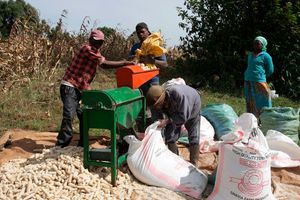
Farmers dry maize in Elburgon town, Nakuru County.
Photo credit: John Njoroge | Nation Media Group
On 25 March this year, Health Director-General Patrick Amoth expressed public health concerns after chemical analysis revealed high levels of aflatoxin in various brands of peanut butter.
Food safety experts argue that the groundnuts used to make the peanut butter identified by the Ministry of Health may not have been contaminated when supplied to the processor.
However, the fungi could have been introduced during storage prior to processing.
"There is a possibility that contamination occurred at the harvesting stage. The fungi can multiply during processing. It can even multiply during transportation or storage,' explains Prof Kimurto.
The researcher says that the effects of aflatoxin are both short-term and long-term, with liver cancer being one of the associated diseases.
He adds that infants are equally at risk, as some weaning products are made from grains that may contain the toxin.
"Children become stunted when they ingest the toxin. The liver, which detoxifies the poison, is also affected, causing cirrhosis or cancer. It is an invisible pathogen that causes serious harm once it enters the body,” says Prof Kimurto.
Food and agriculture experts from Egerton University, the International Institute of Tropical Agriculture (IITA), the Kenya Agricultural and Livestock Research Organisation (KALRO), and other institutions have partnered on a European Union-funded project called Food Safety for Africa. This initiative is being implemented in seven countries — Kenya, South Africa, Cameroon, Nigeria, Benin, and Ghana — with the aim of eliminating toxins in agricultural produce, primarily in the informal sector.
In Kenya, the project is being implemented in Homa Bay, Siaya, Busia, Elgeyo Marakwet, Baringo, Nakuru and parts of Meru.
The project coordinator at Egerton University, Prof George Owuor, explains that these regions were identified after studies revealed high levels of aflatoxin contamination.
“Most companies source groundnuts from these regions, yet the levels of aflatoxin are high. Farmers need to be trained on how to produce safe crops,” he says.
Dr Nancy Njeru, a researcher at KALRO, explains that crops become infected with the toxin when farmers fail to use certified seeds.
She says that the fungus attacks stressed crops, whereas certified seeds are more resilient and can withstand harsh weather conditions.
The organisation also encourages the use of organic manure, proper spacing, and the right inputs.
"Crop rotation is an effective way to reduce contamination, but it should not involve groundnuts and maize, as the fungus affects both crops," explains Dr Njeru.
Peanut butter on bread.
Photo credit: File I Nation Media Group
During harvesting, some farmers place grains directly on the ground, which increases the chances of fungal contamination.
Dr Njeru advises placing grains in containers and transporting them home promptly, rather than leaving them in the field.
During drying, farmers are encouraged to use the recommended materials instead of placing grains directly on the ground.
For storage, experts recommend using hermetic (airtight) bags to preserve dried grains.
Traditionally, farmers rely on physical observation or biting the grains to assess dryness, but this method is unreliable.
Some use a simple method involving placing grains and salt in an airtight jar for up to 30 minutes. If the salt sticks to the sides of the container, the grains are too wet. If it remains loose, the moisture level is safe.
However, Dr Njeru notes that this method is less accurate than scientific tools such as moisture indicator cards.
“These cards change colour when humidity exceeds safe levels,” she explains.
"Stored grains should contain no moisture. They should be stored in airtight bags and safety measures must be observed during transportation.”
“Some dishonest farmers add water to grains during transportation to increase their weight. Aggregators should stop engaging with these producers,” he says.
The project at Egerton University focuses on reducing aflatoxin in groundnuts and developing resistant varieties with enhanced vitamin E content.
KALRO is promoting Aflasafe KE 01, a biological control product developed in its laboratories.
This product consists of roasted sorghum coated with inactive microorganisms that suppress the growth of fungi that produce aflatoxins.
Despite its proven effectiveness, uptake has been slow since its registration by the Pest Control Products Board in 2015.
Using it can reduce aflatoxin contamination by up to 80 per cent, compared to the less than 10 per cent achieved through standard practices alone.
"A 4kg bag can be used per acre, and since it is a public product, its price is capped at Sh230 per kilogram," says Dr Njeru.
As well as aflatoxin, experts warn that pesticide residues and heavy metals such as lead, cadmium and mercury also pose risks to food safety.
Dr Njeru says that climatic conditions, especially drought, increase aflatoxin prevalence.
“Food should not only be available, it must also be safe. Globally, one in ten people fall ill from foodborne diseases, and Africa is the region most affected,” she says.
She adds that approximately 137,000 people die from food poisoning in Africa every year.
The four-year project, which is due to conclude in December 2027, aims to eliminate food hazards such as aflatoxin, bacterial contamination, and pesticide residues.
Experts are training stakeholders across the value chain, including farmers, transporters, vendors and hoteliers, in safe practices.
“Our aim is to raise awareness and provide the necessary tools to manage food safety, particularly in the informal sector,” says Dr Falade.
Kennedy Opiyo, the Homa Bay County Value Chain Development Officer, notes that some companies avoid sourcing groundnuts from the region due to safety concerns.
“It is crucial to raise awareness in order to prevent toxins from reaching consumers,” he says.
The County Agriculture Director, Erick Adel, encourages the use of integrated pest management to reduce reliance on chemicals.
He also advises consumers to wash, peel or cook food to minimise exposure to contaminants.
“There should be a systematic approach to identifying and controlling food hazards. Farmers must ensure that crops are produced in hygienic conditions,” he says.