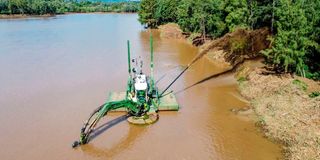
The Watermaster amphibious multipurpose dredger desilting the Sondu Miriu Dam in Kisumu County.

Kenya is at a crossroads, facing a climate crisis and an increasingly severe food security dilemma. Its reliance on imported food has become unsustainable, costing approximately Sh338 billion each year to bring in vital foods such as maize, wheat, rice and sugar.
This heavy reliance on imports is putting a strain on foreign exchange reserves and further endangering the nation’s ability to secure its food supply. However, Kenya has vast amounts of unused irrigable land that could significantly reduce this dependency if used effectively.
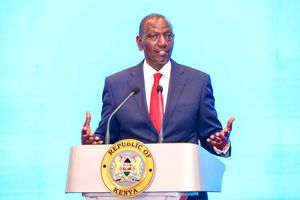
In his recent State of the Nation address, President William Ruto outlined a visionary strategy to transition Kenya from its current reliance on rain-fed agriculture to a more resilient, irrigation-based system.
This bold change of direction is particularly important for the Arid and Semi-Arid Lands (ASALs), which have long been dismissed as zones with low potential. As the president aptly put it, "We have almost exhausted land under rain-fed agriculture. We must now move to irrigation."
With plans to bring 2.5 million acres under irrigation, primarily in the northern and coastal regions, Kenya is on the brink of a new agricultural era.
Harnessing the power of major rivers such as the Tana and the Daua for large-scale irrigation projects could make vast areas available for year-round cultivation, protecting communities from drought and reducing the nation’s reliance on expensive food imports.
However, this grand vision faces a crucial hurdle in the form of decaying irrigation infrastructure, particularly the canals and dams that are vital for delivering water to areas in need. To realise the full potential of irrigation, Kenya must act now to restore the efficiency of its water management systems.
Strategic canal and dam desilting is essential for revitalising irrigation and ensuring food security.
Mr Paul Karuga is the founder and director of Bainridge Construction Company Ltd, a Westlands-based firm that specialises in mechanised desilting and water infrastructure rehabilitation. He highlights the urgent need to revitalise Kenya’s irrigation systems.
“Large-scale irrigation schemes such as the Bura Irrigation Scheme are vital for increasing domestic food production. Yet they have been underperforming for decades due to siltation, invasive vegetation and outdated infrastructure,” he explains.
Over time, canals and reservoirs accumulate sediment, reducing their capacity to channel water effectively. This results in inefficient irrigation, lower agricultural yields, unproductive land and wasted investments. For irrigation schemes to function at their full potential, this hydraulic capacity must be restored.
The Watermaster amphibious multipurpose dredger desilting the Sondu Miriu Dam in Kisumu County.
Without a concerted effort to remove sediment build-up, improve canal flow and repair ageing infrastructure, Kenya will continue to face a food security crisis that undermines public and private investments alike.
Mechanised desilting is a proven solution. Bainridge Construction uses the state-of-the-art Watermaster amphibious dredger. The company has pioneered a mechanised approach to desilting dams, canals, and other water infrastructure.
Unlike traditional methods, the Watermaster dredger can operate directly within live water systems, removing accumulated silt and invasive vegetation without the need to dewater or interrupt ongoing operations.
This enables desilting to be carried out quickly, ensuring that farmers continue to receive the water they need without disruption to irrigation or hydropower services.
“We have successfully deployed this technology in various projects, ensuring minimal downtime and a faster restoration of irrigation systems,” says Mr Karuga. The Watermaster’s precise excavation prevents canals from being widened excessively, maintains bank stability, and protects the environment by preventing sediment from being redeposited downstream.
This solution stands out due to its scalability and impact. The Watermaster dredger can be redeployed across large-scale irrigation systems, including dam reservoirs and primary and secondary canals. This makes it ideal for national projects such as the Bura scheme, as well as for hydropower reservoirs, where sediment management directly affects water availability.
The benefits of restoring these systems are immediate and profound. Increased water conveyance means more land is under effective irrigation, ensuring a reliable water supply throughout cropping cycles and achieving higher yields per hectare. This translates into reduced production risks and, crucially, improved economic returns from public and private investments alike.
Desilting and rehabilitating Kenya’s irrigation infrastructure offers strategic economic benefits beyond food security. By enhancing local farming productivity, Kenya can gradually reduce its annual food import bill of Sh338 billion, conserving foreign exchange and strengthening macroeconomic stability.
Additionally, this initiative will generate employment opportunities across the agricultural value chain, including farming, logistics and agro-processing.
Improving water management will boost food production and help Kenya become more climate-resilient by enabling better water storage and controlled irrigation flows.
Bainridge Construction collaborates with national agencies, state corporations, private investors and county governments to turn Kenya’s irrigation infrastructure challenges into opportunities.
“As a Kenyan contractor with a proven track record in rehabilitating water infrastructure, our company is dedicated to translating policy into practical results that will boost food production and support Kenya’s path to self-sufficiency,” Mr Karuga said.
“If water reaches the field, food reaches the table.”