Nziu is a typical village in the heart of the Wote countryside. The area's rich agricultural potential has led residents to jokingly refer to it as the “Canaan” of Makueni County.
Most farmers cultivate mangoes, tangerines, lime and oranges, while others keep livestock and poultry for household consumption.
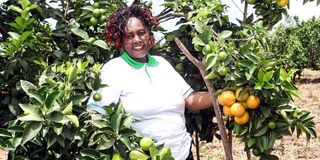
When we arrive, Agnes Mbithe Nzioki is busy inspecting one of her pixie orchards. Spanning several acres, the farm grows various citrus fruits, including pixies, tangerine, orange and lime, although pixies dominate nearly five acres.
"Their morphological characteristics distinguish them: pixies are seedless, yellow to orange in colour, highly nutritious, and slightly smaller than oranges," she explains, adding that, unlike oranges, tangerine forms canopies when mature.
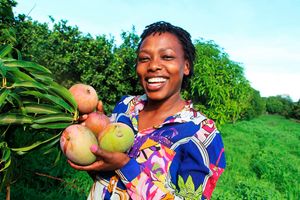
Agnes Mbithe from Nziu village in Makueni County holding sample fruits of pixies. The fruits fetch good market prices compared to oranges.
Photo credit: Richard Maosi | Nation Media Group
Mbithe tells Seeds of Gold that she worked at the former Kenya Agricultural Research Institute (KARI) for 30 years, serving as a technical assistant to senior scientists and participating in numerous projects, including soil research and disease control.
Over the years, she rose through the ranks to eventually become a senior inspector for imports at Jomo Kenyatta International Airport (JKIA). However, in 2016, she opted for early retirement to focus entirely on farming, a venture she had started in 1995.
"I decided to focus all my energy on pixies after realising that mango farming, which is dominant in the region, was highly seasonal and unpredictable in terms of pricing," she recalls.
Mbithe says she initially started with only six pixie plants, replanting dried orange trees before grafting pixies onto rough lemon rootstock due to its resistance to soil-borne diseases and pests.
However, her first attempt nearly failed when the trees started to dry up. In order to salvage the crop, she reduced direct soil contact and improved her management practices.
By 2017, the orchard had flourished, prompting her to purchase an extra three acres of land on which to increase production.
She currently owns more than 2,500 Pixie trees at various stages of development.
She says that, with proper management from flowering to harvesting, a single tree can produce up to 200 kilograms of fruit in a good season.
A kilogramme of pixies sells for between Sh100 and Sh150 during the off-season, and between Sh70 and Sh80 during peak production periods.
Her buyers come from nearby towns, including Wote, Machakos, and Kitui, while brokers transport the produce to Kajiado and the Marikiti market in Nairobi.
To maintain quality production, Mbithe visits the farm every morning to check on the trees and has also trained her workers in good agricultural practices.
She personally oversees pruning, weeding, fertilising and spraying, which is done every two to three weeks. "During the first four months of fruit development, I alternate the chemicals applied so that the fruit does not become resistant or dormant. I use systemic chemicals combined with fungicides, stickers and hormones,” she explains.
During fruiting, she supplements the trees with rabbit urine, which she says enriches the nutrients in the soil. She also applies dried cow dung manure to help retain soil moisture.
Mbithe has dug ring-like trenches around each tree, extending them to the edge of the canopy. She fills these trenches with dried maize stalks, which gradually release potassium into the soil and improve the sweetness of the fruit.
To supplement calcium, she applies agricultural lime during the sunny season, before the fruits harden.
Between November and January, most of the trees produce a heavy bloom. To delay harvesting and achieve better market prices, Mbithe ensures her orchard is sufficiently irrigated, enabling the fruit to remain on the trees until around September, when supply to the market is lower.
“By that time, most farmers will have already sold their produce, but my fruit will still be fresh and ready to sell,” she says with a smile.
The main disease affecting her orchard is citrus canker, which is characterised by drying fruit, fruit drop and black spots on leaves.
She also has to deal with pests such as mites and thrips, which roughen the surface of the fruit, as well as aphids and whiteflies, which feed on tender shoots and encourage the formation of soot. To manage fruit flies, she uses bait traps.
Mbithe says that one of the biggest challenges facing farmers at the grassroots level is the shortage of agricultural extension officers.
“The gap between technical officers, farmers and researchers is mainly caused by poor knowledge transfer, insufficient extension staff, and communication barriers,” she explains.
She believes that the government should invest more in training programmes for farmers, particularly with regard to the proper application of agrochemicals at different stages of crop development.
“The government should take responsibility for ensuring farmers receive practical knowledge on the safe and effective application of chemicals,” she adds.
This lucrative venture has taught her that fruit farming requires constant learning and intensive care because new pests and diseases emerge every season.