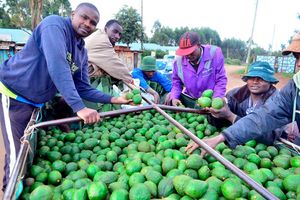
In Cura Village in the bustling Gatundu South region of Kiganjo, the avocado orchards tell a story of transformation, shaped by past frustrations and emerging opportunities.
For years, small-scale farmers here have seen their 'green gold' slip through their fingers as they were exploited by brokers who dictated prices, manipulated weights, and sometimes vanished without a trace.
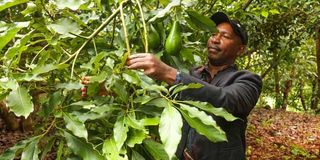
For John Mburu Ndotono, the memory is still fresh. After leaving dairy farming in 2016 to start growing avocados, he had hoped for a steady income. Instead, he encountered a chaotic market dominated by middlemen.
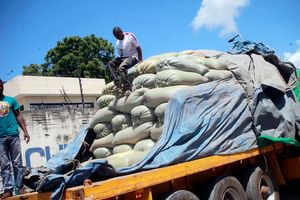
Brokers would come and buy at between three and five shillings per kilo. At one point, they harvested around 1,500 kilos from his farm and promised to return later to collect them. They never came back, he recalls, tears welling in his eyes.
John Mburu Ndotono, an avocado farmer, works in his farm at Kiganjo in Gatundu South, Kiambu County on April 30, 2026.
Photo credit: Evans Habil | Nation
According to Mburu, the fruit had rotted where it had fallen. It was a total loss! Like many farmers, Mr Mburu had no contracts, no traceability and no legal recourse.
Lucy Mumbi remembers selling individual avocados for as little as 25 cents each. “Some brokers would load lorries with avocados and disappear without paying. Farmers had no control,” she says.
The system was exploitative and deeply inefficient. Without cold storage facilities, farmers were forced to sell their produce immediately after harvest at throwaway prices to avoid spoilage. Up to half of the produce harvested could be wasted, particularly during peak seasons.
For James Mwangi Kibunja, the manipulation extended beyond pricing. “A broker would say he was taking five fruits, but then take seven. There was no way to verify this,” the farmer explains.
This is the broken system that companies like Soko Fresh are now disrupting. By introducing grid- and solar-powered cold chain systems at farm level, Soko Fresh has created a structured pathway that links smallholder farmers to export markets.
This approach tackles two of the most significant challenges faced by farmers: post-harvest losses and limited market access. “We realised that most export markets are dominated by medium-to large-scale farms, yet up to 80 per cent of agricultural production in Kenya comes from smallholder farmers. Our goal is to help these farmers participate in high-value supply chains," says Stephen Katingima, Soko Fresh's Chief Operations Officer.
The company runs an aggregation facility in Thika, Kiambu County, and installs decentralised cold storage units — essentially solar-powered refrigeration hubs — at collection points.
The grid-powered aggregation centre receives avocados from across the country, and Mr Katingima reveals that it works with over 15,000 farmers. Farmers deliver freshly harvested avocados, which are then preserved under optimal conditions before aggregation and export.
The impact is immediate. Cold storage extends shelf life, reduces spoilage, and improves fruit quality by up to 20 per cent. Perhaps more importantly, it gives farmers bargaining power.
Today, Mburu earns between Sh80 and Sh100 per kilo through Soko Fresh — a dramatic improvement on the three to five shillings he once received. During the peak season, he can harvest up to three tonnes, significantly increasing his income. “I now have a reliable market. That has changed everything,” says the farmer.
The structured system also eliminates fraud. Payments are made via mobile money within minutes of delivery. Alice Wangari says the difference is like night and day. “After delivering, you receive payment within 30 minutes. It has eliminated cases of cheating.”
Doreen Khaule has also experienced a transformative shift. Previously, she farmed an acre with over 200 avocado trees and sold her produce to brokers for between Sh6 and Sh10 per kilo. Today, she earns around Sh90 per kilo. “Avocados are now a valuable crop. I can educate my children,” the mother of three tells Seeds of Gold .
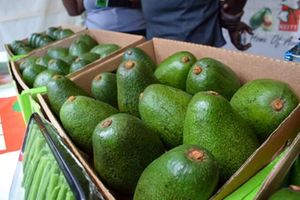
Demand for avocados continues to surge globally.
Photo credit: File | Nation Media Group
In addition to offering competitive prices, Soko Fresh provides farmers with training in good agricultural practices, helping them to meet the strict export standards required. This includes pest control, proper harvesting techniques, and compliance with certifications such as GlobalG.A.P.
Demand for avocados continues to surge globally, with Europe traditionally remaining the most lucrative destination. However, the export firm is increasingly targeting emerging markets in the Middle East, Asia, and China — regions with a growing appetite for the fruit.
In these markets, export-grade avocados fetch between $1.9 and $2.1 (£0.15–0.17) per kilo.
Depending on quality, farmers can earn up to 120 Kenyan shillings per kilo from this.
"Last year, we exported around 300 tonnes, supporting approximately 5,000 smallholder farmers. But this is just a fraction of the potential,” Mr Katingima shared in an exclusive interview.
Kenya remains one of Africa’s leading avocado exporters, with production growing at double-digit rates annually. This growth is being driven by emerging avocado-growing regions such as the Rift Valley.
However, nearly 70 per cent of smallholder farmers still lack access to export markets, largely due to fragmented supply chains and a lack of infrastructure. Development partners have stepped in in this area. The Global Energy Alliance for People and Planet (GEAPP), working through CLASP, has played a key role in scaling up cold chain solutions like those used by Soko Fresh.
GEAPP provides grants that reduce the cost of deploying cold storage technologies through a results-based financing model known as the Productive Use Financing Facility.
This support enables companies to expand into underserved rural areas, where the initial investment would otherwise be prohibitive.
"We essentially de-risk market entry. Once companies demonstrate impact, additional funding is released. This ensures accountability while enabling scale,” says Carol Koech, the GEAPP Africa Vice President.
Between 2021 and 2024, the programme deployed $6.1 million (£4.7 million) across six African countries, including Kenya, to support technologies that improve agricultural productivity and reduce losses.
Soko Fresh initially struggled to penetrate the market, but has since expanded to over 32 cold storage units thanks to the funding, reaching more than 15,000 farmers.
Such partnerships mean that avocado farmers are now reaping significant benefits. For Elizabeth Wambui, a farmer based in Gatundu South, the transformation is already evident. Having transitioned from mixed farming to avocado production on two acres of land, she now earns between Sh90 and Sh120 per kilo. “Avocados give me quicker and better returns compared to other crops,” she says.
However, challenges remain. Farmers grapple with high input costs, pests such as fruit flies and persea mites, theft, and erratic rainfall linked to climate change. Certification for premium export markets is also costly, limiting access for many.