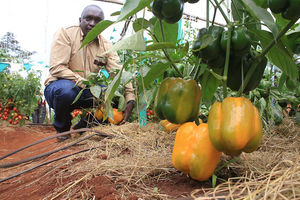
About three kilometres from the Elburgon–Njoro road, we arrive at the border of the Tegat and Nyakiambi farms in Molo sub-county, where Ms Susan Wairimu grows coloured capsicum in a greenhouse.
“I started using the greenhouse in 2024 after learning that my production would increase compared to growing the peppers in the open air. The peppers are popular with customers because they are large and attractive,” said Wairimu, adding that they are also disease-resistant and inexpensive to maintain.
Ms Wairimu used between Sh250,000 and Sh300,000 of her initial capital to purchase materials for the 17m by 8m greenhouse. She said this was enough to buy wooden poles, polythene bags, insect nets, strings, seedlings, water tanks, and water drips, as well as other necessary items. Once the greenhouse was complete, she installed a drip irrigation system to provide her crop with a consistent water supply.
She added that she had sourced 750 certified capsicum seedlings, both red and yellow, from different dealers in Nakuru County at Sh15 per seedling. “I spaced the rows at 75cm and 65cm, planting my seedlings in the beds with 30 cm and 45cm between each one. In those beds, I applied between 1.5 and 2 tonnes of livestock and chicken manure sourced from the farm,” said Ms Wairimu, adding that this spacing allows her to harvest, spray and manage her crop more easily.
After three to seven days, she added basal fertiliser to the top layer of the capsicum seedlings, as this encourages root formation and development. During the same week, she sprayed insecticides and fungicides to kill the cutworms in the soil.
Susan Wairimu at her farm at the border of Nyakiambi and Tegat farms in Elburgon, Nakuru County on May 15, 2026. She grows coloured capsicum inside a greenhouse.
Photo credit: John Njoroge | Nation
During the second and third weeks, Ms Wairimu weeded her crop and top-dressed it with CAN fertiliser, which contains nitrogen and helps boost growth. She also sprayed insecticide and fungicide to prevent attacks, repeating the process every 10–14 days. At this time, she also added foliar fertiliser to promote fruiting and flowering.
"Flowers started to sprout after two months, when I did my second weeding and observed the crop's protection, nutrition, and maintenance. From planting time, capsicum takes between three and a half to four months to mature and be ready for harvesting," said Ms Wairimu, adding that, with better management, one plant can produce an average of 6.5 kilos.
In her first harvest, she harvested 70 kg and sold it at the local market for between Sh100 and Sh200 per kilo, depending on customer demand. Harvesting continued every week, with fruit production increasing with each harvest.
According to the farmer, the market is better during the rainy season than in the dry seasons. The peak season starts in April, but increases between June and September. During these periods, she sells for between Sh300 and Sh400 per kilo at the local market. “The market for coloured capsicum is good and in demand because I have not been able to meet customer demand. Currently, I harvest between 250kg and 300kg every week and sell each kilo for Sh125,” said Ms Wairimu, adding that she sometimes buys the produce from other farmers to meet demand.
Ms Wairimu notes that she cannot compare her current maize crop, as the sector is dominated by middlemen and farmers struggle to access better markets. However, Ms Wairimu has only planted a small amount of maize for silage to feed her cows, which produce manure and milk for domestic use.
She employs two workers on the farm, but hires more depending on the work. To thrive in capsicum farming, Ms Wairimu urges prospective farmers to first seek knowledge from experienced growers, to identify the varieties that customers want, to buy certified, well-propagated seeds, and to find markets for their produce.
Ms Wairimu says that she has gained experience through research, online learning, seminars, exhibitions, and by seeking advice from other experienced farmers. "I do soil testing through the private sector after every season and receive the results within seven days. Extension officers from the county government should visit farmers to educate and inform them, as happens with potato, avocado and dairy farmers, so they can learn about management, disease and pest control, and other factors,” she said.
Susan Wairimu at her farm at the border of Nyakiambi and Tegat farms in Elburgon, Nakuru County on May 15, 2026. She grows coloured capsicum inside a greenhouse.
Photo credit: John Njoroge | Nation
She cites the cost of farm inputs and labour, the lack of electricity, and poor roads as the main challenges in the area. The poor state of the roads is a particular burden for customers accessing the farm or transporting their produce to market, especially during the rainy season.
The farmer uses a generator to pump water from a well on the farm to a large tank located near the greenhouse.
“My plan is to expand to 10 acres within the next three years, practising organic farming and growing in-demand varieties to improve consumers’ health by producing organic fruit. I also want to be present in the market all year round and become the leading farmer in the region by meeting my customers' demands,” said Ms Wairimu.
Nutritionists highlight the health benefits of vitamin C, which protects cells from damage and strengthens the body’s defences against infection. Capsicums are also sweet and improve eye health and heart function.
She called on the county government to find better markets for small-scale farmers and implement policies to support them in improving capsicum farming in the area. She also encouraged those who currently grow capsicums in open fields to consider growing them in greenhouses, as this would allow them to meet customer demand in terms of both quality and quantity.
For more than six years now, farmers in the area have been growing large quantities of fruit, especially tree tomatoes, passion fruits and Hass avocados.
Reuben Kitienye, who grows tree tomatoes in Mariashoni, Molo sub-county, says that fruit has better markets than other crops. “Fruit farming has no brokers, unlike other crops. Clients buy the produce directly from the farm, which reduces transport costs, the main challenge farmers face,” said Mr Kitienye, adding that fruit promotes health and boosts immunity to fight disease.