Ruiru, located in Kiambu County, is a bustling hub of activity, encompassing everything from transportation and real estate development to the sale of agricultural produce and urban farming. Horticulture is one of the most notable activities in which locals are engaged.
Coffee, maize, beans and various types of fruit are widely cultivated. However, Dr Ndungu Kabare has chosen to do more than many other farmers. A former Karatina University lecturer with a background in agriculture, he is now promoting the cultivation of climate-resilient small grains and seeds in Kenya.
In Biashara Ward in Ruiru, he runs a farm that he established after leaving academia. He says that it proves that the country’s debate on food security and hunger can be resolved through practical solutions.
On his three-acre farm, the former lecturer has dedicated half an acre to producing drought-tolerant small grains such as sorghum, millet, and teff — a crop used to make injera, a popular Ethiopian dish.
He grows various small seeds, including chia, flax and amaranth, and cultivates lentils (kamande) and butter beans (known in Kikuyu as noe). He is also working on introducing quinoa and buckwheat into his system.
Quinoa is a highly resilient, drought-tolerant pseudocereal valued for its dense nutritional profile. According to the farmer, it is one of the few plant-based foods to contain all nine essential amino acids, making it a complete protein source and a promising way to enhance food security. It thrives in alkaline soils and can withstand harsh climatic conditions, including cold environments where many conventional crops struggle.
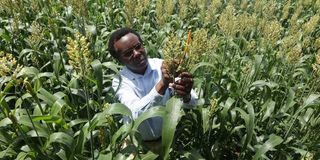
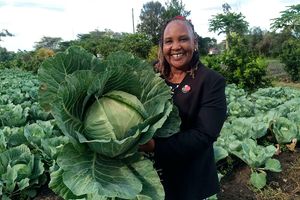
Imani Park Gardens CEO Ndungu Kabare at his green amaranth farm in Ruiru, Kiambu County on May 20, 2026.
Photo credit: Evans Habil | Nation
Buckwheat, on the other hand, is a fast-growing, broad-leaved annual plant cultivated for its triangular seeds, which are used as a substitute for grains. It also serves as an effective cover crop. It performs well in well-drained acidic soils and matures quickly, going from planting to harvest in about 75 to 90 days. This makes it suitable for short rainfall seasons and fast cropping cycles.
“We are used to large grains, commonly referred to as cereals, such as maize, wheat, rice, barley and oats. These are major sources of carbohydrates or starch and form the basis of most human and livestock diets. However, small grains such as sorghum, millet and teff are also rich in carbohydrates and tend to contain higher levels of minerals and other nutrients than larger grains. They also have different structural properties that give them unique nutritional and industrial benefits that can help to address food insecurity in Kenya,” says the farmer, who holds a degree in agriculture.
Dr Kabare also has a Master's degree in Animal Production and a PhD in Business Management with a specialisation in marketing.
The agricultural expert-turned-farmer has collaborated with the Kenya Agricultural and Livestock Research Organisation (KALRO) to promote climate-resilient grains and seeds. Having worked across the agriculture and academia industries for many years, he says he became increasingly convinced that Kenya’s agricultural sector had far more potential than was being realised.
Before turning to agribusiness full time, he built a strong academic and professional foundation that would later shape his farming philosophy. He began his career in the private sector as a technical sales representative dealing with agro-derived ingredients, particularly starches from locally and internationally sourced maize, cassava, and potatoes.
In this role, he interacted closely with food processing industries in Kenya and neighbouring countries. This experience revealed a significant gap in the agricultural system – the vast, untapped potential of farm produce for industrial applications. He then moved into academia, becoming a university lecturer in agribusiness marketing, a role that deepened his understanding of agricultural value chains. This conviction ultimately prompted him to leave teaching and pursue agribusiness full time. Using personal savings and consultancy earnings, he established Imani Park Gardens in Ruiru, Kiambu County.
"What began as an events venue for weddings, corporate retreats and social functions gradually evolved into something more complex. While developing the three-acre property, I planted fruit and vegetables initially to support the hospitality side of the business. Over time, the kitchen garden expanded and transformed into structured demonstration plots designed to educate farmers, students and visitors in climate-smart agriculture,” he tells Seeds of Gold .
Imani Park Gardens CEO Ndungu Kabare at his green amaranth farm in Ruiru, Kiambu County on May 20, 2026.
Photo credit: Evans Habil | Nation
In light of Ruiru's increasingly unpredictable and frequently low rainfall patterns, Dr Kabare began prioritising crops that could thrive with minimal water. In 2022, he started experimenting with locally available seeds, and, in 2023, he formally partnered with the KALRO in Katumani. Through this collaboration, he explains, they received certified seeds such as sorghum, teff and green amaranth, while chia seeds were introduced through independent sourcing. This marked a turning point, as the farm evolved into a demonstration site for research-informed, climate-resilient agriculture under real field conditions.
Half an acre of the three-acre farm has been set aside for intensive demonstration plots. Within this space, sorghum, teff, wheat, chia, grain amaranth, cowpeas, butter beans and selected fruit varieties are grown in carefully managed sections. The remaining land continues to support events and agritourism, creating a hybrid model that integrates agriculture, education, and commercial hospitality.
During the interview at the farm, Mr Kabare stated that this structure allows visitors to observe directly how climate-smart farming can function within an urbanising landscape like Kiambu County.
"Much of Kenyan agriculture remains heavily dependent on large grains such as maize, wheat, and rice — crops that are increasingly exposed to climate variability. In contrast, small grains and seeds such as sorghum, millet, teff, chia and amaranth mature faster, require less rainfall and can produce up to two cycles per year under rain-fed conditions, with a possible third cycle under irrigation. Sorghum, for instance, matures in about three to four months depending on the variety, while chia and amaranth follow similarly short production cycles,” he explained.
Kabare says that white sorghum can be used to make ugali as a substitute for maize, which could ease the growing competition between humans and livestock for this crop. He adds that this would also reduce the cost of animal feed, since more maize would be available for use in feed formulations.
The cost of animal feed has been rising since 2020, partly due to Kenya’s heavy reliance on imported raw materials. The country imports more than 80 per cent of the ingredients used in manufactured animal feed, leaving the livestock and feed milling industries highly exposed to global supply chain disruptions and shifting regional weather patterns.
A trial conducted in 2023-2025 by Kabare in partnership with KALRO showed promising yields under rain-fed conditions in Ruiru. Sorghum produces between 1,200 and 1,900 kilogrammes per acre, with the Gadam variety yielding around 1,200 kilogrammes within three months.
Chia seeds yield around 600 kilogrammes per acre; teff yields between 300 and 460 kilogrammes; grain amaranth yields about 850 kilogrammes; and wheat yields between 500 and 700 kilogrammes, depending on the variety. “These results have been achieved even in seasons where rainfall lasts barely a week, emphasising the crops’ resilience,” says the farmer.
Based on these figures, Dr Kabare estimates potential annual returns of approximately Sh150,000–Sh180,000 per acre for sorghum, up to Sh600,000 for chia seeds, around Sh500,000 for teff and approximately Sh650,000 for grain amaranth, while wheat may generate Sh60,000–Sh100,000 per acre. He is quick to note that these are still experimental baselines, but they point to strong commercial viability.
Interest in these crops is growing in the market, particularly among urban consumers in Nairobi and Kiambu who are moving towards healthier diets. Additional demand is coming from millers, health food processors, bakeries and manufacturers of livestock feed. Teff, in particular, is attracting attention due to its export potential and rising global demand for injera production.
Apart from generating income, Mr Kabare insists that these crops are important because of their contribution to food and nutrition security. He says that, unlike large grains, which mainly provide carbohydrates, small grains and seeds are richer in minerals, vitamins, antioxidants, and dietary fibre. Crops such as sorghum, millet, teff, chia and amaranth also have a lower glycaemic index, making them suitable for people managing diabetes and obesity.
Mr Kabare believes that this model could be replicated in other arid and semi-arid regions of Kenya where conventional crops often fail due to erratic rainfall. He cites successful seed distribution trials in areas such as Kitengela, Nakuru, Molo and Marsabit, where farmers have reported positive outcomes despite the harsh climate. He claims that the crops naturally adapt to drier environments by shortening their maturity periods while still producing viable yields.
However, despite the promise, challenges remain. Birds pose a significant threat during grain maturation, often resulting in substantial losses. Another major issue is the lack of mechanisation, particularly when it comes to threshing small seeds like chia. He has called for the development of affordable, small-scale threshers and UV-resistant bird netting solutions. He also emphasises the need for greater public awareness, including national campaigns, to accelerate adoption. Dr Kabare further suggests establishing a dedicated day for small grains and seeds.