After retiring in 2017 as an extension, livestock, feed and feeding systems specialist, where she had been promoting dairy production in East Africa, Ms Josphine Wangechi, aged 61, continued with her dairy farming.
Despite having little time to take care of her animals on a daily basis while working, she managed to continue with her farming. After retiring, she now had enough time to manage and look after the cows, which she rears using zero-grazing techniques, in order to increase her milk production.
"After realising that I was spending a lot on animal feed, I decided to make my own maize silage and take charge of feeding the animals myself. First, I identified the right variety of maize for silage and established how many seedlings to use per acre. I then planted them in a four-acre plot of land,” said Ms Wangechi, adding that she used the correct farming practices to achieve better yields.
During a recent interview at her Tegat Farm in Elburgon, Nakuru County, the farmer revealed that she used compost manure collected from her livestock, reducing the need to purchase additional fertiliser from Agrovet shops.
In 2018, she planted the seeds in furrows spaced two-and-a-half feet apart to allow the maize seeds to germinate well. She reduced the space between each plant but increased the number of seedlings to 12 kg per acre, rather than the normal 10 kg, in order to increase the number of plants per acre of maize for silage, which increased production per acre.
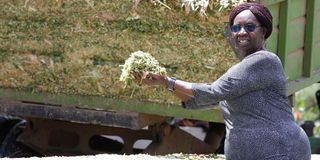
Ms Josphine Wangechi displays maize silage which she makes for her dairy cows in Elburgon, Nakuru County, on July 23, 2026.
Photo credit: John Njoroge | Nation Media Group
She noted that maize for silage is harvested while green or during the roasting stage in order to free up land for planting other crops in the short term. That year, maize silage production increased, enabling her to provide quality feed for her cows all year round.
“By using the right variety and proper management, I was able to achieve a silage yield of 30 tonnes per acre, unlike in the past when production was as low as 13–17 tonnes per acre. To manage my plants, I weeded and applied top-dressing fertiliser when they were knee-high (2 ft), as well as spraying pesticides to control pests,” said Ms Wangechi.
She added that the silage has helped her reduce feeding costs, as she used to buy low-quality feed, such as green maize, from other farms, which lowered production because she lacked enough feed for the whole year.
Ms Wangechi says that the green maize for silage is cut by hand on the farm by casual workers and then cut into pieces by a chopping machine hired from a local cooperative dairy, before being transported to the homestead for conservation in a bunker that holds 130 tonnes.
"The chopped silage is spread in the silo and compacted by a tractor to remove the air. It is then covered with polythene and soil is added on top to continue the compaction process.
Ms Josphine Wangechi and her husband Kibet Kirui display maize silage they make for their dairy cows in Elburgon, Nakuru County on July 23, 2026.
Photo credit: John Njoroge | Nation Media Group
After two months, the silage is ready for the cows, but the fermentation process takes between 21 and 45 days, so farmers can feed their animals as needed,” she said, adding that the 15-metre-long, 5-metre-wide, 1.5-metre-deep silo is valued at Sh600,000 and can hold silage for many years if well maintained.
Ms Wangechi noted that, since starting her project, she has been able to sustain high milk production for longer, for at least six months per cow, especially when preparing them for drying off before calving, unlike the three-month cycle previously experienced. She cannot regret this move because, by making her own silage from maize, she has given back to the community.
She has shared the knowledge she acquired over many years online, trained farmers and other stakeholders, and encouraged young people and women to start practising dairy farming on a small scale.
Ms Wangechi said that small-scale farmers can grow maize for silage for their own use or to sell to other farmers, starting with an area of land as small as ¼ of an acre. "With an initial investment of Sh5,000, small-scale farmers can hire or lease land, purchase necessary supplies such as seeds and fertiliser, and produce silage for one or two cows. Making silage enables farmers to reduce the cost to less than two shillings per kilo, as opposed to buying at Sh14 per kilo or Sh1,050 per 70 kg bale,” she noted, adding that farmers should first plan the animals' food requirements before bringing them to be reared, and identify how much silage they need before planting. Through planning, she says, farmers will know their animals' feed requirements throughout the year and be able to generate an income from farming sustainably.
To prevent silage wastage and spoilage when feeding the cows, Ms Wangechi advises farmers to slice or cut enough fresh silage depending on how much the cows need, as this will enable them to feed the cows for longer. During the dry season, she sources water from a sustainable community borehole and also collects rainwater.
Due to the inconsistent climate caused by climate change, which affects many farmers in the region, she grows two types of crop a year and conserves the crop residue to combat this issue. On her farm, she grows lucerne, which is rich in protein, and nappier grass, and she feeds the cows dairy meal to supplement their feed.
“To increase my knowledge, I visit agricultural shows and experienced farmers, do online research, interact with Kenya Dairy Stakeholders on WhatsApp, get information from the media, and work closely with the Ministry of Agriculture,” said Ms Wangechi. She added that she practises crop rotation by growing potatoes and nitrogen-fixing crops, such as beans, to reduce diseases caused by growing the same crops, especially from the same family, for a long period.
She plans to increase the current portion of maize for silage to 10 acres over the next four years to increase and sustain production over a longer period. She is also optimistic that she will have enough silage to feed the cows for three consecutive years, especially during periods of food shortage due to inconsistent climate change.
“Before I moved to the banker, I used to conserve my silage in tubes and above-ground silos in order to increase the tonnage,” added Ms Wangechi.