Hello

Your subscription is almost coming to an end. Don’t miss out on the great content on Nation.Africa

Ready to continue your informative journey with us?

Hello

Your premium access has ended, but the best of Nation.Africa is still within reach. Renew now to unlock exclusive stories and in-depth features.

Reclaim your full access. Click below to renew.

Nickson Otiso
Caption for the landscape image:

How Nyamira youth moved from joblessness to employer

Scroll down to read the article

Nickson Otiso displays a tray of vegetable seedlings he grows using Coco Peat on his farm in Makairo village, Mugirango West, in Nyamira County.

Photo credit: Wycliffe Nyaberi | Nation Media Group

If you visit Makairo Village in West Mugirango Constituency, Nyamira County, for the first time, you will notice a number of greenhouses in the area. 

You might think that they are owned by a group of individuals or a limited company, but that is not the case. 
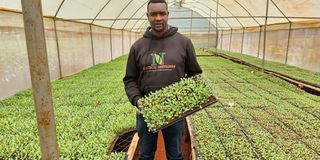
They belong to 30-year-old Nickson Otiso, who uses them to propagate millions of vegetable seedlings in a soil-free medium commonly referred to as coco peat. He sells them. 

His success story is proof of what can be achieved through a combination of hard work, resilience and determination.

Unlike many graduates, when Otiso graduated with a Diploma in General Agriculture from Eldoret Polytechnic in 2020, he did not embark on hunting for any formal employment.

Instead, he returned to his rural home to embark on a more challenging but enriching venture that would later provide him with a stable income.

Five years on, Otiso’s enterprise has set him far ahead of his peers, as it has started to pay dividends.

He has freed himself from the shackles of poverty and unemployment, which plague many Kenyan youths. 

Seeds of Gold visited Otiso at his farm to gain insight into how he built his multi-million seedling propagation empire.

He revealed that, while at school, he was aware of the difficulties that most Kenyans face when looking for formal jobs after completing their studies. 

As securing formal employment in Kenya is not easy, Otiso decided to forge his own path.

Rather than wasting time dropping off CVs in offices, he chose to venture into seedling propagation.

Nickson Otiso

Nickson Otiso sprays his seedlings grown using Coco peat technology at his farm in Makairo village, Mugirango West, in Nyamira County.

Photo credit: Wycliffe Nyaberi | Nation Media Group

He did this after realising that there was a shortage of quality seedlings in his home county and neighbouring regions. 

Two years on, Otiso has reason to smile, as his venture has started to pay off.

“I didn’t want to experience the heartache and disappointment that my former college mates were going through in formal employment, which is always overcrowded and competitive. While they were busy approaching prospective employers, I approached my parents and asked them for a plot of land on which to start propagating vegetable seedlings,” Otiso told Seeds of Gold at his farm, Niktech Seedlings. 

He is now one of the biggest suppliers of quality vegetable seedlings in Nyamira and other parts of the country. 

Otiso sells his seedlings to subsistence and commercial farmers.

He recounted how he got started. 

“I started by investing a small amount of money, around Sh30,000. I had saved it over a long period of time,” he said. 

“I used the money to buy nets, construction materials, propagating media, trays, and seeds. This set me off, and the business has grown by leaps and bounds,” he added. 

Initially, he propagated around 5,000 seedlings. He sold all of them and reinvested some of the proceeds into expanding his enterprise. 

Over time, he progressed from one greenhouse to over 10. He produces millions of seedlings a month in these greenhouses using coco peat.
He specialises in producing capsicum, cabbage, kale, spinach, tomatoes and other fruits.

The price of each seedling on his farm depends on the type. Sukumawiki and spinach seedlings cost Sh2 each, tomatoes cost Sh15 each, and capsicum costs Sh5 per piece. 

He uses a treated coco peat medium to propagate the seedlings, and he says that this technology gives the seedlings a higher survival rate than those grown in open fields.

Coco peat is made from the pith inside coconut husks and is naturally antifungal.

Because of this, Otiso adds that it is the most recommended medium for propagating seedlings in nurseries. 

He points out that plants grown using coco peat are easily portable, making them easy to move from one area to another. 

Mr Otiso also argues that, compared to those grown in open areas, plants grown using this technology are largely unaffected by disease or heavy rains such as hail. 

At Niktech Seedlings, it takes about a month for the seedlings to be ready for transplanting. 

“We grow our seedlings within four weeks. We monitor them frequently, spraying them with plenty of water and organic fertiliser to keep them healthy. Farmers who buy seedlings from us have said that they are high quality and provide a good return on investment,” Otiso added. 

Thanks to his hard work, Mr Otiso has created 20 jobs for young people. 

They help him look after the seedlings, and in return they earn a daily wage.

Mr Otiso says that, when he started his seedling propagation business, many people thought he would fail. They did not believe him when he uprooted some of the tea bushes at his parents’ farm to start a new business. 

However, a few years later, they are amazed by how far he has come. 

“When I started, many were surprised and did not pay much attention to my goal and purpose. But as time went on, they accepted my work, and some have even started to embrace it,” he said. 

Otiso pinpoints some of the challenges he faces as a young entrepreneur. 

He says that during sunny periods, he struggles to get water, which is essential for the growth of seedlings.

He also lamented the poor state of many of the roads from his village to urban centres, which makes it difficult for him to deliver his seedlings to clients across the country.