Chicken feed prices in the country continue to rise, driven by factors such as drought conditions, disruptions to the global grain market, and higher transportation and processing costs.
For many smallholder farmers in Siaya County, rearing kienyeji chickens for commercial and subsistence purposes has always been expensive.
Commercial feeds, such as soya and fishmeal, often consume more than 60 per cent of farm income, trapping farmers in a cycle of high input costs and shrinking margins — a challenge that experts describe as the 'protein trap'.
However, at the Anglican Development Services (ADS) Western learning site in Siaya County, Bondo Sub-county, West Sakwa Ward, Maditha Village, a quiet shift is underway.
Rather than relying solely on purchased feed, farmers are being taught to produce their own protein using Azolla, a fast-growing aquatic fern which is now a nitrogen-fixing crop with exceptional potential as a sustainable, climate-smart feed for livestock and poultry.
“Azolla has changed how I look at poultry farming,” says Jacob Inyimbi, a participant in ADS Western programmes who keeps 120 kienyeji birds. “Before, I spent almost all my profits on feed. Now I harvest Azolla daily, and my feed costs have dropped by more than half.”
Initially, he relied heavily on a combination of local, readily available resources to feed the poultry.
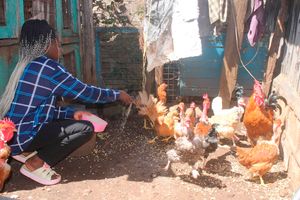
Like most households, he allowed his chickens to free-range, scavenging for insects, seeds, weeds and plant matter on farms, in pastures and around yards.
However, the local feeds had many disadvantages, the most significant of which was the lack of balanced nutrition, which greatly affects bird performance and health, especially if the feed lacks a standardised nutrient profile.
He also realised that the lack of better feed made it difficult for him to meet the high local market demand for eggs and meat.
Since adopting Azolla Feeds, his life has changed for the better. He says they offer a wide range of advantages in agriculture, livestock and environmental sustainability, thanks to their unique biological and ecological properties.
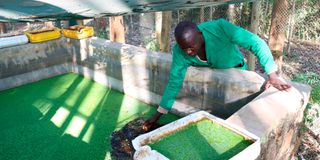
Inimbi says that taking care of the free-floating water fern is quite easy, as it turns red when there are no longer any nutrients in the water, indicating that more water needs to be added.
Once harvested, he also sells the seeds to local farmers, with each kilo going for Sh1,000.
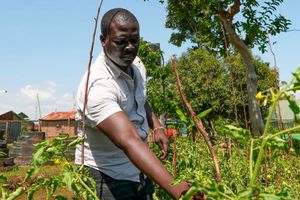
Jacob Inyimbi from Maditha village in Siaya County, tending to his Azolla Farm, a highly nutritious and climate-smart livestock and poultry feed.
Photo credit: Richard Maosi | Nation Media Group
Laurence Okumu, a farmer from Mungatsi in Busia County, says the project has helped him reduce his dependence on formulated feeds by 25 percent.
He harvests 16–18 kg of Azolla protein plant per month, which he mixes with other feeds and gives to chickens, while selling the rest to farmers who rear fish and goats.
Since the plant is highly nutritious, it improves the quality of chicken meat and provides stable egg production.
According to George Vuyala, an agronomist with ADS Western, Azolla fits into a broader circular farming model being promoted across Siaya, Kakamega, Vihiga and Bungoma counties.
“We are moving farmers away from dependency on inputs,” he explains. “Azolla is not just feed; it is part of a system where nutrients are recycled, costs are reduced, and multiple enterprises benefit from the entire value chain.”
At the Maditha site, Azolla ponds are integrated with conical kitchen gardens and drip irrigation systems. The nitrogen-rich water from the ponds is reused to irrigate vegetables such as collard greens (sukuma wiki) and tomatoes, creating a low-cost, near-zero-waste loop.
Mr Vuyala explains that the dense population of dairy and poultry farmers in Western Kenya has created a growing market for Azolla starter cultures.
Farmers who produce surplus biomass now sell it to neighbours, turning a feed solution into a small business.
Despite its benefits, Azolla requires proper management. While the fern fixes its own nitrogen, it consumes large amounts of phosphorus. Many ponds become depleted of nutrients after two to three months and fail as a result.
“To maintain healthy growth, farmers should add about 20 grams of superphosphate or compost tea weekly,” advises Mr Vuyala. “That simple practice can mean the difference between a dying pond and a daily harvest.”
Additionally, shade is equally critical. Excess sunlight causes Azolla to turn red, increasing fibre content and reducing protein levels.
For farmers aiming for the optimal 30 per cent protein content, careful shade management is essential.
In conclusion, Azolla is no longer just a backyard experiment. As Kenya moves towards reducing the cost of agricultural inputs through tax incentives and local production, farmers who embrace on-farm protein sources will be better positioned to survive market shocks.
Azolla is emerging as a transformative resource for smallholder farmers worldwide, offering a sustainable, low-cost solution that reduces feed and fertiliser expenses while enhancing productivity and resilience.
According to him, it takes two weeks for the feed to mature. He also says that to fertilise the water, some fresh cow dung is applied. You then mix it well until a slurry is formed, after which you introduce the seeds.