From left to right: Pauline Sambu, Lavender Chepkogei and Sheila Lagat from the Tuigoin Trading Centre in Trans-Nzoia, holding improvised brooders that mimic the environmental conditions used to rear chicks.

Tuigoin Trading Centre, located along the busy Eldoret–Cherangany road in Trans-Nzoia County, has become a small but growing hub for poultry farming. Here, Pauline Sambu carefully attends to chicks awaiting distribution to nearby markets.
Ms Sambu says demand for small chicks—especially day-old chicks—has been rising steadily, driven by commercial poultry production and the growing popularity of backyard and small-scale farming.
“The market for small chicks, particularly day-old ones, is robust and expanding,” she says.
To improve chick survival, Ms Sambu has adopted a simple but effective local innovation—an improvised brooder made from locally available materials that provides warmth and protection for chicks during their first weeks of life.

Pauline Sambu (left) from Tuigoin Trading Centre in Trans-Nzoia is sorting chicks for some of her customers.
The system, popularly known as “Teret”, replicates the warmth normally provided by a mother hen. It consists of a clay pot with perforations on its sides, filled with charcoal that burns slowly to generate steady heat.
The improvised brooder offers an affordable alternative to modern brooder machines, which many smallholder farmers find too expensive.
Ms Sambu says she turned to the innovation after realising that many farmers lose chicks in their first days due to stress and cold temperatures, a common challenge in the region.
“With the right warmth and care, the survival rate of chicks improves significantly,” she explains.
Her business supplies four types of chicks—Rainbow Rooster, Sasso, Kuroiler and Improved Kienyeji. Most are sourced from Jinja in neighbouring Uganda, while others come through Namanga.
Ms Sambu works with three other women, pooling their funds to purchase chicks and support smallholder poultry farmers. The group distributes the chicks to farmers who rear them before selling the birds to buyers.
This cooperative approach helps reduce transportation costs and creates a steady income stream for participating farmers.
“After about three weeks, the chicks are sold at Sh200 each, while a day-old chick goes for Sh100,” she says.
Ms Sambu advises aspiring poultry farmers to seek professional guidance before starting out, noting that choosing the right breed is critical to success.
She recommends setting up a secure, draft-free brooder that provides at least one square foot of space per chick. The floor should be lined with dust-free wood shavings to improve insulation, although farmers should avoid cedar or fine sawdust.
“Chicks may eat the particles, which can block their digestive systems and lead to starvation or death,” she warns.
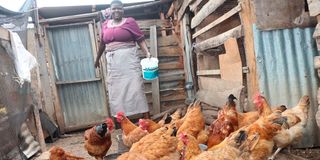
Pauline Sambu from Tuigoin Trading Centre in Trans-Nzoia county feeding some of her mature hens ready for distribution in the market in this photo taken on February 27, 2026.
Proper ventilation is also essential, while the brooder must be covered to prevent chicks from escaping.
Disease prevention is another key aspect of poultry management. Chicks should be vaccinated against common poultry diseases such as Newcastle Disease, Coccidiosis, Infectious Bursal Disease (Gumboro) and Fowl Pox.
To maintain hygiene, Ms Sambu regularly sprays the chick-rearing area with disinfectants and has installed a footbath with disinfected water at the entrance to enhance biosecurity. She also ensures the chicks are protected from predators such as dogs.
“Farmers must source chicks from reputable hatcheries, maintain clean and dry litter, ensure proper ventilation and follow vaccination schedules,” she says.
Lydia Chebet, one of the beneficiaries of the innovation, says she ventured into poultry farming in January after struggling to secure employment following college graduation.
She says local innovations such as the improvised brooder can stimulate economic activity by creating markets, industries and employment opportunities for women and youth.
“Local solutions are easier to adopt because they use materials and knowledge already available in the community,” she says.
From left to right: Pauline Sambu, Lavender Chepkogei and Sheila Lagat from the Tuigoin Trading Centre in Trans-Nzoia, holding improvised brooders that mimic the environmental conditions used to rear chicks.
Ms Chebet encourages young people and women to consider poultry farming because it requires relatively little space and modest capital.
“With increasing urbanisation, land is becoming smaller and fragmented, making large-scale farming difficult,” she notes.
Ms Sambu says the poultry business is particularly profitable during the festive season, when mature hens sell for between Sh1,400 and Sh1,800.
Most of her customers include restaurant and hotel owners as well as farmers from Eldoret, Trans-Nzoia, Elgeyo-Marakwet, Nandi and parts of Kakamega.
She believes that adopting improved techniques and practical innovations can significantly enhance rural livelihoods, strengthen food security and boost incomes for smallholder farmers.
Across Africa, she says, smart agricultural practices and grassroots innovations are increasingly helping farmers overcome the challenges of food insecurity.
Follow our WhatsApp channel for breaking news updates and more stories like this.