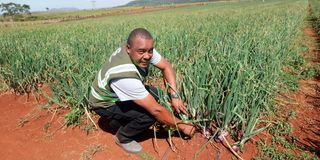
Suleiman Maundu Ramadhan, founder of Rama Farm Supplies Limited, at his onion farm in Kyeleni Tala, Machakos County on January 23, 2026.

Even before anyone speaks, the land in Tala, Machakos County, tells its own story. Many dismiss this area as too dry, too harsh and too unreliable for serious farming, especially in the face of intensifying climate change.
Dust rises easily and rainfall is erratic. For decades, the area has been labelled Arid and Semi-Arid Land (ASAL), which is mainly considered suitable for survival crops and pastoral livelihoods.
However, amid these climatic challenges, one farmer is deliberately writing a different story.
A visit to his farm in Kwa Matingi village in the Matungulu sub-county of Tala reveals neat rows of onions and tomatoes stretching across what was once bare land.
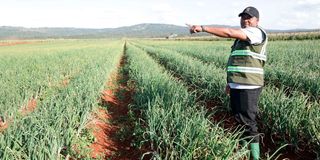
Suleiman Maundu Ramadhan, founder of Rama Farm Supplies Limited, at his onion farm in Kyeleni Tala, Machakos County on January 23, 2026.
Thin black drip lines snake neatly between the crops, delivering water with precision. It is immediately clear that this transformation is the result of design, not chance.
At the heart of this transformation is Suleiman Maundu Ramadhan: an engineer by training, profession and conviction.
Armed with systems thinking, persistence, and a deep belief in the power of irrigation, he has transformed a dry parcel of land into a thriving horticultural hub.
Mr Maundu did not set out to become a large-scale farmer. For most of his adult life, his professional identity was firmly rooted in engineering.
He runs Ramtek Services Ltd, an engineering firm dealing with machines, systems, and industrial processes.
Having trained as a mechanical technician, he holds a diploma in mechanical engineering and has worked in beer and water processing plants.
He further honed his skills through training programmes in Germany.
“Engineering taught me discipline, planning and respect for detail,” he says. "Farming, as I later discovered, demands exactly the same qualities," he adds.
The turning point came in 2020, at the height of the Covid-19 pandemic. Restrictions on movement grounded travel and slowed projects, and uncertainty hung over nearly every sector of the economy.
Like many others, Maundu found himself spending more time at home and thinking deeply about food security, productivity, and resilience.
He owned around ten acres of land in Tala and made a practical decision: If movement was restricted and engineering projects were disrupted, at least farming could guarantee food and generate some income.
This led to the creation of Rama Farm Supplies Ltd, a venture which he jokingly refers to as his 'Covid-19 baby'.
"During the pandemic, we weren't travelling and projects had slowed due to lockdowns and restrictions on movement in Nairobi and neighbouring counties such as Machakos, Kiambu and Kajiado. But people still had to eat. Farming was the most logical thing to do,” he recalls.
The decision was not romantic; it was calculated. At the time, onion prices were soaring, with a kilogram retailing at up to Sh150.
Tomatoes were also fetching attractive prices. Mr Maundu did the sums and saw an opportunity. He concluded that horticultural farming offered better and faster returns than many conventional investments.
He decided to test the waters cautiously by allocating only part of his land to production.
Suleiman Maundu Ramadhan, founder of Rama Farm Supplies Limited, at his onion farm in Kyeleni Tala, Machakos County on January 23, 2026.
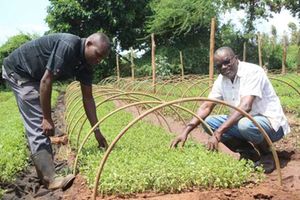
“I started with about four acres of onions and three acres of tomatoes, alongside smaller plots of cabbage and capsicum,” he says.
He also planted maize and beans, not as commercial crops, but as part of a crop rotation strategy to improve soil health and break pest cycles. From the outset, sustainability mattered as much as yields.
Water quickly emerged as the most critical challenge. In a semi-arid region like Tala, rain-fed agriculture alone could not consistently support production.
Maundu visited a colleague who was using drip irrigation and was immediately convinced by it. The system appealed to his engineering instincts, offering controlled flow, efficiency, and minimal waste.
However, installing drip irrigation across the entire farm was expensive, eventually costing around 2.5 million Kenyan shillings for ten acres. This investment was made gradually, starting with onions and tomatoes before expanding to other sections.
“Irrigation is everything. You can pray for rain, but without irrigation, it is impossible to farm consistently in a place like this,” says the farmer.
The first harvest coincided with some of the toughest months of the pandemic.
Remarkable achievement
While labour was readily available as many people remained in the village, transporting produce to market proved extremely difficult. Curfews, roadblocks and logistical bottlenecks threatened to undo months of hard work.
"That is when I learned that farming success does not end at the farm gate," he says. “Markets, transport and timing matter just as much as production,” he adds.
He recalls losing produce worth millions of shillings when the harvest coincided with market surpluses.
"When the Coronavirus struck, almost everyone turned to horticulture farming. Produce was everywhere and prices collapsed," he says.
Despite these setbacks, the farm broke even in its first year. Encouraged by the results and having learned some hard lessons, Maundu expanded.
Five years on, Rama Farm has grown into a network of three farms. One covers about six acres, a major operation spans roughly 32 acres, and a sister farm near Kilima Mbogo, bordering Kiambu County, adds another six acres under production.
In total, close to 30 acres are fully irrigated, which is a remarkable achievement in an ASAL zone.
“We failed in some seasons, we learned, and we improved. Farming teaches you very quickly if you are willing to learn," he observes.
Standing in the middle of his green fields, he describes his farm as 'a small Israel in the heart of the drylands'.
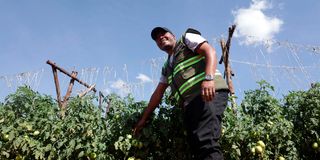
Suleiman Maundu Ramadhan, founder of Rama Farm Supplies Limited, at his tomato farm in Kyeleni Tala, Machakos County on January 23, 2026.
Onions and tomatoes remain the backbone of the business. “At any given time, about 18 to 20 acres are covered with onions alone, which are carefully staggered to ensure a monthly harvest,” Maundu explains.
During a recent visit by Seeds of Gold, six acres were nearing harvest, seven more acres were just two weeks old and additional seedlings were ready in the nursery. This deliberate subdivision ensures a steady market presence throughout the year.
Tomatoes follow a similar pattern, with around five acres at Tala and three at the sister farm, ensuring a continuous supply.
With good agronomic management, onions yield between 15 and 20 tonnes per acre and tomatoes between 30 and 50 tonnes.
"Volume matters in farming. When you produce well and consistently, even small margins add up,” says Mr Maundu.
However, prices fluctuate sharply. Tomatoes can sell for as little as Sh20 per kilo during periods of surplus or rise to Sh50 when supply is tight.
Onions, on the other hand, range in price from Sh40 to over Sh100 per kilo, depending on market conditions. Rather than speculating, Maundu focuses on volume, timing and consistency.
Around 80 per cent of the produce is sold locally to supply markets in Tala, Matuu, Ruai, Nairobi and the surrounding area. Some produce reaches major supermarkets such as Naivas, Quickmart, Carrefour and Magunas via established suppliers.
The remaining 20 per cent is sold to traders who buy directly from the farm and export it to Uganda and Tanzania.
Irrigation underpins everything. Two colonial-era dams, Kyamisanzi and Kyamatinga, supply the farm.
One pump is solar-powered and the other is connected to the national electricity grid.
Together, they deliver at least 600,000 litres of water daily, which is enough to sustain production even during prolonged dry spells.
Solar power reduces costs during sunny periods, while electricity provides a reliable source of power at night or during cloudy seasons.
Plum Agri Irrigation, a Kenyan firm specialising in modern irrigation and water management systems, as well as farm inputs, has played a key role in setting up the infrastructure.
“The key to addressing food insecurity is irrigating farms,” says Joshua Musyoka, the company’s branch manager. “But it must be done using quality systems installed correctly after proper site assessment.”
Rama Farm now employs 24 permanent workers, up from just 10 in the early days. They live on the farm.
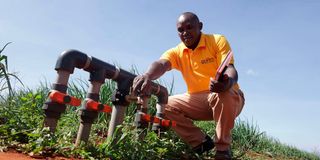
Joshua Musyoka of Plum Agri-Irrigation opens irrigation pipes at Rama Farm Supplies Limited in Kyeleni Tala, Machakos County on January 23, 2026.
During peak periods, such as the harvest, between 30 and 70 casual labourers are hired daily from neighbouring villages, according to farm manager Simon Mutungi.
Herbicides are largely avoided in favour of manual weeding, which provides employment and better crop control.
Around 70 per cent of inputs are organic, including goat and cow manure, with synthetic fertilisers used where necessary.
Maundu runs the farm with his wife, who manages operations in his absence.
The agri-preneur has installed surveillance cameras which allow him to monitor activities remotely.
“I can follow any activity on the farm at the touch of a button on my smartphone, including the solar panels at the dams,” he says.
Despite the success, challenges persist. Market surpluses can depress prices, while rising input costs can squeeze margins.
Initially, quality issues limited access to premium markets, but experience, improved agronomy practices and the hiring of a dedicated agronomist have changed that.
Today, buyers from high-end markets regularly visit the farm.
For Maundu, the lesson is clear: with planning, technology such as irrigation and persistence, farming can thrive even in drylands.