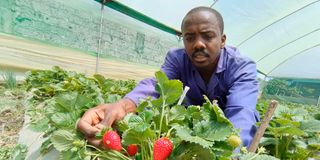
Wearing a blue dust coat, Anthony Ngatia bends over the neatly arranged rows of strawberry plants and carefully picks the ripe fruit that is destined for a client later in the afternoon.
It is mid-morning in Mwihoko, Kiambu County, and despite the rising heat inside the greenhouse, the 30-year-old farmer remains focused on harvesting only the best fruits.
The fruits stand out: deep, dark red; firm to the touch; and uniformly conical in shape. These qualities have earned him a growing clientele in high-end markets across Kiambu, Nairobi, and neighbouring counties.
Strawberries harvested by Anthony Ngatia on March 31, 2026, are ready for supply to his clients.
Photo credit: Sammy Waweru| Nation Media Group
“This is my main source of income. Every morning, I come here to work,” says Ngatia, an electrical and telecommunications engineering graduate from Multimedia University.
His journey into strawberry farming began just two years ago and is a story of curiosity, calculated risk and smart technological integration.
Raised in a family with a background in agriculture, Ngatia had always been inclined towards farming, although his academic path had led him into engineering.
After graduating in 2018, he worked for several companies, but his desire to venture into modern agriculture faded.
His turning point came through online research. Initially, he considered growing herbs and other greenhouse crops, such as capsicum. However, strawberries quickly stood out.
“Herbs are good, but they are seasonal. I wanted something that could provide consistent production throughout the year,” he explains.
Youthful farmer Anthony Ngatia, who grows strawberries in Mwihoko, Kiambu County, on March 31, 2026.
Photo credit: Sammy Waweru| Nation Media Group
A YouTube video introduced him to a local strawberry farmer whose work inspired him. He reached out to the farmer, received guidance and acquired his first planting materials — runners used for propagation. This marked the beginning of his venture.
With around Sh60,000 in seed capital, drawn from personal savings and support from his mother, he set up his farm on a quarter of an acre in Milima Mbili, Mwihoko, Kiambu County.
The space also accommodates his house and a water reservoir, showcasing his ability to maximise the use of limited urban land.
He started small, planting around 300 seedlings. Today, through continuous propagation, he has increased this number to around 1,300 plants.
“I didn’t rush to fill the whole farm. I started small, learnt the process, and expanded gradually,” he says. This growth has been matched by a significant increase in production. In the early days, he harvested between 1.5 and 2 kilograms per week, equating to around 6 kilograms per month.
Today, depending on weather conditions and plant performance, his output ranges from 50 to 60 kilograms per month.
Strawberries harvested by Anthony Ngatia on March 31, 2026, ready for supply to his clients.
Photo credit: Sammy Waweru| Nation Media Group
At the heart of this transformation is technology, particularly artificial intelligence (AI), which he has embraced to improve efficiency and productivity.
“AI has been very helpful, especially in offering guidance on crop management. It helps me diagnose plant issues and make decisions faster,” he explains.
Previously, a lack of expert advice limited his production. Hiring agronomists was expensive, but AI tools now offer accessible, real-time insights. He still consults human experts when necessary, but technology has significantly reduced his dependency on them and his costs.
Apart from AI, Ngatia is also leveraging his engineering background to develop Internet of Things (IoT) solutions tailored to his farm. These include systems to monitor water levels in storage tanks and sensors to track soil conditions such as pH and nutrient levels.
“I am working on automating processes like irrigation and monitoring. This ensures that the plants are always in optimal conditions, eliminating the need for constant manual checks,” he says.
Embracing artificial intelligence is increasingly seen as a crucial step in accelerating growth within the agricultural sector. Experts note that technological innovation will transform farming by improving efficiency and boosting productivity.
“Technology is advancing rapidly, and AI is at the heart of this agricultural transformation. The finance industry has already embraced this technology, and agriculture must follow suit,” says Richard Omondi, proprietor of Agri-Irrigation and Solutions Africa. The firm offers irrigation services, including system installation, borehole drilling, and the construction of water pans and dams.
Youthful farmer Anthony Ngatia, who grows strawberries in Mwihoko, Kiambu County, on March 31, 2026.
Photo credit: Sammy Waweru| Nation Media Group
This technology is proving instrumental in enabling farmers to monitor crop health, predict pests and diseases, optimise the use of irrigation and fertiliser, automate operations and ultimately improve yields.
By analysing data in real time, AI enables more informed decision-making, reduces operational costs, enhances efficiency and promotes sustainable farming practices across diverse agricultural systems.
Water management is critical in strawberry farming. Ngatia relies on drip irrigation, using a combination of harvested rainwater, a borehole supply, and stored reserves. This ensures consistent watering, as even a short interruption can affect plant performance.
He mainly grows the San Andreas variety of strawberry, which is an ever-bearing type that produces fruit continuously rather than seasonally. This enables him to provide his customers with a consistent supply.
The fruits are visually appealing, being deep red, glossy, firm and uniformly shaped. Their sweetness and consistency make them attractive to premium buyers.
“It’s all about good farming practices: proper feeding, pruning, watering and pest control,” he says.
He practises organic farming, using manure, biochar and agricultural lime to enrich the soil. He also applies organic foliar sprays and uses fertigation systems to deliver nutrients directly to the plants' roots. Despite his success, he has faced challenges along the way. Access to skilled strawberry farmers remains limited, forcing him to rely on referrals.
Managing pests and diseases is also challenging, particularly in organic production where chemical solutions are restricted.
The devastating effects of climate change, in the form of adverse weather conditions, posed yet another hurdle. Initially, he farmed in an open field, but heavy rainfall caused fungal infections that reduced yields. This prompted him to invest in a greenhouse, which now provides a controlled environment in which to protect the delicate crop.
“Strawberries are sensitive. Too much rain or poor handling can lead to losses,” he told Seeds of Gold in an exclusive interview. Market access has steadily improved, however. What started as sales within Mwihoko has expanded to include high-end outlets such as supermarkets, restaurants, bakeries and organic food markets in Kiambu, Nairobi and the surrounding area. He attributes his success in these premium markets to his ability to produce high-quality organic strawberries.
“A kilo can fetch up to 1,200 shillings when sold directly to consumers,” he says. This price reflects both the quality of the fruit and the growing demand for fresh, locally produced berries.
He notes that strawberry farming is not only profitable, but also engaging. The crop requires constant attention, from monitoring nutrient levels and managing pests to harvesting at the right time.
Apart from growth in production, he notes that the venture has evolved from a one-man operation into a source of employment, currently providing casual work for one person.