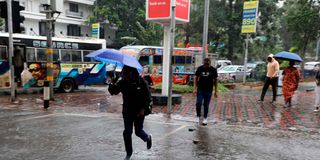
More than 400mm of rain. Above-average rainfall. Heavy rains or normal rainfall. By now, these are familiar words. They appear in weather forecasts, climate outlooks and advisories.
As the country prepares for the October-November-December rainfall season, which meteorologists say is already being influenced by “Very strong” El Niño conditions, many people are keeping tabs on the daily advisories.
A weather update that was recently sent by the Kenya Meteorological Service Authority (KMSA).
Photo credit: Kenya Meteorological Service Authority
You might read them and think, well, it is going to rain a lot. You might even start to make plans around the forecast because you read some 400 mm somewhere, and that must mean a lot of rain.
But have you ever wondered what some of these terms mean? When a forecast says an area could receive more than 400mm of rain, what does the “mm” actually mean? How much rain is that? And when meteorologists say rainfall will be “above average”, what are they comparing it with?
Hannah Kimani, assistant director, Public Weather Services at the Kenya Meteorological Service Authority, breaks down some of the terms we hear in weather forecasts.
One millimetre of rainfall is equivalent to one litre of water falling over an area of one square metre, a space measuring one metre by one metre.
When weather forecasters say 20 or 50 millimetres, for example, you are basically taking one litre of water and pouring it in that one square metre space.
But, here’s the thing: the impact of rainfall is guided by what the 50 litres of water will do to that small space that is just one square metre.
With that, you can begin to understand what meteorological services mean when they give us a certain amount of rainfall, and what impact that amount of rain could have across different sectors.
Notably, it’s important to understand the climatology of an area because the impact is pegged on that. For instance, 20mm of rainfall in Nairobi will not have the same impact as 20mm in an area like Kakamega.
The reason is that Nairobi is highly populated and largely urban, with extensive areas covered in concrete and other impermeable surfaces. There are also drainage challenges. So when it rains, the water has nowhere to percolate into the ground and can quickly flood the streets.
Compare that with somewhere else with more vegetation and open ground. The same amount of rainfall may be absorbed into the soil rather than becoming stagnant water or running off into streets.
So, one needs to understand not just an area's climatology, but also its exposure and vulnerability.
When meteorologists talk about “normal” rainfall, they are comparing the expected amount of rain with what an area has historically received.
They use what is called the Long-Term Mean (LTM), which is the average rainfall recorded over a 30-year period. The LTM can be calculated for different periods, including daily, weekly, monthly or seasonal rainfall.
Rainfall is considered normal when it falls between 75 and 125 per cent of the LTM. Anything below 75 per cent is classified as below-normal rainfall, while anything above 125 per cent is considered above-normal rainfall.
For example, if a station normally receives an average of 600mm of rain during the October-November-December season, rainfall between 450mm and 750mm would be considered normal. Less than 450mm would be below normal, while more than 750mm would be above normal.
So when a forecast says an area is likely to receive “above-normal rainfall”, it doesn't simply mean a lot of rain will fall. It means the expected rainfall is more than 125 per cent of what that area has historically received during that particular period.
Not at all. This simply means an area is expected to receive less rain than it normally does during a particular period, such as a month or a season.
That does not mean the skies will remain dry. It could still rain, but the total amount may be lower than usual for that time of year. In some cases, an area may experience occasional rainfall but receive very little overall. In others, heavy storms may occur over a short period, followed by prolonged dry spells.
No. If an area receives 250 mm of rainfall, receiving 700 mm means it received more rain than it normally does during a particular period, such as a month or a season.
It does not necessarily mean it will rain every day. An area could have prolonged wet spells with only a few dry days in between. It could also experience intense storms over a short period, followed by several dry days.
What matters is the total amount of rainfall received over the period. Even with dry spells in between, rainfall can still be classified as above normal if the cumulative amount is higher than usual.