Kenya’s 2026 long rains brought a measure of relief to millions of households across the country, but the season’s apparently favourable rainfall masked a more complicated reality: in many of the areas that needed the rains most, water arrived too early, fell unevenly or stopped before crops, pasture and water sources could fully recover.
The Kenya Food Security Steering Group (KFSSG), in its 2026 Long Rains Assessment, says most parts of the country received near-average to above-average rainfall between March and May, with some areas recording significantly more rain than usual.
However, according to the report the rains did not translate into the expected improvements in food and nutrition security because of prolonged dry spells, poor temporal distribution and early cessation. “Pasture, water sources and crops did not recover as well as the total amounts might suggest,” the report says.
The long rains, which began earlier than usual in some areas towards the end of February and early March, were largely characterized by early cessation across most parts of the country, according to the assessment.
The uncommon early rains got many farmers in the North Rift region, the country's food basket unprepared forcing them to review their planting calendars.
For many farmers in maize planting zones such as Uasin Gishu, Trans Nzoia, Nandi and parts of Elgeyo Marakwet the planting exercise begins with land preparation in February and extends to early May when the region experience reliable rainfall cycle.
A tractor ploughs land in Mogotio, Baringo County on February 21, 2025 ahead of long rains. Africa holds 60 per cent of the world’s untapped arable land.
Photo credit: Boniface Mwangi
"Many farmers had not completed preparing their land and the early rains forced them to rush planting which impacted negatively to this season yield," said James Song ok, large scale maize and wheat farmer from Kerita, Uasin Gishu county.
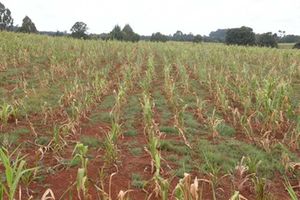
Ironically the early rains were followed by dry spell in most agricultural-producing zones, including Uasin Gishu and Trans Nzoia, the country’s leading maize-producing counties that left farmers counting losses following crop failure and reduced yields.
The problem, according to the report, was not necessarily how much rain fell, but when and where it fell.
The assessment involved the Ministries of East African Community (EAC), ASALs and Regional Development, Agriculture and Livestock Development, Water and Sanitation, Health, Education, Labour and Social Protection and Interior and National Administration, through the Department of Refugee Services.
Other participating institutions included the National Drought Management Authority (NDMA), Kenya Meteorological Service Authority (KMSA), United Nations Development Programme (UNDP), Action Against Hunger (ACF), Plan International, Kenya National Bureau of Statistics (KNBS), World Food Programme (UN WFP), Integrated Food Security Phase Classification (IPC), Famine Early Warning Systems Network (FEWS NET), and Arid and Semi-Arid Lands (ASAL) County Steering Groups (CSGs), with financial support from the Government of Kenya through NDMA and its partners.
The early onset encouraged farmers to plant and, in several counties, expand the area under cultivation in anticipation of a productive season. “However, the early start was followed by dry spells in several locations. Garissa, for instance, experienced a three-week dry spell after the rains began, while rainfall in several northern counties peaked unusually early. In Samburu, March alone accounted for about 67 percent of the entire season’s rainfall,” the Kenya Food Security Steering Group (KFSSG) states report.
According to the assessment, such concentration of rainfall meant that some areas received substantial quantities of water within a short period but lacked moisture during critical crop-growing stages. In Isiolo, for example, some stations recorded more than 20 rainy days while others recorded fewer than 10, showing the uneven distribution even within the same county.
The season also ended earlier than normal in several pastoral areas. In Wajir, rains stopped during the first week of May, while in Mandera they ended in late April in most areas.
The report further notes that in Isiolo, rains ended in late April in many locations. The early cessation shortened the growing period and limited recovery of crops, pasture and water sources.
The consequences were reflected in crop production. National maize production from the long rains season is projected at about 27.1 million 90-kilogramme bags, a 21.6 percent decline from the five-year average of approximately 34.6 million bags. Against annual domestic requirements of about 46 million bags, this leaves an estimated shortfall of 18.9 million bags.
Loaders spread maize to dry at Railways Ground in Nakuru on October 17, 2025.
Photo credit: Boniface Mwangi | Nation Media Group
The report, however, appears to contradict the Government’s recent position on maize production. A few days ago, while announcing a reduction in the price of subsidised fertiliser from Sh2,500 to Sh2,000 per 50kg bag, Agriculture and Livestock Development Cabinet Secretary Mutahi Kagwe said maize production had increased from 34.3 million 90kg bags in 2022 to 73 million bags in 2025.
“Kenya has recorded gains in agricultural production. Maize production increased from 34.3 million 90-kilogramme bags in 2022 to 73 million bags in 2025, while maize imports declined by more than 66.5 percent over the same period,” he said.
However, these gains are now under threat following drought in key maize-producing counties, including Uasin Gishu and Trans Nzoia, where crop failure and reduced yields have left farmers counting losses. The production shortfall has prompted the Government to allow the private sector to import 25 million 90kg bags of maize to bridge the deficit.
Samuel Macharia who planted 70 acres of maize in Moi's Bridge, Uasin Gishu County, projecting to harvest 1,500 bags worth Sh6 million is among farmers who are counting losses after the crop was damaged by unrelenting dry spell.
“I have never witnessed such a worst planting season in my life time. The entire crop was wiped out by the dry spell and I expect no yield yet I have a loan of Sh1.5 million to repay,” said Mr Macharia.
According to Phanice Khatundi, Trans Nzoia's County Executive Committee member for Agriculture, the 2026 long rains arrived earlier than usual, with onset in mid-February encouraging farmers to prepare land and plant on schedule. Then the pattern broke.
"As the season progressed, an erratic rainfall pattern emerged that disrupted the normal crop calendar and farming operations," Khatundi said, noting that what followed diverged sharply from the seasonal forecast the Kenya Meteorological Department had issued for March through May. The dry spell dragged into June and July.
More than 120,000 smallholder farmers across the North Rift have been affected, according to the Ministry of Agriculture, which projects the region's harvest will drop by 30 percent this season.
Sammin Kipkemboi Kottut, Uasin Gishu's CEC for Agriculture, said the depressed rainfall linked directly to irregular weather will translate to low yield threatening farmers income and the country’s food security.
“Farmers planted maize between January and June but we have learnt that there is crop failure after the crops were damaged by drought,” said Mr Kottut.
“We have been hard hit after most of the crop withered and there is no hope even after the government announced reduction in fertilizer and maize seed prices to enable us plant the crop during the anticipated El Niño rains,” said Mathew lang’at maize farmer from saos, Nandi County.
The Principal Secretary State Department for Agriculture and Livestock Development Dr. Kipronoh Ronoh, has warned that the unfolding crisis is a severe blow to maize farmers and a threat to national food security.
"The current crop failure is not only a blow to farmers but a threat to the national food security since the North Rift region is our grain basket," said Dr Ronoh.
According to the East Africa Grains Council (EAGC) erratic rainfall could result in reduced maize harvest in Uganda, Tanzania and Kenya setting stage to increased flour prices.
Farmers inspect their failed maize crop in Mirera, Naivasha, Nakuru County, on July 12, 2026.
Photo credit: Boniface Mwangi| Nation Media Group
“There is likely to be significant country-level variations in maize supply across the region, worsened by expectations of below average net supply in Kenya, Rwanda, Burundi and South Sudan,” the EAGC said in a report released early this month.
The government through the National Strategic Food Reserve is to have 4 million bags of gains –maize, rice, beans as emergency stock or cash equivalent to the quantity.
According to the 2026 Economic Survey by the Kenya National Bureau of Statistics, maize imports in 2025 jumped by 51.4 per cent to 468,109 metric tonnes driven by a duty-free window for yellow maize.
The data indicates that the country imports more than it exports with food items such as maize ballooning the country’s imports in 2025, further deteriorating the trade balance to Sh1.6 trillion.
Beans, according to Kenya Food Security Steering Group (KFSSG) 2026 long rains assessment report, have also performed poorly, with production projected at 5.7 million 90kg bags, 18.6 percent below the long-term average of seven million bags. The situation was particularly severe in some areas. In Samburu, projected maize production was just 2,700 bags, compared with a long-term average of 240,000 bags, equivalent to only about one percent of the average. Bean production stood at 1,800 bags against a long-term average of 10,000 bags.
In Turkana, maize production declined by 40.5 percent compared with the long-term average, while sorghum and cowpea production fell by 52.7 percent and 33 percent respectively. In Makueni, maize production declined by 41 percent, while pigeon peas fell by 28 percent and green grams by 18 percent, largely because of uneven rainfall and early cessation.
Even with the decline in production, drought-tolerant crops performed significantly better in many ASAL areas. Green-gram production was 60 percent above the long-term average, while cowpea production doubled the average. Their shorter maturity periods and lower water requirements allowed them to reach maturity before the rains ended.
“Kitui emerged as a particularly strong performer in maize, recording yields equivalent to 257 percent of its long-term average. The county also accounted for about 70 percent of the 198,073 hectares planted under green grams in the assessed ASAL counties,” says the report.
The mixed agricultural performance has helped improve the overall food security picture, but the improvement is far from complete. The number of people facing crisis or worse food insecurity in the 23 ASAL counties declined from 3.27 million in February 2026 to 2.74 million between July and October. Of this number, approximately 350,000 people are in Integrated Food Security Phase Classification (IPC) phase 4, or Emergency.
Eight counties, namely; Baringo, Garissa, Mandera, Marsabit, Samburu, Tana River, Turkana and Wajir, are currently classified in IPC phase 3, or crisis, while the remaining 16 analysed ASAL counties are in phase 2, or stressed.
The improvement was largely attributed to the long rains, which boosted pasture, browse, water resources and crop production in parts of the ASALs. The report projects that the number of food-insecure people could fall further to about 2.11 million between November 2026 and January 2027 if the forecast above-average October–December rains materialise.
During this period, the country is expected to receive El Niño rains, with preparations under way to mitigate their potential impacts. In a previous interview with the Nation, CS Kagwe reaffirmed the Government’s commitment to constructing water pans and dams to harvest and store water for agricultural use.
“The rains could bring both benefits and disruptions depending on their intensity and location. Increased rainfall could replenish dams and boost grass and vegetation growth in some areas, but excessive rains could cause flooding, destroy roads and sweep away livestock,” Mr Kagwe said.
The July 2026 IPC Acute Malnutrition analysis classified 14 areas in phase 4, or critical. These include Baringo East-Tiaty, Garissa, Tana River, Wajir, Isiolo, Mandera, North Horr/Chalbi, Laisamis/Loyangalani, Samburu, several parts of Turkana and Dadaab refugee camp.
Other areas, including West Pokot, Saku, Moyale, Kalobeyei and Kakuma, were classified in Phase 3, or Serious. The assessment estimates that 832,743 people require treatment for acute malnutrition in the ASAL, urban and non-ASAL areas, up from 810,871 in February. This includes 620,325 children aged six to 59 months suffering from moderate acute malnutrition and 212,418 suffering from severe acute malnutrition. A further 110,854 pregnant and breastfeeding women and girls require support.
City residents shield themselves from the rain in Nairobi on Sunday, February 22, 2026.
Photo credit: Dennis Onsongo I Nation Media Group
The situation among refugees is also worrying. In Dadaab, Kakuma and Kalobeyei, an estimated 351,449 people are facing IPC Phase 3 or worse acute food insecurity, including 77,900 people in Emergency.
The report indicates that crisis is expected to persist through September across pastoral regions driven by constrained income and increased food prices that will limit food access to many households.
“The conditions are expected to improve between October and January as anticipated above average short rains will enhance livestock productivity and improve household food access. Mandera, the region worst affected by the failure of the 2025 short rains the condition will persist through January,” added the report.
The National Treasury allocated Sh9 billion early this year for drought intervention to support millions of Kenyans affected by devastating effects of drought.
Some Sh8.5 billion of the fund was used for emergency food assistance and Sh500 million for purchase of livestock feed to protect livelihoods.
According to the national Drought Management Authority (NDMA) nine counties are experiencing drought which has led to worsening food security.
The counties in alert phase include, Wajir, Garissa, Kilifi, Marsabit, Kitui, Kwale, Kajiado, Isiolo, and Tana River, while Mandera is in the critical “alarm” phase.
Most Arid and semi-arid (ASAL) counties are ill prepared to tackle disasters including food security and have to rely on national and external assistance.
They are faced with financial constraints and effective implementation of early warning systems which has led to confusion on the roles of the national and county in mitigating against the effects of starvation.