Under a scorching sun in Singiraine village, Esther Ndari was still waiting for her turn at the borehole. The 45-year-old mother of five had left home around 3am on Sunday with her co-wife and several female neighbours.
They loaded jerrycans onto ten donkeys, each carrying at least four 20-litre containers, and trekked for almost two hours in darkness to the community borehole at Naudot sublocation. It is about 20 kilometres from her home and a few miles from Mile 46 shopping centre. They arrived around 5am. Dozens of women were already queuing.
“It’s rare not to find people queuing for water. Those who come late usually go home without water in the evening as the pump usually fails to pump water around 6PM,” said Esther. “This has been my trend in the last three months. Donkeys come in handy in search of water due to the harsh terrain with no definite routes to our rural villages.”
The borehole is solar-powered and supplies salty water. Residents say the pump sometimes only starts working around noon, once it has stored enough solar energy. Some women chatted as they waited. Others dozed off, worn out by the long hours. Esther finally got her turn around 3pm, competing for the scarce water with livestock that had flocked to the borehole to drink.
“At least, my family is assured of water for two days. Back at home, water is not a luxury but a rare commodity that needs to be used when extremely necessary. I will be back on Wednesday to try my luck,” said Esther.
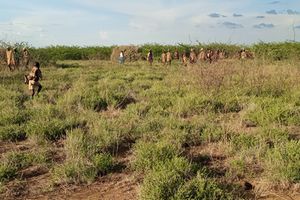
She is not the only one. In Singiraine, women trek up to 50 kilometres to this single borehole after the shallow water pans, locally known as Siranga, dried up. Across Kajiado West and Iloodokilani sub-counties, stretching to Magadi division, vegetation has withered to scattered shrubs, and the seasonal rivers have run dry.
Joan Kisimil, 23, recently married, had to leave her child, barely a year old, with her co-wife to make the trip.
“I have no option but to step in search of water for the extended family. I am the young Co-wife in a polygamous family. The elderly and children are left home sometimes without food,” said Joan.
Maria Henry, Esther’s co-wife, said the daily search for water had disrupted their routines and shut them out of income-generating activities.
“We (women) no longer engage ourselves in economic engagement nowadays. Our concerted efforts are to search for water as the situation continues getting worse,” said Maria.
The women are not alone at the borehole or on the road to it. Residents say wildlife compete with them for the little water available, and elephants have sometimes damaged the pump. Footprints and freshly felled acacia trees were visible around it. Elephants from neighbouring Shompole roam into residential areas during the dry season, raising concerns among residents who must trek through the same terrain.
Ezekiel Ntiyiene, from Maili 46, said herders from far-flung areas also flock to the borehole around lunchtime, making the competition worse. Most residents are pastoralists, and some herders have moved their animals to Naivasha in Nakuru County and the south of Narok County in search of pasture.
“Due to the creeping drought, most herders have relocated most of their animals, especially cows, to neighbouring counties. Goats and sheep currently feeding on Acacia tree leaves compete for water with women at the community borehole,” said Ntiyiene.
Those herders are forced to lease private grazing fields or graze along road reserves to avoid disputes over pasture with locals.
Singiraini Location, Kajiado West, Senior Chief Joseph Katitia inspects empty underground water tanks next to the Tata Chemicals Railway line stopover on Oct 12 26.
Photo credit: Stanley Ngotho | Nation
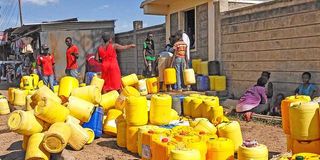
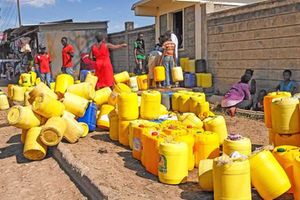
Back home, water costs money. Dorcas Mopiyan, 40, said a 20-litre jerrycan of salty water was selling for between Sh100 and Sh150, and was not readily available from vendors. She said the yellow jerrycan had become a symbol of water scarcity in nearly every homestead, but that however many containers a household owned, most remained empty.
“A 20-litre jerrycan retails at 100 and beyond. We are currently selling livestock to get water, but it’s not an assurance to get the rare commodity promptly from the vendors who sometimes use motorcycles to ferry water to the villages.”
Singiraini Location Senior Chief Joseph Katitia said the drought had brought hunger that was taking a toll on older people, women and children. He warned that if the rains failed to arrive in the coming days, livestock deaths could follow.
“As the hunger continues to bite, women, children and the aged continue becoming vulnerable as young men relocate animals to neighbouring sub-counties in search of pasture,” said Chief Katitia. “Women travel long distances in search of water, courting the danger of wildlife attacks. Let the government step in to supply water and relief food to the locals.”
Some male senior citizens now gather at the shopping centre hoping for food and water from well-wishers. The drought is threatening the food security of an estimated 3,500 residents, as well as learners at a local public primary school.
Elsewhere in the country, clouds are gathering ahead of the predicted El Niño rains. Over this region, the skies remain clear.
The last drought is still fresh. Between 2020 and 2022, Kajiado suffered a severe drought that killed at least one million livestock and left more than 300 families without food, according to 2021 data from the National Drought Management Authority. At the height of the crisis, a mature cow reportedly sold for as little as Sh500, and many pastoralists have struggled to rebuild their herds since. Residents are now hoping the El Niño rains will restore pasture, replenish water sources and bring relief.