At 6.30am on August 1, 2026, a cold drizzle had settled over the homesteads of Kamukuywa, Bungoma County.
But beneath a makeshift shelter, eight men sat around a three-stone fireplace, seemingly gathered to escape the morning chill. The fire, however, had a deeper purpose.
Several stout metal blades rested above the flames, raised on small pieces of wood to keep them from touching the ground. As the blades warmed, the men sang traditional folk songs, their voices rising through the damp morning air.
Lukembe, the traditional circumcision knives used during the Bukusu initiation rites, are displayed after being sharpened ahead of the 2026 circumcision season in Bungoma County on August 1, 2026. The knives are prepared before the biennial initiation ceremonies that mark the transition of boys into manhood.
Photo credit: Alex Odhiambo| Nation Media Group
“This is Lukhembe,” he said.
For the Bukusu, Lukhembe is no ordinary knife. It is a sacred circumcision blade, central to a traditional rite of passage through which boys are initiated into manhood.
Forged from steel, it embodies power, ancestry, courage and cultural identity. For generations, the ceremonial blade has symbolised the transition from boyhood to adulthood while connecting successive generations to the traditions of their ancestors.
“We don’t call it a knife; we call it Lukhembe. We treat it very delicately because if we mistreat it, there shall be misfortune, which may include death or barrenness,” says Mr Wekesa.
Ngaribas (traditional circumcisers) heat the Lukembe, the ceremonial circumcision knife, over a fire as part of its preparation ahead of the Bukusu male circumcision season in Bungoma County on August 1, 2026. The knife is heated to sterilize it before the biennial initiation rites that mark the transition of boys into manhood.
Photo credit: Alex Odhiambo| Nation Media Group
According to Mr Wekesa, the person who forges the blade must do so naked. More importantly, the blacksmith is expected to speak to the blade throughout the forging process, appealing to it to bring good fortune to the boy who will eventually face it.
As the hammer strikes the glowing metal, words accompany every blow.
“You are required to talk to it, telling it to protect the boys who the knife will be used on, so that they are disciplined, fertile and take education seriously,” says Mr Wekesa.
Even its physical design sets Lukhembe apart from an ordinary kitchen knife. It does not have the pointed tip typical of most knives. Instead, its tip is curved.
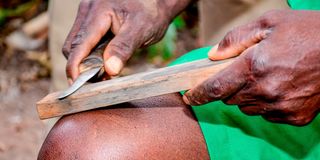
The metallic portion, known locally as Sironda, is sharpened on both sides, making it double-edged.
A Ngariba (traditional circumciser) sharpens a Lukembe, the ceremonial circumcision knife, ahead of the Bukusu male circumcision in Bungoma on August 1, 2026.
Photo credit: Alex Odhiambo| Nation Media Group
Its wooden handle is curved in the shape of a male genital organ, while tradition requires that the handle be made from the root of a specific tree, the Kamukimiila.
Before the circumcision season begins, traditional circumcisers from the Bukusu and Tachoni communities in Bungoma gather for a ceremony to cleanse and bless their blades.
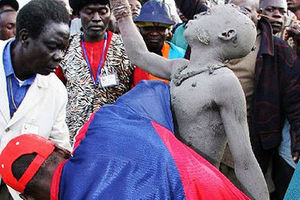
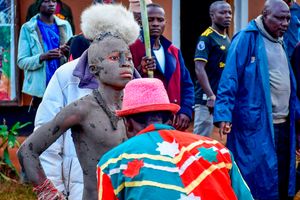
A Bukusu initiate undergoes traditional circumcision in Bungoma County on August 1, 2026. The ceremony marks the culmination of the biennial initiation rites through which boys transition into adulthood in the Bukusu community.
Photo credit: Alex Odhiambo| Nation Media Group
This year, the ceremony was held at Malaha. A white rooster, known as kutwaya kuwanga, was slaughtered, and its blood, together with traditional liquor, busaa, was sprinkled over the blades.
The act is a symbolic sacrifice intended to invoke and connect the circumcisers with the spirits of their ancestors, known as Bakuka.
The elders seek the ancestors’ blessings for a successful circumcision season and protection for the initiates.
After examining them, the elders predicted that the country could experience food shortages and heightened political tensions the following year.
“The signs indicate that next year may bring famine and political unrest. We urge the youth to remain peaceful and cautious,” says Mr Wekesa, who is also the chairman of the Bungoma County Traditional Circumcisers Association.
For the circumcisers, these rituals are not mere ceremonies. They are rules that must be observed if the blade is to continue serving its purpose without bringing misfortune.
A Bukusu initiate undergoes traditional circumcision in Bungoma County on August 1, 2026. The ceremony marks the culmination of the biennial initiation rites through which boys transition into adulthood in the Bukusu community.
Photo credit: Alex Odhiambo| Nation Media Group
Mr Wekesa says a circumciser does not hand his blade directly to a colleague. Instead, he places it somewhere for the other circumciser to pick up.
The consequences of violating the rules can be severe. If a circumciser drops Lukhembe and it touches the ground, he must stop performing circumcisions for the remainder of that season.
He is expected to leave quietly and, according to Mr Wekesa, avoid explaining what has happened to anyone on the way home. If questioned, he responds only with one word: “Ahoro.” The silence is itself part of the ritual.
Yet, despite the spiritual weight attached to Lukhembe, circumcisers also observe a practical rule during the operation: one knife is used for one initiate to prevent infections.
For the Bukusu, the meaning of Lukhembe lies in much more than the moment when steel meets skin.
Ngaribas (traditional circumcisers) heat the Lukembe, the ceremonial circumcision knife, over a fire as part of its preparation ahead of the Bukusu male circumcision season in Bungoma County on August 1, 2026. The knife is heated to sterilize it before the biennial initiation rites that mark the transition of boys into manhood.
Photo credit: Alex Odhiambo| Nation Media Group
It begins in the forging of the blade, in the words whispered over glowing metal, in the rituals performed before the circumcision season and in the blood of the white rooster offered in invocation of the ancestors.
In the quiet traditions that surround it, Lukhembe emerges not merely as a blade that cuts flesh, but as an object believed to carry the hopes, fears, blessings and memories of generations.
It is a blade that makes a man — and, if tradition is not respected, one that can bring a curse upon a home.