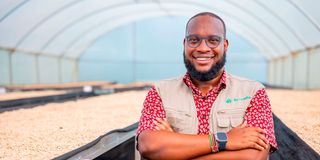
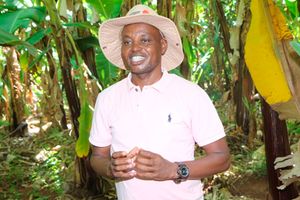
Kenya's agricultural sector is at a critical juncture. Climate volatility, rising input costs and declining arable productivity are forcing farmers to reconsider traditional production methods. Taita Ngetich, the founder of Synnefa and an agritech innovator, is working to establish precision farming as a practical necessity for smallholders navigating climate uncertainty. In this conversation with Margaret Maina of Seeds of Gold , he discusses the economics, limitations and future of smart farming in Kenya.
What inspired the founding of Synnefa, and how has it taken shape over time?
Growing up in Kericho, I saw farming families repeatedly lose harvests due to erratic weather, post-harvest waste, and weak supply chains. That experience pushed me to study Mechanical Engineering at the University of Nairobi, with the intention of building practical solutions for agriculture. I founded Synnefa in 2013 from a university hostel in Nairobi with the belief that African farmers needed better tools to improve productivity and reduce losses. Over time, that single idea has grown into a full agritech platform integrating smart greenhouses, IoT sensors, digital farm management systems, and post-harvest technologies like solar dryers.
Strathmore University Business School Founding Dean Dr George Njenga (left) presents a trophy to Synnefa CEO Taita Ngetich during the Top 40 Under 40 Men Awards gala dinner event held at Serena Hotel in Nairobi on December 5, 2025.
Photo credit: Bonface Bogita | Nation
How does Synnefa’s integrated technology stack improve efficiency and access for smallholder farmers?
Synnefa’s IoT-enabled technology improves decision-making, productivity and market access for smallholder farmers by addressing inefficiencies across the production cycle. Smart Solar Dryers cut drying time from 10 to 14 days to 5 to 7 days and reduce post-harvest losses by up to 45 per cent. FarmShield sensors provide real-time crop monitoring for early detection of risks, while FarmCloud integrates data to support traceability, market linkages and access to finance. Kenyan agriculture is often described as structurally constrained.
What is the real binding constraint?
The binding constraint is information asymmetry. Farmers make high-stakes decisions blind, without reliable feedback from markets, weather systems or advisory services. Our FarmShield sensors have flagged soil moisture deficits days before crop stress became visible, allowing farmers to irrigate early and protect their yields. Multiply that single decision across fertiliser application, pest control and harvest timing, and the difference between a profitable season and a loss-making one becomes clear. What is missing is not just technology, but an integrated system where reliable information flows continuously across the agricultural value chain.
Why does precision agriculture still have low adoption among smallholder farmers?
Adoption remains low because most innovations enter agriculture as finished products rather than growing systems. Farming is iterative and risk-sensitive. A farmer who has survived several seasons using a certain method requires more than evidence to change. It requires trust and risk reduction. The gap persists because adoption has not been sufficiently de-risked at the farmer level.
What is the economic justification for a smallholder investing in IoT-based farming systems?
The economic value of IoT-based farming lies in improving efficiency and reducing uncertainty. Many smallholder farmers lose income through poorly timed irrigation, inaccurate fertiliser application and delayed harvesting, which increase production costs and reduce returns. Even a 10 to 20 per cent improvement in input efficiency can translate into meaningful income gains because profit margins are often thin, while better planning helps farmers manage climate risks and make more informed production decisions.
Synnefa Engineer installs a solar panel to power FarmShield.
Photo credit: Eddy Ashioya | Nation
What is the biggest barrier to scaling agritech ventures in Kenya?
The biggest barrier to scaling agritech ventures in Kenya is the lack of supporting infrastructure. Successful expansion depends on reliable internet connectivity, maintenance networks and local technical expertise. While many agritech innovations perform well during pilot projects under controlled conditions, scaling them nationally is often constrained by fragmented systems and limited support services. Without strong decentralised technical support, many promising innovations struggle to achieve widespread adoption. As agriculture becomes more data-driven, who should own the data generated on farms? Farmers should retain ownership of the data generated on their farms. However, ownership must be accompanied by tangible benefits, including improved access to credit, better market information and more targeted advisory services. When farmers can use their data to make informed decisions and improve profitability, it becomes a valuable asset rather than simply information they possess.
What is actually changing under climate-smart agriculture in Kenya?
Climate-smart agriculture is gradually changing how farmers manage production by encouraging the adoption of irrigation, drought-tolerant crop varieties and digital advisory services. However, much of Kenya's agriculture still depends on rainfall, meaning adoption remains uneven across regions. The sector is therefore in a transition phase, with traditional farming practices increasingly being complemented by modern, climate-resilient technologies.
How realistic is IoT-based farming in rural Kenya today?
It is realistic if infrastructure is viewed as a developing rather than fixed challenge. Connectivity, energy access and technical support are gradually improving, creating opportunities for wider adoption of digital farming technologies. Scaling will ultimately depend on stronger partnerships between telecommunications providers, county governments and the private sector.
Stacy Oyalo and Lynnete Njeri of Synnefa, showing the FarmShield innovation AI-powered farm automation system designed to give precise, real-time insights for crops and environment in this photo taken on October 2, 2025.
Photo credit: Richard Maosi | Nation
What factors influence farmers' willingness to adopt digital agricultural technologies?
Farmers carefully weigh the risks before adopting new technologies. Even when a solution offers clear benefits, many are reluctant to change if it threatens short-term income or food security. Building confidence through consistent results and practical demonstrations is therefore essential to encouraging wider adoption.
How do you measure success for farmers using your system?
Success is measured by consistent production rather than a single bumper harvest. When farmers can accurately predict yields, manage inputs efficiently and reduce seasonal losses, they achieve more stable incomes and are better able to plan and invest in their farms.
Is there a risk that precision agriculture is widening inequality between commercial and smallholder farmers?
Yes, that risk exists where adoption is driven purely by market forces, as better-resourced farmers are normally the first to access new technologies. Inclusive approaches such as subsidised access, cooperative ownership and shared infrastructure can help extend adoption. When designed with equity in mind, precision agriculture has the potential to narrow rather than widen existing inequalities in the sector.
What measures does Synnefa use to ensure inclusion of women and youth in agritech solutions, and what impact has it achieved in this area?
Synnefa designs access pathways that do not assume land ownership or significant capital, recognising that women and youth participate in agriculture through group farming, cooperatives and value addition. Solutions are structured around these entry points to reduce barriers to participation. This has enabled the company to reach more than 21,000 farmers through smart greenhouse systems and over 7,000 through Smart Solar Dryers, working with over 35 enterprises and farmer cooperatives sourcing from more than 32,000 farmers across Kenya, Uganda and Ghana, with about 80 per cent of beneficiaries being women.
Ms Shalom Mbugua, Synnefa Business Development Lead displaying a farm shield, which acts as a brain in a farm to regulate operations, at the Agritech Africa exhibition at KICC.
Photo credit: Sammy Waweru | Nation Media Group
How would you assess the direction of Kenya's agricultural sector?
Kenya has made progress in promoting climate-smart agriculture and digital innovation, but scaling these solutions remains a major challenge. While policy frameworks are increasingly supportive, many farmers still lack the infrastructure, financing and extension services needed to adopt new technologies beyond pilot projects.
How is digital technology reshaping agricultural extension services?
Agricultural extension remains indispensable, although it is often constrained by limited resources and personnel. Digital technologies can strengthen extension services by providing real-time data and improving farmers' access to information, creating a model that combines technology with on-the-ground technical support.
Will automation change the role of farmers in the future?
Automation will enable farmers to make more informed and timely decisions, but it will not replace their knowledge and experience. Successful farming will continue to depend on combining digital tools with local expertise to respond to changing weather, soils and production conditions.