By the end of June next year, the national government will have funded counties to the tune of Sh5 trillion, marking 14 years since the start of devolution.
About a third of the funding would have been allocated to 10 counties that have emerged as the biggest beneficiaries of devolution by far. This sets them ahead of the game in terms of growing their economies and serving their residents.
Since the onset of devolution, they have been allocated Sh1.6 trillion, consistently topping the list of counties receiving the most cash to fund their operations and implement projects as the State applied different formulae to determine who gets what.
The funding is in the form of equitable share of national revenues and additional allocations. Nairobi has received Sh240 billion — the highest amount allocated to any county in the country.
In terms of regional share, however, Northern Kenya counties benefited most. Three counties from the region are in the top 10 list, underlining the role devolution has played in ensuring that marginalised parts receive resources to develop.
Turkana has received funding totalling Sh167.4 billion over the last 14 years, ranking second only to Nairobi. Mandera ranks seventh with total funding of Sh150.5 billion, and Wajir is 10th with Sh129 billion.
Together, the three northern Kenya counties were allocated Sh447 billion, about nine per cent of the total equitable share funding to all the counties.
The amount is close to double the funding for Nairobi, although the combined population of the three Northern Kenya counties was estimated at 2.99 million as at 2025. This is less than Nairobi’s 4.9 million residents, based on the Kenya National Bureau of Statistics (KNBS).
The Western region has produced two of the top 10 counties in resource allocation. Kakamega County was allocated Sh164 billion, ranking fourth, while Bungoma County ranks seventh with Sh140 billion funding since the onset of devolution.
Last year, the two counties had a combined population of 3.9 million people. Their collective funding further proves that the formula used to distribute national resources among counties has focused on different parameters, besides population.
Only Northern and Western Kenya had more than one county in the top 10 list of regions that received the most funding since devolution started.
The Rift Valley region has Nakuru County which was allocated Sh165.7 billion over the 14 years (fourth on the list). At the Coast, Kilifi ranks fifth with total funding of Sh157.3 billion, while Kiambu County represents Central region with funding of Sh157 billion, ranking behind Kilifi, and Kitui.
The latter ranked ninth with an allocation of Sh135.4 billion, is the only county from Eastern region in the top 10 list.
Parliament has allocated a total of Sh5.016 trillion to all the 47 counties in the last 14 years. Sixty per cent of the cash was disbursed in the past seven years.
“Total disbursements to county governments over the last six years (FY 2020/21 through FY 2025/26) amount to Sh2.5 trillion, comprising equitable share of revenue and additional (conditional and unconditional) allocations,” the National Treasury said in its latest public statement on the status of disbursements to the counties.
During the current fiscal year, counties have been allocated about Sh503 billion, being Sh428 billion in equitable share of revenues and Sh75.7 billion in conditional and unconditional allocations, which form much of the funding for their operations.
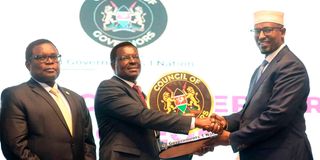
President William Ruto, Governor Gladys Wanga, (left) Council of Governors Chair Ahmed Abdullahi (left), Vice Chair Mutahi Kahiga (2nd right), Senate Speaker Amason Kingi (2nd left), Governor Joshua Sang (extreme left) and PS Devolution Michael Lenasalon (extreme right) unveil the Council of Governors (COG) Devolution Institute Manual during the opening of the Devolution Conference, 2025 at Homabay National School, Homabay County
Photo credit: Photo | PCS
Counties also draw some of the funding for their operations from their own source revenue. By the end of June 2027, the top 10 counties will have spent 32 per cent of the entire funding from the National Treasury.
Based on the Kenya National Bureau of Statistics estimates on population as at 2025, at least 20 million Kenyans live in these 10 counties, which makes up over 37 per cent of Kenya’s population.
The Commission on Revenue Allocation (CRA) has used various formulae to determine the amount of cash that each county receives. The main factors have been population and poverty levels.
In the early years of devolution, 2013/14 to 2016/17, the CRA applied a formula that placed much weight on population. A total of Sh966.5 billion was disbursed through that period.
In the first revenue sharing formula, 45 per cent weight was placed on a county’s population, and 25 per cent on establishing and running the governments (basic equal share).
During the period, counties that got most cash included Nairobi (Sh48 billion), Turkana (Sh39 billion), and Mandera (Sh33 billion).
Counties that received the least funding were; Lamu (Sh7.6 billion), Isiolo (Sh11.4 billion), Tharaka-Nithi (Sh11.67 billion) and Elgeyo Marakwet (Sh12.2 billion).
Under the second formula, which determined the amount of money individual counties got from the national government from 2017/18 to 2019/20, much focus was still placed on a county’s population (45 per cent), followed by the basic equal share (26 per cent), and a county’s poverty levels (18 per cent).
Treasury disbursed a total of Sh932.5 billion through the three years, with Nairobi receiving the most (Sh47.1 billion), followed by Turkana (Sh31.4 billion), and Kilifi (Sh31.2 billion). At the bottom of the allocation was Lamu which received Sh8.6 billion, followed by Tharaka-Nithi and Elgeyo-Marakwet, which each received Sh11.25 billion.
Under the fourth basis of revenue sharing, which has been in place since July last year and will be used until June 2030, focus is on counties’ population which has a 45 per cent weight, followed by equal share (22 per cent), poverty (14 per cent), and income distance (13 per cent).