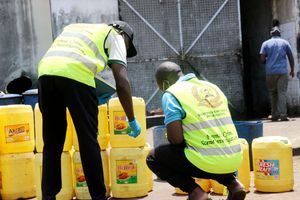
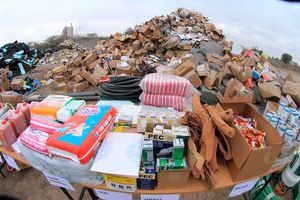
On August 1, the Directorate of Criminal Investigations (DCI) arrested a man suspected to be behind a syndicate supplying counterfeit alcohol to several bars in Eldoret and neighbouring counties.
The man was arrested while driving to a house in Oletepesi in Eldoret, Uasin Gishu County, which the DCI said had been converted to a production and packaging site for counterfeit alcohol.
“Preliminary investigations indicate that the suspect allegedly sources ethanol through the Busia border before processing, packaging and distributing the illicit brews to an established market within Eldoret and neighbouring counties,” the DCI said in a statement.
Two other men believed to be accomplices were also arrested. At the house, police recovered 30 cartons of suspected counterfeit alcoholic drinks and several empty 60-litre jerricans believed to have been used in the operation.
Photo credit: Nation Media Group
Police also found labels for well-known alcoholic drinks, and excise stamps believed to be forged.
On January 19, a multi-agency team in Eldoret’s Pioneer estate seized counterfeit alcohol which would have fetched Sh7.6 million in the open market as the county grows into one of the hubs hosting illegal producers in posh estates.
During the raid, authorities seized 1,103 cartons of gin and 422 cartons of brandy.
And on May 26, 2025, police arrested a man who had allegedly converted a house in Moiben in Eldoret into another production and packaging site.
Several raids by authorities reveal that the manufacture of poisonous substances passed off as legitimate alcoholic brands is no longer exclusive to dingy, dim-lit rooms in the backstreets of urban centres, as criminals behind those syndicates have shifted base to affluent neighbourhoods.
Data from the Anti-Counterfeit Authority (ACA) shows that about 19 per cent of alcohol in the Kenyan market is counterfeit, with the agency investigating over 124 cases in the last three years. Kiambu, Kirinyaga, Murang’a, Nyandarua and Nyeri Counties contributed to 63 of those cases.
Security officers in Embu County seize alcohol suspected to be laced with poisonous chemicals at Kianjokoma town in a past operation.
Photo credit: File
In Nairobi alone, the ACA investigated 29 cases of counterfeiting of alcohol, as 11 investigations were conducted in Eldoret.
With regular patrols seeking counterfeiters and other criminals becoming a hindrance to that section of the black market, its players have turned ordinary rental houses into secret compounding hubs.
A number of Kenyans are unknowingly living next door to illegal chemical mixing operations which are exposing unsuspecting consumers to severe health risks.
The residential shift is not entirely new, revealing a worrying trend over the years.
In residential homes, the black market players seize barrels of industrial ethanol used to mix and create fake brands of the poisonous liquor.
By December 2025, the playbook had evolved further, with the festive season crackdowns uncovering how distributors were completely abandoning commercial warehouses to turn ordinary houses in areas like Maai Mahiu and Kijabe into secret storage and distribution points.
What began years ago as an infiltration of upscale neighbourhoods has now ballooned into a widespread underground housing network that has brought industrial hazards directly to Kenyan doors, producing what is now blamed for taking lives.
“There are also instances where we have discovered people or individuals producing alcohol in the residential areas within the country, and once that happens, it is impractically impossible sometimes to trace the production lines unless members of the public are willing to share with us the information of who is doing this,” said Dr Robi King’a, the Executive Director and CEO of the authority.
About 2 out of 10 bottles of alcohol in the Kenyan market are counterfeit.
Photo credit: Pool
His statement follows the arrest of two individuals who were apprehended after a video went viral showing two individuals refilling alcohol bottles in an untidy environment, which led to an uproar from Kenyans on social media.
The scale of the underground economy is laid bare during multi-agency crackdowns across the capital.
In Nairobi, recent enforcement operations have uncovered major illegal storage and compounding dens in commercial hubs like Eastleigh and Ngara to upscale residential neighbourhoods like Lavington, proving that no level of housing is immune to the dangerous trade.
Over the past 3 years, the authority has seized alcoholic products worth Sh61.37 million.
The authority stated that Nairobi and Eldoret commanded the heaviest financial impact, with Nairobi recording Sh43 million, followed by Eldoret with Sh 7.7 million in 2026.
Enforcement data reveals that this is overwhelmingly a domestic operation rather than a cross-border smuggling issue.
ACA says that out of the alcohol seized, 77 per cent is manufactured locally, 15 per cent is imported from foreign countries, with the remaining 8 per cent originating from unknown sources.
The underground networks, however, have specific types of alcoholic drinks that they target.
Gin leads the market as the most prevalently counterfeited alcohol at 15 per cent, followed by vodka at 10 per cent and craft spirits at 8 per cent.
Government administrators destroy illicit brew.
Photo credit: File | Nation
Rounding out the list are wine at 6 per cent, beer at 6 per cent, whiskey at 5 per cent, rum at 3 per cent, liqueurs at 3 per cent, tequila at 1 per cent, and brandy at 1 per cent too.
The figures illustrate that the criminals disproportionately target clear, high-potency spirits that are easier to compound quickly using raw ethanol and water inside residential kitchens.
Enforcement is further crippled by major structural gaps in how products are monitored from the factory floor to the store shelf.
According to the authority’s lead researcher Henry Maina, most drinks lack an effective track-and-trace system or an easy product authentication mechanism, making the rapid identification of genuine versus counterfeit spirits extremely difficult for both consumers and inspectors.
The National Authority for the Campaign Against Alcohol and Drug Abuse (NACADA) warns that this criminal ecosystem is causing a double public health emergency. It is leading to acute poisoning and chronic organ failure.
Laboratory findings reveal that illicit syndicates are increasingly mixing the drinks with methanol, an industrial solvent that causes blindness and kills at doses as small as 10 millilitres, alongside other industrial chemicals.
“What our labs are finding should concern every Kenyan who has ever bought alcohol from an unverified source,” notes NACADA in a response to the illicit trade.
“We are detecting methanol, not ethanol, the alcohol that is safe to drink—but methanol that can cause blindness and can even kill at doses as small as 10 millilitres.”
Alcohol by volume levels, according to the agency, bear no relationship to bottle labels, leaving consumers to pay premium prices for dangerous dilutions or toxic mixtures.
According to the authority, this is no longer just about petty bootlegging, but rather “a distribution network deliberately built to be invisible, which is expanding into new user groups, including university students and young adults, at an alarming rate.”
Addressing the high-tech shadow economy requires modernising how the state tracks its goods, with Dr King’a noting, “The fake alcohol market has moved from backrooms to e-commerce platforms, which make it easy to move these hazardous products, and so should our enforcement.”