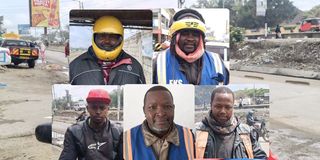
The familiar vroom-vroom of motorcycle taxis commonly known as boda bodas ferrying passengers to and from designated stages in Kajiado County’s satellite towns is a reminder of the growing role of the boda boda sector in Kenya’s economy.
In Kitengela, one of Kajiado’s biggest metropolises, some bikes are being operated by university and college graduates whose academic qualifications have not translated into the formal employment they once hoped for.
With formal job opportunities shrinking and the search for employment becoming increasingly frustrating, the graduates are turning to motorcycle taxi riding to eke out a living.
The Nation interviewed several of them in and around Kitengela, and their stories paint a sobering picture of dashed dreams, hopelessness and the ridicule that comes with abandoning the promise of white-collar careers for the dusty roads and unpredictable earnings of boda boda riding.
Mr Samuel Mwangi Maina, a Bachelor of Science degree in Applied Statistics and Computing from Maasai Mara University graduate on November 12, 2026 .He is boda boda rider in Kitengela town.
Photo credit: Stanley Ngotho | Nation
For Mr Samuel Mwangi Maina, 34, the last seven years have been an uphill battle after graduating with a Bachelor of Science degree in Applied Statistics and Computing from Maasai Mara University. A year later, he obtained a diploma in Technical Trainer Education (Mathematics and Statistics) from the Kenya School of TVET in Gigiri, Nairobi.
The father of three said his efforts to secure formal employment had consistently been met with rejection letters, leaving him with little choice but to ride a motorcycle to earn a living.
“I have no option but to toil to provide for my young family. The biggest challenge in our country is nepotism, where job opportunities are advertised as a formality to hoodwink Kenyans,” said a bitter Mr Maina.
“I have lost count of the applications I have made in the last seven years. When I was growing up, I knew education was the equaliser, but it has dawned on me that this is not the reality,” he said.
Mr Maina earns about Sh1,000 a day, which barely caters for his basic needs. He said it pains him when some pillion passengers look down on boda boda riders, assuming they are illiterate and treating them as though they are worthless.
“Sometimes you have a pillion passenger who treats you badly, assuming you took up the boda boda job because you are a failure in life, not knowing that some of us have degrees at home. It is a painful experience, but I persevere,” added Mr Maina.
“Boda boda riding is challenging work with a lot of risks. Either a job comes my way or, otherwise, I am working on an exit plan. In Kenya, the aged are employed while others hold senior government positions but they advise the youth to seek self-employment. It is the irony of life,” said Mr Maina.
A kilometre from Kitengela town, at Kimalat on the Athi River-Namanga Highway, we caught up with 47-year-old Nicholas Roimen Keeja braving heavy rains and the morning cold of Thursday.
A 2021 graduate of KCA University with a degree in Finance and a CPA(K) qualification, Mr Keeja said he had been riding a motorcycle since 2023, following a two-year stint at the Kajiado East Constituency Development Fund (CDF) offices in Kitengela.
“When a new MP was elected in the 2022 General Election, I lost my job despite my qualifications. I used the little savings I had accumulated to buy a motorcycle and pay the other stage charges through a Sacco to start off,” said Mr Keeja.
Donning a white shirt and black trousers, a heavy jacket and a helmet, Mr Keeja stood out among his colleagues during the brief interview.
The father of four, who also looks after his ageing parents, lamented that he faces ridicule from his colleagues because of his seemingly worthless academic qualifications.
“I cannot even advise my colleagues on the importance of education. They ridicule me, but I have no option but to persevere,” added Mr Keeja, urging the government to create job opportunities for people with genuine academic qualifications.
Mr Alex Njoroge, 24, a Bachelor of Business Information Technology graduate from Embu University, has joined the growing list of graduates eking out a living as boda boda riders in Kitengela town.
Mr Njoroge graduated in September 2025, but, realising that white-collar jobs were not forthcoming, took a leap of faith and acquired a motorcycle on loan.
On a good day, the young graduate said he earns about Sh1,000, enough to cater for his upkeep as he continues making job applications.
To avoid ridicule, he said, he rarely talks about his academic journey. He said it had not been easy, despite his determination, as he grapples with the painful feeling that his academic efforts are going to waste.
“I am still young and optimistic, but it is not easy in a country where corruption is deeply rooted,” he said.
His sentiments were echoed by Obwocha Aondo Benard, a Bachelor of Science (Agricultural Economics) graduate from Egerton University, Njoro Campus, who said society had many imbalances.
Boniface Mbae Katuu a graduate in Theology and Leadership from Focused Optimum College.Works as a boda boda rider in Kitengela town on November 12, 2026.
Photo credit: Stanley Ngotho | Nation
For Mr Boniface Mbae Katuu, 34, a graduate in Theology and Leadership from Focused Optimum College, the high expectations he had after graduating in 2025 have gradually been wearing away.
“I was using my meagre earnings from boda boda riding to fund my college education, but it has not paid off. I had high hopes that my leadership skills would be instrumental in youth-focused faith-based institutions,” said the father of four.
For Mr Edger Kiprotich, 36, the journey into the boda boda industry began in 2016 when he dropped out of Kenyatta University in his third year, where he was pursuing a Bachelor of Commerce degree, due to lack of school fees.
The father of three said his efforts to accumulate enough money to return to school had repeatedly hit a snag due to dwindling earnings in the trade and the growing number of riders.
“First, I acquired a motorcycle on loan, which took me at least two years to repay. I earn so little that I cannot go back to university and complete my course,” he added.
Mr Samson Odhiambo, a graduate of Criminology and Security Studies from Moi University and a boda boda rider in Kitengela town, bitterly said academic papers were not enough to secure someone a job without “connections”.
He noted that the seven years since his graduation had been difficult as he worked as a boda boda rider in Kitengela town.
The father of five said some of his employers offered as little as Sh15,000 a month, less than he could make from the boda boda sector.
“Most employers do not value professionals, offering too little to sustain someone in town. Let the government know that the high rate of jobless graduates is making formal education lose value. Why do you have to spend years in school only to end up as a boda boda rider?” he wondered.
Mr Alex Gitari, chairman of the Kajiado County Boda Boda Association, said at least 30 graduates formed part of the county’s 35,000 registered riders.
He said that although graduate riders were not given any special privileges, they played a pivotal role in the leadership of the different designated stages from which they operated.
“We (the association) try to tap their knowledge in running their respective stages, considering that they are knowledgeable and have a better understanding of issues than their colleagues,” said Mr Gitari.
He added that the association had been pushing for employment opportunities for its graduate members in motorcycle sales and financing institutions, but the companies had yet to respond positively, with some opting for cheaper labour.
“We have been recommending our graduate members for positions in both motorcycle-selling and financing companies, but some of them are reluctant to absorb them, avoiding paying them high salaries. We (the association) are still pushing,” he added.
Mr Gitari said the boda boda sector was not the best alternative employment opportunity for graduates in a country seeking to industrialise.
“Some of these graduates should be manufacturing motorcycles, not riding them to make a living. It is a wake-up call for the government,” he added.
Beneath the disappointment and humiliation, however, there lies a remarkable story of resilience. For these graduates, every journey, every pillion passenger and every shilling earned is a reminder that, despite the odds, they have refused to give up.
Motorcycles used as boda bodas were introduced in Kenya in the late 1990s. However, in 2003, the Mwai Kibaki administration zero-rated import duty on motorcycles, boosting the sector. It subsequently became a major contributor to the country’s economic growth and one of the most popular means of transport.
Data from the National Transport and Safety Authority (NTSA) shows that the number of registered motorcycles in Kenya has increased significantly since 2008.
There are more than two million registered motorcycles in Kenya, while the total number of registered motorcycles in the East African region is estimated at more than five million.