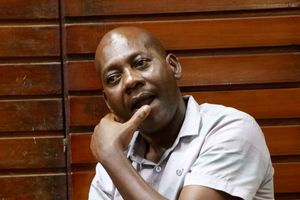
Three years after the Shakahola tragedy shocked the nation, the former home of preacher Paul Mackenzie still stands deep inside the forest where prosecutors say hundreds of his followers starved to death, serving as a stark reminder of a movement whose influence investigators argue has not entirely disappeared.
During a court inspection of Mackenzie’s former Furunzi home in Malindi, Kilifi County, and parts of the vast Shakahola forest, witnesses told the court that some teachings associated with the preacher continue to influence former followers despite years of investigations, arrests and court proceedings.
The inspection formed part of ongoing proceedings aimed at establishing links between deaths reported in Shakahola and later fatalities in Kwa Bi Nzaro forest.
High Court Judge Justice Wendy Kagendo when she visited Shakahola Forest in Malindi Sub-county on June 24, 2026.
Photo credit: Kevin Odit | Nation Media Group
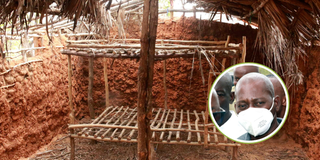
Mackenzie’s semi-permanent three-bedroom house, built of mud and cement and roofed with makuti, remains largely intact despite being abandoned since his arrest in 2023. The house stands in contrast to dozens of other structures in the area, most of which have collapsed or been reclaimed by vegetation.
When Mackenzie arrived at the compound under tight security, he appeared distressed by its condition and complained that his belongings had been stolen.
“They have taken away every valuable thing from my house. They have destroyed here and there,” he told the court.
Prison officers, however, did not allow him to enter the house.
Inside, the court observed a wooden bed in the preacher’s bedroom, an improvised double-decker bed in another room believed to have been used by his children, and scattered clothing that suggested a family once lived there. Nearby sanitation facilities also remained standing, although parts had begun deteriorating.
Prosecutors told the court that the homestead served as the command centre from which Mackenzie oversaw church activities after followers moved deeper into the forest.
Through elders assigned to villages such as Bethania, Bethlehem, Judea, Galilee and Tiro, instructions were allegedly relayed to followers living across the settlement.
Witnesses testified that Mackenzie continued living with his family at the compound while followers were allegedly directed to undertake prolonged fasting that ultimately resulted in deaths.
Less than 10 metres from the house, the court inspected a circular structure enclosed by wooden poles and covered with black nylon sheeting.
“This is where all disputes were handled,” said J.O., a protected witness and survivor of both the Shakahola and Kwa Bi Nzaro incidents.
The witness said followers brought family disagreements and other conflicts before Mackenzie for resolution. He told Justice Wendy Micheni that a dispute between him and his wife, identified as protected witness L.A., had been settled there.
The court also visited the Mitola trees, which witnesses described as a key meeting point within the settlement.
According to J.O., elders moved between villages informing followers of weekly Saturday gatherings held beneath the trees, where sermons were delivered and instructions issued.
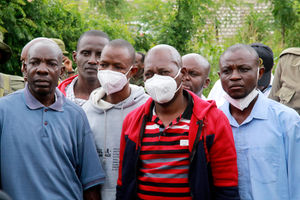
Pastor Paul Mackenzie with his co-accused when High Court Judge Justice Wendy Kagendo visited Shakahola Forest in Malindi Sub-county on June 24, 2026.
Photo credit: Kevin Odit | Nation Media Group
“These leaves form a very good canopy when it rains. We were many people, about 1,000. There were children, elderly men and women,” he told the court.
The witness said at least four homesteads once surrounded the meeting site, though only ruins remain today.
Across the forest, abandoned houses and decaying structures stand as reminders of a community that once housed hundreds of followers.
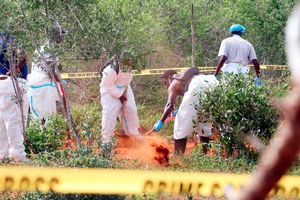
Some former residents are now witnesses or accused persons in court cases linked to the deaths, while many victims whose remains were exhumed from shallow graves are yet to be identified. More than 429 bodies were recovered from Shakahola following investigations that began in 2023.
During the inspection, the court heard that all eight suspects facing charges linked to deaths in Kwa Bi Nzaro had previously lived in Shakahola and attended meetings under the Mitola trees.
“I used to see Sharleen Temba Anindo during these meetings. She was a very nosy person,” J.O. told the court.
The witness identified all eight accused persons and linked them to activities within the Shakahola settlement.
“It is those who escaped arrest in Shakahola who regrouped with the help of Mackenzie and revived the cult activities that happened in Kwa Bi Nzaro forest,” he claimed.
The court was shown locations where several of the accused allegedly lived, including Kahindi Kazungu Garama, Tom Ochieng Mkonwe, also known as Thomas, Julius Thuva Luwali, Johnson Gona Richard and James Kazungu Kahindi, alias Ponda or Baba Bura.
According to testimony presented before the court, the accused interacted regularly with other followers and maintained homes within the settlement.
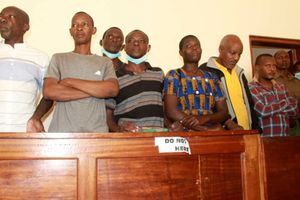
Pastor Paul Mackenzie (centre) with his co-accused at Kwa Binzaro area in Malindi Sub-county when High Court Judge Justice Wendy Kagendo visited Shakahola Forest June 25, 2026.
Photo credit: Kevin Odit | Nation Media Group
Prosecutors are relying on the evidence to establish continuity between the Shakahola deaths and those later reported in Kwa Bi Nzaro, arguing that individuals who escaped the initial crackdown regrouped and revived the same radical teachings.
J.O. told the court that he lived in Tiro village with his wife and six children before leaving the forest in January 2023 after a fasting order was issued.
“I left the forest towards the end of January 2023. A fasting order had been issued,” he said.
He also alleged that Garama frequently acted as master of ceremonies before inviting Mackenzie to address followers during meetings.
The court further visited the former home of Kahindi and his wife, Dhahabu Kabwere. Witnesses testified that the couple lived there with their five children, who remain unaccounted for.
The court heard that the first adult death recorded in the forest occurred at the homestead. The deceased, Raymond Katana, was Kahindi’s nephew.
Area Chief Raymond Charo testified that he issued a burial permit after being informed that the death resulted from natural causes.
The site visit began at Lango Baya Police Station before proceeding to the former Shakahola command centre, which has since been converted into a police camp.
The camp, staffed by about 20 officers on monthly rotations, secures the 4,860-acre section of Chakama Ranch that was declared a crime scene after the discovery of hundreds of bodies linked to Good News International Church.
Inspector Geoffrey Koros, who heads the camp, told the court that officers are responsible for preventing unauthorised access to the area.
He said Kwa Bi Nzaro was outside the camp’s original jurisdiction but officers were deployed there after reports of deaths emerged.
Pastor Paul Mackenzie follows proceedings when High Court Judge Justice Wendy Kagendo visited his homestead within Shakahola Forest in Malindi Sub-county June 24, 2026.
Photo credit: Kevin Odit | Nation Media Group
The inspection is intended to help the court better understand the evidence and determine whether there are links between the Shakahola deaths and those later reported in Kwa Bi Nzaro.
Mackenzie, Anindo and four others are charged with 23 counts of murder as crimes against humanity in connection with the deaths of 23 children between January and October 2025.
The other accused are Garama, alias Mlewa, Mkonwe, Thuva and Richard.
In alternative counts, they face charges of murdering the same victims named in the main charges.
Two other suspects, Charles Mutua Musee, alias Mzee Mutua, and Kahindi face separate charges as accessories after the fact.
Musee is accused of harbouring Thuva at his home in Kanyaa Village, Mwingi Sub-county, knowing he had allegedly committed murder and helping him evade arrest.
Kahindi is accused of helping Anindo, Garama and Mkonwe evade arrest in Mombasa between July 19 and 21, 2025. All the accused have denied the charges.