In Luo culture, it is customary for a man—particularly the firstborn son—to construct a house known as simba within his father's homestead.
Traditionally, the eldest son’s simba is built to the right of the father's house (or the first wife’s house in a polygamous home), while the second-born builds to the left.
Historically, these simba dwellings were simple mud huts with grass-thatched roofs, and over time they evolved into more permanent structures.
However, they were still considered temporary until a man established his own homestead locally known as goyo dala , on land allocated by his father. Goyo dala marks a key rite of passage into adulthood and independence in the Luo community.
But former Prime Minister Raila Odinga, a longtime advocate for preserving Luo traditions, is now calling for this cultural practice to be abandoned.
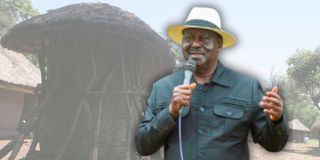
ODM leader Raila Odinga in Kisumu County on June 26, 2025.
Photo credit: Alex Odhiambo | Nation
Mr Odinga argues that the tradition has led to scattered homesteads, complicating efforts to develop essential infrastructure such as roads, electricity, water and healthcare in rural areas.
Speaking in Kisumu during a meeting with leaders from Nyakach including members of the Luo Council of Elders, clergy, elected officials led by Governor Anyang’ Nyong’o, his deputy Dr Mathew Owili and other professionals, Mr Odinga advocated for a paradigm shift.
“What we must do as a community is reflect critically on goyo dala and embrace more dignified, modern housing. Our elders must initiate this dialogue. Let us learn from countries like South Korea, Malaysia and Singapore,” he said.
Mr Odinga proposed a community-based model where families live together in clustered homesteads, strengthening family bonds while enabling more efficient delivery of public services.
The ODM leader noted that it is far easier to install critical infrastructure such as electricity, water and hospitals in consolidated communities than in scattered rural settlements.
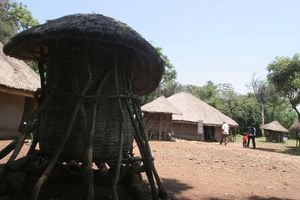
A traditional Luo homestead at the National Museums of Kenya in Kisumu.
Photo credit: Tom Otieno | Nation Media Group
“In earlier times, the population was small and land was abundant. That is no longer the case. Rather than subdividing land endlessly, we should designate central zones for housing while preserving the rest for agriculture and amenities,” he remarked.
He expressed concern over what he described as “rural slums,” visible from the air attributed to poor planning and unchecked land fragmentation.
Mr Odinga has extended his advocacy beyond the Luo community, championing integrated living as a national imperative.
During the burial of Mzee Gideon Baya Mung’aro, father of Kilifi Governor Gideon Mung’aro, in Dabaso, Kilifi County, he cited the inefficiencies of inherited land division as a national challenge. He illustrated the issue with a hypothetical:
“A father with 20 acres of land bequeaths it to four sons each receiving five acres. Over generations, these plots shrink and eventually become too small to accommodate even basic infrastructure. Under an integrated housing model families would live in planned communities with access to playgrounds, shops and clean water all within a shared compound,” he said.
Mr Odinga has emerged as one of the strongest proponents of President William Ruto’s Affordable Housing initiative, which seeks to provide sustainable housing solutions across Kenya.
“We must move away from generational land fragmentation. It is no longer viable and we should support the government's efforts to create affordable, integrated housing where diverse people live together with access to shops, swimming pools and play areas,” he said.
However, he said that such a shift must be matched by government investments in education, employment and healthcare.
“People must have access to jobs and markets to generate income. Without this, they cannot afford mortgage payments,” he cautioned.
Chief Officer for Physical Planning, Housin and Urban Development in the Kisumu County Government, Victor Kanyaura, endorsed the idea, citing successful models in Kericho’s tea estates.
There, workers live in consolidated quarters, enabling efficient delivery of water and electricity while preserving land for farming.
Mr Kanyaura noted that clustered housing not only reduces infrastructure costs but also fosters communal living.
“This enhances unity and shared meals, which are integral to African culture. Muslims already practice this model, and it works,” he said.
But still, not everyone agrees. Some critics warn that clustering families could lead to overcrowding, especially given Kenya’s rapidly growing population.
Despite such concerns, the Chairman of the Luo Council of Elders, Ker Odungi Randa, supports the proposed shift.
“Many are already embracing thi including prominent members of our community. With time, even rural villagers will recognise its benefits,” he said.
He added that constructing storeyed buildings within family compounds allows different family units to live independently while conserving space and promoting cohesion.