Leone Frank Doso still remembers the nights when Kisumu’s nightlife had a heartbeat you could feel from the doorway.
Back then, the music pulled people onto their feet, onto a shared stage of rhythm, style and carefree abandon. For him and many others of his generation, the dance floor was not just part of the club but the reason to go out.
At Club Basement better known as Area 51, Doso found his rhythm, his confidence and sometimes even his company for the night. Dressed sharp, moving with ease and surrendering to the pulse of Afro-benga and soul, he belonged to an era when dancing was the main event and everything else followed.
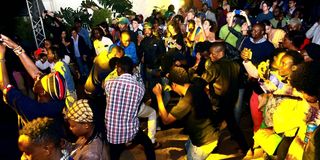
Fans on the dance floor at Backyard club.
Photo credit: File
Today, as Kisumu’s nightlife transforms under the glow of VIP sections, bottle service and tightly packed seating, that once-vibrant space for movement is quietly fading and is taking with it a culture that defined a generation.
“The dance floor was where we found our groove. At Basement, we danced, let go and we forgot every trouble in the world. That is where I first danced with a lady what a moment. I truly miss that experience,” Doso reflects.
Those unforgettable afternoons stretching from 1 pm to 6 pm belonged to the young and the free, while night-time revelry was reserved for a more mature crowd.
Sharing in those golden escapades was celebrated Afro-benga sensation Stanley Omondi, popularly known as Apesi, who also thrived under the shimmering lights of Area 51.
“I made so many friends there. In those days, women wanted the sharpest dresser and the smoothest dancer. I was both,” he says with a cheeky smile.
Veteran journalist Fred Madanje is equally swept by nostalgia as he recalls another jewel of Kisumu’s nightlife, Club Royale.
An aerial view of Kisumu City.
Photo credit: Alex Odhiambo | Nation Media Group
Situated in the heart of the CBD where Kisumu Hotel now stands, Club Royale was once the crown jewel of evening entertainment. Its discotheque boasted one of the most enchanting dance floors in the lakeside city, with massive mirrors lining the walls, reflecting every spin, every step, every flourish.
“Club Royale’s dance floor was heavenly. The jam sessions were electric, groovy and unforgettable. From 6 pm, they played love songs until about 7.30pm and romance blossomed right there on that floor,” Madanje remembers.
For decades, the dance floor was the great equaliser in a space where strangers became acquaintances, music dictated movement and status dissolved into rhythm.
Across Kisumu, beyond Royale and Area 51, venues such as Kimwa Grand Hotel, Signature, Grills and Tamies all boasted vibrant dance floors. In Nairobi, revellers still reminisce about Florida 2000, Secrets Lounge, and Bettyz where the night belonged to movement and music.
Whether in dimly lit underground joints or polished high-end establishments, the dance floor was once the nucleus of nightlife.
Today, however, that communal space is quietly shrinking, if not vanishing altogether.
In its place, tightly packed tables, plush seating and exclusive VIP sections now dominate many entertainment joints reshaping not only club architecture but the very culture of going out.
A walk through contemporary venues in Kisumu, Nairobi and beyond reveals a transformed landscape of couches and high tables crowding the floor, leaving little or no room for free movement.
Jeffrey Victor Obonyo, a frequent reveller in Kisumu, believes earlier clubs struck a better balance between dance space and seating.
For many enthusiasts, the disappearance of the dance floor marks a loss of authenticity. The communal spirit that once defined nightlife is giving way to a more fragmented, transactional experience, where patrons often remain seated, eyes fixed on their phones rather than the music around them.
Nelly Maina, a reveller from Nairobi, remembers dance floors not just as social spaces but as arenas of vitality.
“One could dance and stay awake instead of blacking out as happens nowadays. The more you danced, the more you drank water and stayed sober. We were fitter then, unlike now,” she says.
To her, the dance floor embodied the true meaning of release, far removed from today’s nights of lingering hangovers and aching backs from stiff seats.
For Peter Obiene, safety also plays a role in the shift.
“In the past, there were fewer cases of drink spiking. We could leave our drinks and head to the dance floor without worry. Now you cannot risk it unless you trust someone to watch over it,” he observes.
Today, he says, many simply nod along to music from their seats, singing quietly rather than surrendering fully to the dance.
The Murbs building on Makasembo Road in Kisumu that houses Club Signature.
Photo credit: File | Nation Media Group
Club operators increasingly view space through a commercial lens as every square metre must now generate revenue. A dance floor, though culturally significant, offers little direct return. Tables, on the other hand, can be reserved, priced and monetised.
Bottle service, minimum spend requirements and exclusive seating arrangements also promise predictable and often higher profits.
Bob Onyona, Director of Alleyways Beer Garden, acknowledges the shift.
“Dancing has largely been replaced by bottle sections. People want to be seen buying premium drinks, arriving with lights and captured in photos and videos,” he explains.
He notes that historically, cover charges justified expansive dance floors. “You could enjoy the night even with a single soda. Now, even when there is a cover charge, it is often redeemable for drinks. It is about controlling idlers and maximising sales."
Brenda Akinyi, Director of Canopy Club, shares similar sentiments alluding to generational change.
“The dance culture is no longer there. The new generation, especially Gen Z, has a different vibe. Clubs now hire dancers to entertain revellers instead of dedicating space to a dance floor,” she says.
Vester Edwin, popularly known as DJ Ves, recalls advising a venue to replace its dance floor with tables.
“People are more comfortable dancing near their tables among familiar faces. A dance floor today is seen as attracting people who come for fun but do not spend. Modern clubs are sales-driven and the dance floor works against that,” he explains.
He also notes that restricting dancing to smaller controlled spaces can reduce incidents of inappropriate behaviour.
Music itself has evolved in response. DJs who once curated sets to keep dancers busy now cater to a more passive audience.
Gordon Omondi, known as DJ Gordo the Guru, describes many modern clubs as “souped-up bars”.
“For me, real dancing now lives in concerts. In clubs, you have to balance the vibe with alcohol sales. That is the reality,” he says.