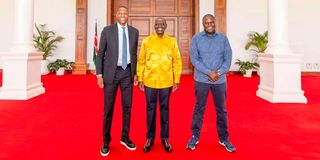
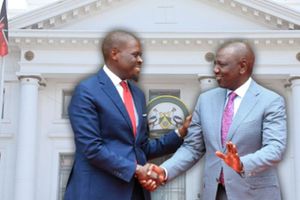
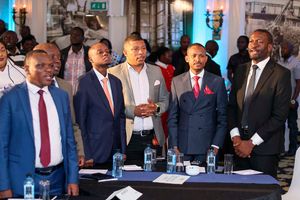
Public dressing-down doesn’t come any worse than when the country’s president lectures you on your clothes in front of visitors who have flown for more than 15 hours for the occasion.
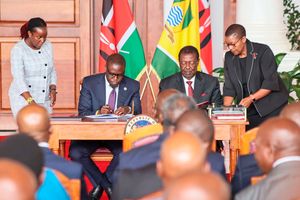
That is what Nairobi Governor Johnson Sakaja went through at State House on April 10, where an agreement was signed between US-based Zaria Group and Kenya Railways Corporation regarding the development of a sports and entertainment hub in Nairobi.
It is telling that Mr Sakaja did not feature in any of the photos Dr Ruto shared on X after the event.
“Looking at the people who have come for this occasion, including the governor of Nairobi, I was asking myself whether they are here by design or they were waylaid,” the President said.
“The way they are dressed, they don’t look like they knew they were coming to State House. Next time, I’ll ask the people at the gate not to allow people dressed this way, especially when they are coming for a serious function.”
The President went on to apologise to American ex-basket player Masai Ujiri, the co-founder of Zaria Group, for the apparent wardrobe malfunction.
“Ujiri, I want to tell you that the manner of dressing of these people has no indication about the seriousness of the occasion. We take this event very, very seriously,” Dr Ruto said.
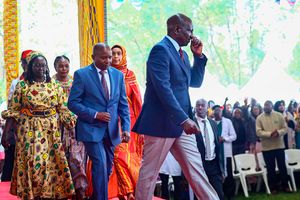
The remarks left many scratching their heads on the ideal way to dress when visiting the House on the Hill.
Former journalist Wanjohi Githae, now a public communication director at State House, told the Saturday Nation that there aren’t laid out rules; concurring with our suggestion that dressing is supposed to be a way of according the country’s seat of power the respect it deserves.
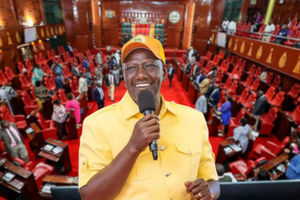
The closest one comes to a laid-down official dress code in Kenya is from a ruling by National Assembly Speaker Moses Wetang’ula in November 2023, which is available on the Parliament website.
Nairobi City County Governor Johnson Sakaja during an interview at his residence in Nairobi on February 14, 2026.
Photo credit: Wilfred Nyangaresi | Nation Media Group
In the 14-page ruling that discussed if a Kaunda suit should be allowed as acceptable dressing, he rejected the idea and laid out what is admissible.
“A proper dress for men means a coat, collar, tie, long-sleeved shirt, long trousers, socks and shoes or service uniform. For the ladies, business, formal or smart casual wear applies,” Mr Wetang’ula said as he referred to the Speaker’s rules.
Parliament is one of the places what one puts on is closely monitored, and every so often debates arise on the manner or dressing of a member.
Security officers at the gates are known to deny entry to anyone who is “improperly” dressed. Courts too have such rules.
Former Nyamira senator Kennedy Okong’o Mong’are told the Saturday Nation that all this is because Kenya borrows from the Commonwealth traditions on dressing.
One was in March when Senior Counsel Nelson Havi appeared in court in green overalls, reminiscent of what Argentinian revolutionary Ernesto Che Guevara used to wear. Mr Havi was kicked out for being improperly dressed.
Another was in June 2024 when President Ruto ordered Kikuyu MP Kimani Ichung’wah to remove his left hand from his trouser pocket.
“There are mannerisms and etiquette respective of the closeness you have to power; to keep the status of the offices,” said Mr Mong’are, who is also a lawyer and author.
“When you are going to sign documents in an official capacity involving many partners, you need to be formally dressed,” Mr Mong’are said.
“It was out of order for the governor to go to State House dressed that way yet he was transacting business in his official capacity as the chief executive of Nairobi County.”
“It depends on the event. If it is an official function at State House, you must be formally dressed,” Mr Mong’are said.
“If it’s a dinner, there’s a dinner dress code.”
He added that when President is assenting to documents like Bills of Parliament, the Speakers and clerks are formally dressed.
“Even the President is formally dressed on such occasion, unless it is on a weekend,” he said.
Mr Mong’are recalled a failed effort by then-Chief Justice Willy Mutunga to Africanise the garments worn in court some years ago.
“We are a British model and have not yet customised,” the former senator added.