The growing presence of tractors and other motorised vehicles in Lamu Old Town is raising questions about enforcement of heritage protection rules, as traditional donkey operators also complain that the machinery has taken over their cargo transport business and threatens their livelihoods.
The development has exposed the delicate balance needed between the demands of a growing economy and the need to preserve the historic settlement's centuries-old transport culture, which has relied predominantly on pedestrians, donkeys and dhows.
Omar Bwana, an 80-year-old pioneer heritage conservationist, is among those unhappy with the changing transport landscape.
Mr Bwana recalls the August 2015 directive by the County Government of Lamu, under Governor Issa Timamy, banning automobiles from operating within the Old Town to protect the Unesco World Heritage Site.
A private tractor is parked while loading mangrove poles on the Lamu Old Town seafront in this photo, taken on November 15, 2026.
Photo credit: Kalume Kazungu | Nation
At the time, strict restrictions allowed only three essential government vehicles: an ambulance, a fire engine and a municipal garbage tractor. The measures were intended to preserve the historic Swahili settlement's quiet, walkable character and its traditional donkey-and-dhow transport system. But the situation has changed, with private tractors joining government vehicles.
“I feel these vehicles are actually testing Lamu's heritage rules in modern times, forcing a reckoning between fast modern hauling and preserving a fragile living monument. Something needs to be done urgently,” says Mr Bwana.
He remembers a time when Lamu Old Town was peaceful, with no cars, just footsteps along narrow lanes and donkeys carrying loads, preserving the traditional walking culture. Today, he says, noisy tractors, vehicles and even motorcycles have taken over the streets.
"Yes, we accept that Lamu Old Town has grown and changed in recent years, but tractors and other vehicles operating within it must be regulated. In fact, they must have their own designated stage and be kept completely out of the heritage town centre and central business district," says Mr Bwana.
According to the Lamu Municipality, nine tractors operate on the island. Three belong to the municipality, while the other six are privately owned.
The Nation also observed the presence of two double-cabin pickups on Lamu Island, both owned by private citizens, mainly business people.
A private tractor is parked while loading mangrove poles on the Lamu Old Town seafront in this photo, taken on November 15, 2026.
Photo credit: Kalume Kazungu | Nation
Traditional donkey operators, whose existence is part of Lamu’s heritage, complain that their livelihoods are being undermined. The dispute pits the convenience and speed of mechanised transport against cultural preservation, heritage protection rules and the economic survival of families who depend on working donkeys.
Donkey owners said their animals had for decades been hired to transport the stones and sand used to build the town, providing them with an income to support their families and educate their children.
Mohamed Fahmi, a donkey owner from Gadeni, said the arrival of tractors is taking over their work, destroying their main source of livelihood and pushing them out of business. He complained that county and privately owned tractors are increasingly encroaching on the island's traditional transport business.
“Today, people who need cargo moved are secretly colluding with municipality tractor drivers behind our backs. Instead of paying donkey owners at least Sh5,000 to ferry their building materials to a construction site, these tractor drivers undercut us by taking just Sh2,500 to speedily haul the same load. Worse still, there are times they even do it for free just to help builders move their materials, leaving those of us who depend on donkeys with no work at all,” said Mr Fahmi.
Mr Omar Athman, another donkey owner, said the absence of proper footpaths forced them to share the narrow streets with heavy machinery.
“Many times, speeding tractors have hit our loaded donkeys, leaving the animals injured and ruining our livelihood,” said Mr Athman.
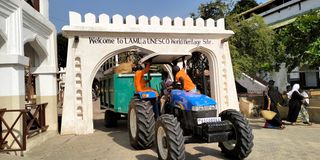
A tractor moving within Lamu Old Town seafront on November 15, 2026.
Photo credit: Kalume Kazungu | Nation
The donkey operators want the county government to explain the specific duties assigned to municipal tractors and how their operations are regulated.
Lamu Municipal Manager Abdulswamadu Ali Abdallah, however, described the municipal tractors as essential multi-purpose assets for daily service delivery.
Mr Abdallah said that, besides their primary role of collecting garbage and transporting it to designated dumpsites on the island, the tractors were regularly deployed to support the community. Their duties include distributing relief food, delivering firewood to local schools, churches and mosques, and providing emergency humanitarian assistance when needed.
Mr Abdallah said that although the municipality allowed the privately owned tractors to operate on the island, their movements were restricted outside protected areas of the Lamu Old Town's Unesco World Heritage Site.
“Let it be clear that those six private tractors are prohibited from operating inside the Lamu Old Town Unesco World Heritage Site, where motor vehicles aren't allowed. Yes, they may only pick cargo from designated seafront points and ferry it to outer areas like Kashmir, Kandahar, Bombay, Wiyoni, and as far as Mararani and Matondoni, but not enter the Old Town central business district,” said Mr Abdallah.
The Municipal Manager, however, acknowledged that his office currently lacked an active law or bylaw empowering it to arrest and prosecute private tractor and vehicle owners who breach heritage protection rules.
“However, we've gazetted draft bylaws and submitted them to the County Assembly. Once passed and published into law, the municipality will have the legal authority and upper hand to arrest and prosecute anyone violating heritage regulations in town,” said Mr Abdallah.
A tractor stationed along the Lamu Old Town seafront on November 15, 2026.
Photo credit: Kalume Kazungu | Nation
On complaints that tractors were taking over the donkey transport business, Mr Abdallah said some builders requested the services of municipal tractors to ferry cargo to distant locations that donkeys could not reach. He said such requests were subjected to vetting and approval by the municipality.
“Our town has grown, and we must accept that change. The municipality works with the community to drive development. Sending municipal tractors to haul heavy construction cargo from town to distant areas, work donkeys cannot handle, causes no harm and supports the growth we all see,” he explained.
Dr James Gichiah Njogu, the Acting Secretary General and CEO of the Kenya National Commission for UNESCO (KNATCOM), said development in the wider Lamu region could complement the World Heritage Site by attracting more visitors while supporting heritage preservation.
KNATCOM is a Kenyan state corporation mandated to promote Kenya's national interests within UNESCO and coordinate the organisation's programmes and activities in the country.
Dr Njogu noted that prominent architectural heritage sites around the world were located within major cities, surrounded by urban settlements and economic activities, including industries.
He said Lamu Old Town's Outstanding Universal Value was anchored in its unique Swahili architecture, historic urban fabric, cultural traditions and living heritage.
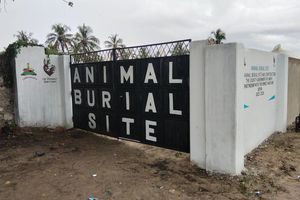
The main gate to the Donkey Sanctuary in Lamu Island, also referred to as Lamu Donkey Hospital, on November 15,2026.
Photo credit: Kalume Kazungu | Nation Media Group
Traditionally, movement within the Old Town has been predominantly pedestrian, with donkeys serving as the principal mode of transport, a practice that, according to Dr Njogu, has remained largely unchanged to date.
“Activities capable of affecting the site's authenticity, integrity or cultural character require careful management and oversight by the responsible authorities,” he said.
Dr Njogu reiterated that Unesco promotes sustainable development compatible with the conservation of World Heritage properties.
“With regard to tractors and other motorised vehicles, the general conservation principle is that activities within the World Heritage property should be carefully regulated and managed so as not to damage historic structures, public spaces, cultural landscapes, or undermine the site's authenticity and integrity,” said Dr Njogu.
He explained that the movement of tractors and other vehicles in the wider Lamu area was not inherently problematic, provided they used designated access routes, remained within approved project areas and complied with applicable environmental, heritage conservation and planning requirements.