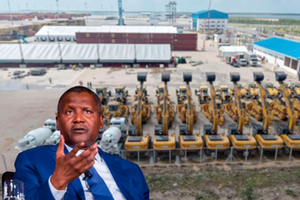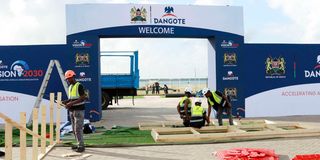
Preparations for the groundbreaking ceremony of the East African Refinery in Lamu, Kenya, on September 29, 2026.

Kenya is today set to break ground on a Sh2 trillion oil refinery in Lamu, a project designed to match the capacity of Africa’s biggest single-train refinery and reposition the country as a regional fuel-processing hub.
The refinery, whose estimated cost is equivalent to about 12 per cent of Kenya’s 2025 nominal gross domestic product of Sh17.58 trillion, is expected to process 700,000 barrels of crude oil a day when completed. President William Ruto is expected to preside over the groundbreaking ceremony at Lamu Port, with the project’s promoters seeking to replicate in East Africa the industrial and energy impact of the Dangote Petroleum Refinery in Lagos, Nigeria.
The scale of the Kenyan project came into sharper focus last week when Dr Ruto toured the Dangote refinery at the invitation of Dangote Group president and chief executive Aliko Dangote.

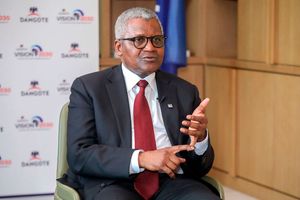
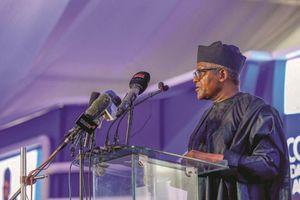
The founder and President of the Dangote Group, Aliko Dangote, during an interview at JW Marriott Hotel Nairobi on Tuesday, September 29, 2026.
Stretching along the Lekki coastline, the Nigerian facility has a crude distillation capacity of 700,000 barrels a day and produces more than 100 million litres of petrol, diesel and aviation fuel daily, according to the President.
Dr Ruto also highlighted the supporting infrastructure behind the Nigerian operation, including 120 kilometres of subsea cables and pipelines used to transport crude oil from ships to the refinery.
The Lamu facility is planned on a similar scale. If completed as proposed, it will be East Africa’s largest refinery and will supply petroleum products to Kenya and neighbouring markets, including Ethiopia, Uganda, Tanzania, South Sudan and Burundi.
The project is expected to reduce Kenya’s dependence on imported refined petroleum products while creating a regional processing hub and strengthening energy security.
Its promoters also envisage crude supplies from Kenya’s exploration fields and neighbouring producers such as South Sudan, potentially linking producers, transport infrastructure, refining and regional markets in a broader East African energy value chain.
Construction is expected to take between 30 months and four years after today’s groundbreaking, meaning the project remains at the development stage even as the Lagos refinery is already operating at commercial scale.
Sh2.6 trillion
The difference is significant. The Dangote refinery was developed at an estimated cost of $20 billion, about Sh2.6 trillion, while the proposed Lamu refinery is valued at about Sh2 trillion, or $16 billion.
Both projects, however, are built around the same broad objective: increasing domestic refining capacity and reducing reliance on imported fuels.
In Nigeria, the Dangote refinery has begun supplying petrol to the domestic market while exporting refined products to other African countries and European markets. The facility has also grown into a wider industrial complex supported by a 435-megawatt power plant and extensive pipeline infrastructure.
Kenya expects the Lamu project to generate similar economic spillovers. Projections indicate up to 60,000 direct and indirect jobs during construction and operations, while related industries could include petrochemicals, fertiliser production, chemicals, packaging and manufacturing.
Dr Ruto has said the refinery will be central to transforming Kenya’s petroleum industry, improving fuel reliability and security, supporting industrialisation and creating jobs across the region.
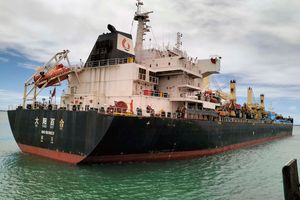
The first visible signs of mobilisation emerged over the weekend when the vessel MV Da Yang Bai He docked at the Port of Lamu carrying more than 2,900 metric tonnes of construction and project cargo.
The arrival marked a key logistical step ahead of full construction and gave a physical dimension to a project that has largely existed in plans and investment projections.
The Lagos comparison is central because its refinery shows how such facilities can anchor wider industrial activity.
Kenya’s project is similarly being positioned as an integrated petroleum and petrochemical hub that could attract manufacturers, energy-intensive businesses and logistics services to Lamu while strengthening the port’s economic role. Its regional potential is significant, given neighbouring countries’ reliance on imported refined petroleum products.
The Kenyan venture also draws heavily on expertise used to develop the Lagos refinery.
Engineers India Limited (EIL), the Indian state-owned engineering consultancy involved in the Dangote refinery, has been awarded a contract worth more than $450 million, about Sh58 billion, to act as Project Management Consultant and Engineering, Procurement and Construction Management consultant for the Kenyan refinery and petrochemical complex.
Lekki Free Zone
EIL said its appointment was based on its experience at the Lekki Free Zone, where it worked as both a project management and EPCM consultant during the construction of the Dangote refinery and is involved in its planned expansion.
The Kenyan plant is being designed as a greenfield refinery and petrochemical complex capable of processing 700,000 barrels of crude oil daily and handling a broader basket of crude oils.
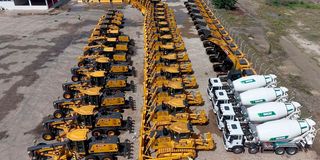
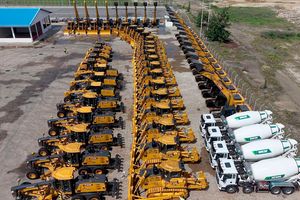
Equipment on site at the Lamu Port on September 28, 2026 ahead of the Dangote East Africa Refinery groundbreaking ceremony set for September 30.
EIL said the project would help meet growing regional demand for petroleum products, reduce dependence on imports and improve energy security while creating capacity to supply international markets.
“Believing in EIL’s engineering and project management excellence, the Dangote Group has once again joined hands with EIL in this endeavour,” the company said.
The Indian firm said the contract reflected Dangote’s confidence in its ability to deliver projects of exceptional scale and complexity, adding that it would deploy its multidisciplinary expertise and global execution model to the Kenyan venture. The choice of EIL underscores the extent to which the Lamu project is being modelled on the Lagos experience.
Technical and project-management expertise used on the Nigerian refinery is now being brought to Kenya as Dangote seeks to reproduce the industrial ecosystem built around its West African operation.
The Nigerian refinery itself is not standing still. It has reached its original operational benchmark and plans to expand its processing capacity to 1.4 million barrels a day by 2029. For Kenya, the proposed refinery therefore represents both an infrastructure investment and an attempt to build a new regional energy value chain. Its success will depend on the delivery of a project that is still at the development stage, even as preparations for construction move into a more visible phase.
Dr Ruto, after visiting Lagos, described the Dangote refinery as evidence of what governments, private investors and financial institutions can achieve through cooperation. He said the benefits of the Lamu project would extend beyond fuel production, with spin-off industries expected to emerge around fertilisers, chemicals and packaging.
After today’s groundbreaking, the next phase will shift attention from the scale of the proposal to construction, financing, infrastructure delivery and the eventual ability of the refinery to supply Kenya and regional markets at commercial scale across the wider region.
Follow our WhatsApp channel for breaking news updates and more stories like this.