After a decade in the classroom, shaping young minds in Lamu, 35-year-old Christine Agutu is stepping onto a very different stage: the often-combative arena of trade union politics.
For 10 years, Ms Agutu has taught Biology and Chemistry at Lamu Girls’ Secondary School, her first and only posting since joining the profession in 2016. Now, she is trading chalk for leadership, mounting a bold bid for the top seat in the Kenya Union of Post Primary Education Teachers (Kuppet), a position that has long been dominated by men.
In doing so, she is taking on a formidable opponent Emuhaya MP Omboko Milemba in a race she says is about redefining leadership and restoring the voice of the ordinary classroom teacher.
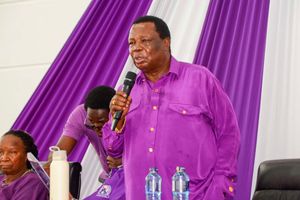
Kenya Union of Post Primary Education Teachers (Kuppet) National Chairman Omboko Milemba.
Photo credit: File | Nation
“I am not just vying to win a seat. I am vying to change how leadership in the union works to make it responsive, present and grounded in the realities teachers face every day,” she told Nation during an interview.
Ms Agutu’s decision to run did not come overnight. It was born out of years of observation, frustration and, ultimately, conviction that teachers deserve better representation.
Currently serving in Job Group C4, she has witnessed what she describes as a growing disconnect between union leadership and the everyday struggles of teachers.
At the heart of her campaign is a strong critique of the current leadership structure particularly the dual roles held by the incumbent chairperson.
“By constitutional right, the chairperson is the leader of the delegation and must be fully present. That office should be a top priority. But the current holder is a Member of Parliament, an official in a political party, and serves in multiple parliamentary committees. That raises serious questions about availability and focus,” said Ms Agutu.
Her concerns intensified last year when Kuppet amended its constitution to allow State officers elected into union leadership to serve on a part-time basis.
“That amendment effectively turned the union into a side hustle. Teachers deserve a leader who is fully committed not one who is juggling multiple powerful offices. I am challenging the status quo,” she said.
However, breaking into union politics has not been easy or cheap.
Ms Agutu reveals that she paid Sh500,000 as a nomination fee to contest for the national chairmanship, in addition to Sh50,000 at the branch level in Lamu, where she also vied for the Gender One representative position.
“For a classroom teacher, that is a huge amount of money. I had to fundraise from friends, family and well-wishers just to get on the ballot,” she said.
She believes the high nomination fees were deliberately introduced to lock out new entrants and protect entrenched leadership.
Teacher Christine Agutu in class at Lamu Girls’ Secondary School.
Photo credit: Pool
“But I refused to be intimidated. If no one else was willing to challenge the system, then I would,” said the Biology and Chemistry teacher.
Her campaign has already taken her across the country from the Coast to Central, Rift Valley and Nyanza regions —and she is now targeting Eastern and North Eastern Kenya. Backed by a small team of four teachers, she has also turned to social media platforms including WhatsApp, Facebook and X to amplify her message.
Her goal is simple but ambitious: to ensure that teachers in all of Kenya’s more than 9,000 secondary schools know that one of their own is in the race and a call for better deals.
Central to Ms Agutu’s platform is the push for better working conditions, particularly in collective bargaining agreements (CBAs).
She takes issue with the recent non-monetary CBA signed by Kuppet, which she says failed to deliver meaningful financial gains for teachers.
“The headline’s said teachers were smiling all the way to the bank. But in reality, the increment was barely Sh25. That is not something to celebrate,” said Ms Agutu.
She contrasts this with what she describes as a stronger deal negotiated by the Kenya National Union of Teachers (Knut), questioning whether Kuppet leaders exercised due diligence before signing the agreement.
“Did they read the document thoroughly? Were they keen on the details? These are questions teachers are asking,” she says.
Healthcare is another major pillar of her campaign. Ms Agutu paints a grim picture of teachers battling serious illnesses such as cancer, often forced to exhaust their medical cover and turn to public fundraising to meet treatment costs.
“We have normalised harambees for sick teachers, and that is not acceptable. A teacher who is unwell cannot deliver effectively in the classroom,” said Ms Agutu.
She also criticises disparities in maternity benefits under the Social Health Authority, where younger teachers receive lower coverage compared to their older counterparts.
“Why should younger, fertile teachers be treated as less deserving? Health benefits must be equal and fair,” she argues.
Her proposed solution is a comprehensive review of the medical scheme to ensure it meets the needs of all teachers across the country.
Ms Agutu is also pushing for structural reforms within the union, including eliminating what she terms as conflicts of interest in leadership.
“How can a Member of Parliament sit across the table from the government which is also the employer and negotiate on behalf of teachers? It cannot work,” said the union leader.
She is advocating for the principle of “one man, one job, one payslip,” insisting that union leaders should not hold multiple influential positions that could compromise their independence.
Additionally, she wants punitive clauses in the Kuppet constitution reviewed, arguing that they stifle democracy and limit participation.
“We contribute to the union through our salaries. We deserve to be fully included in its leadership and decision-making,” she says.
At the grassroots level, Ms Agutu says Kuppet branches are struggling due to inadequate funding, limiting their ability to support teachers.
If elected, she promises to increase allocations to branches and strengthen their role in addressing teachers’ welfare.
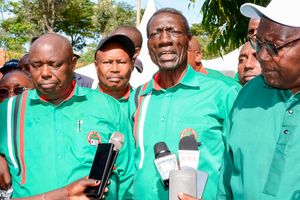
Kenya Union of Post Primary Education Teachers Secretary officials address the media in Nairobi on August 25, 2024.
Photo credit: Dennis Onsongo | Nation Media Group
She is also championing the immediate confirmation of intern teachers, citing court rulings that have declared prolonged internships unlawful.
Ms Agutu is equally vocal about the need to grant autonomy to Junior School teachers, saying current administrative conflicts with primary school headteachers are disrupting learning.
Beyond policy, Ms Agutu’s candidacy carries symbolic weight.
Since Kuppet’s formation in 1998, no woman has held any of the top three positions: secretary-general, chairperson or treasurer.
“I don’t know why women have not been stepping forward. But I am,” she says.
She dismisses tokenism, insisting that women should compete fairly and earn leadership positions on merit.
“Gone are the days when women waited to be given positions. If we are capable and elected, we deserve to serve,” she says.
Raised in Lamu, she recalls the long and often difficult journey to school trekking through Boni Forest to Mokowe Jetty, crossing the Indian Ocean and sometimes riding a donkey to complete the trip.
She attended Mkomani Primary School (now Mahmoud Bin Fadhil Ilgaz Primary School) before joining Loreto High School. She later pursued a Bachelor of Education (Science) at Egerton University in Njoro.
Leadership has been a constant thread in her life from school captain in primary school to deputy captain in secondary school, class representative at university, and later the first chairlady of the Egerton Catholic Students Association.
At Lamu Girls’, she has served in various administrative roles, including Head of Chemistry, Dean of Studies and Senior Mistress in charge of Internal Quality Assurance. In 2024, she also acted as deputy principal during a maternity leave.
As the campaign intensifies, Ms Agutu remains steadfast in her message: teachers must come first.
“A healthy teacher means a better learner and, ultimately, a better nation. Education is the backbone of everything else, and we must treat teachers with the dignity they deserve,” she says.