Students joining university are now facing a more restrictive funding regime after the government confirmed it has stopped awarding scholarships to those placed in private universities.
This comes even as enrolment in higher education has surged by more than 300 per cent over the last decade, according to University Fund acting CEO Dr Edwin Wanyonyi.
Under the revised funding structure, students admitted to private universities through the Kenya Universities and Colleges Central Placement Service (KUCCPS) will only access government loans, with scholarships now reserved exclusively for those placed in public universities.
In an interview, Dr Wanyonyi said the 2021–2023 cohort was the last group of government-sponsored students in private universities to benefit from scholarship support.
From subsequent intakes, students placed in private institutions through KUCCPS will only access loans effectively excluding them from state scholarship funding.
“Students make their choices and are placed accordingly, which is in order. However, the last cohort of government-sponsored students in private universities was 2021–2023. After that, we have not placed government-sponsored students in private universities in terms of scholarships,” said Dr Wanyonyi.
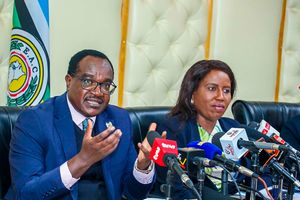
KUCCPS Chief Executive Officer Agnes Mercy Wahome.
Photo credit: File I Nation Media Group
On April 7, KUCCPS invited candidates who sat the 2025 KCSE examinations to apply for degree and TVET programmes.
The placement agency said it had received results for 980,444 eligible candidates, out of whom 268,700 attained a mean grade of C+ and above, qualifying for placement to degree programmes in 43 public and 31 private universities.
Dr Wanyonyi clarified that while placement into private universities remains part of the national system, government support has now been restructured into a dual model—where students in public universities qualify for both scholarships and loans, while those in private universities can only access loans.
This means that even students placed in private universities through KUCCPS will now have to rely entirely on loans and household contributions to finance their studies, despite being selected through the national placement system.
“The key change is that such students are no longer eligible for scholarships, only loans,” he added.
Government data shows student numbers have increased from about 70,000 in 2017 to approximately 258,000 in 2025 representing a rise of more than 300 per cent in under a decade.
Currently, 437,648 students are funded under the system, drawn from three cohorts: 122,634 admitted in 2023, 134,889 in 2024, and 180,125 in 2025.
“In terms of student numbers, the growth is very significant. Over the last 10 years, enrolment has grown by more than 300 per cent, while the economy has grown at an average rate of 5 to 6 per cent,” Dr Wanyonyi said.
As a result, the government says it is only able to fund about 70 per cent of universities’ resource requirements.
“Currently, we are funding close to 70 per cent of the resource requirement for universities in terms of scholarships,” he added.
Under the current model, funding is targeted at the neediest students, while others are expected to contribute through loans and family support.
Kenya’s higher education sector faces a Sh260 billion deficit in the 2026/2027 budget proposals.
Photo credit: Pool
Dr Wanyonyi revealed that discussions are ongoing with the National Treasury and the Ministry of Education to boost funding for higher education, with proposals to increase scholarship allocations by about Sh30 billion.
“We are projecting an increase of close to Sh30 billion in scholarship funding from the current Sh15 billion. That will go a long way in helping to bridge the resource gap,” he said.
Higher Education Principal Secretary Beatrice Inyangala told MPs that funding for the 2025/26 financial year has remained unchanged despite the admission of the largest student cohort to date.
She said the ministry requires Sh29.55 billion to fully support students under the new model but has been allocated Sh16.92 billion, leaving a shortfall of Sh12.63 billion. This means universities are currently operating at about 57 per cent of the required funding.
An additional Sh1.5 billion has been proposed under Supplementary Budget I to raise scholarship funding to Sh18.42 billion, increasing coverage to about 62 per cent—still below the full requirement.