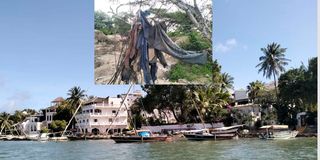
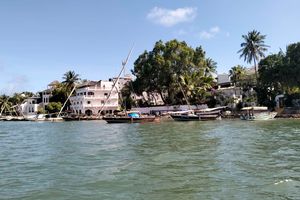
When you arrive in islands and towns such as Lamu, Shella and Mokowe, the iconic coral stone bungalows and Swahili mansions you see across the scattered islands are closely linked to Manda Island.
Manda is home to Manda Maweni Village, the main source of many of the raw materials used to build these prestigious structures, including the opulent hotels in Lamu County. The island also houses Manda Airport, the main aviation hub connecting the rest of Lamu by air.
Manda also lays claim to being one of the archaeological foundations of Swahili civilisation, with a rich history that includes the ninth century Manda Swahili Town ruins and the 15th century Takwa National Monument.
Edward Rambugu,55, a quarry worker in Manda Island in Lamu County in this photo taken on June 19,2026.
Photo credit: Kalume Kazungu | Nation Media Group
Yet despite its importance, the island presents a stark paradox. It supplies the bricks and quarry stone used to build wealthier towns and cities, but at home the contrast is hard to miss.
With a population of more than 6,000 people and an area of about 18 square kilometres, residents have endured decades of hardship since independence, including the lack of basic amenities. Manda Island hosts the main airport in Lamu but the area has no tarmac road, and residents must rely on rough, dusty footpaths that are often impassable.
Basic water, electricity and health services are also missing. The island has only one dispensary, Manda Dispensary, which is poorly equipped and lacks essential drugs.
Separated from Lamu Island by a narrow channel of the Indian Ocean, residents of Manda often suffer, especially during emergencies. They are sometimes forced to pay between Sh1,500 and Sh2,000 one way to hire motorbikes and boats across the ocean to reach King Fahd Referral Hospital, the main county health facility on Lamu Island.
Local artisans have long depended on Manda for coral stone, harvested from the island’s reefs and cut into heavy blocks for walls. The island also supplies mangrove poles, logs and timber from surrounding forests for the roofs and ceilings of luxurious mansions in the rest of the county.
By contrast, most villages on Manda Island consist of informal settlements made up of rusted, mismatched corrugated iron sheets, makeshift mud and wattle structures and little modern sanitation.
Residents said the lack of land ownership documents is one of the main reasons many people still live in semi-permanent, mud-walled huts and corrugated shacks despite contributing largely to developing other areas. Most residents of Manda Island are squatters because they do not have title deeds for the land they have occupied for years.
Manda Island community paralegal Benson Juma Ojuok said the absence of formal title deeds has discouraged many villagers from investing in permanent structures like those built with stone and concrete. Mr Ojuok said that although many families have lived in the villages for a long time, they have still not been recognised or issued with the crucial documents proving land ownership.
“We don’t have title deeds. That’s why most of us in every village of Manda you visit, you’ll find out that we’re living in corrugated, semi permanent structures. Yes, some of us are able financially but we aren’t ready to risk constructing permanent buildings on land we aren’t formally entitled to and then face sudden evictions or demolitions,” said Mr Ojuok.
Ms Hellen Okore, 51, has lived and worked as a quarry worker on Manda Island since 1982. All seven of her children and four grandchildren were born and raised on the island.
“How can one do meaningful developments on land whose fate is unknown? Even if we try constructing permanent houses, tycoons have always come out threatening us with evictions. Something needs to be done to change our lives for the better,” said Ms Okore.
Hellen Okore,51, a quarry worker in Manda Island in this photo taken on June 19,2026.
Photo credit: Kalume Kazungu | Nation Media Group
Mr Edward Rambugu, 55, has lived in the same area for 20 years. The father of four said the lives of many artisanal quarry workers like him continue to be marked by systematic exploitation.
Mr Rambugu said middlemen and brokers have taken advantage of the workers’ lack of direct market access and their informal status. They buy stones, bricks, ballast and building sand at suppressed prices while keeping the profits.
He said that without middlemen, they could sell a brick for as much as Sh50 each.
“Unfortunately, because of the presence of middlemen and brokers, we end up selling a brick at between Sh20 and Sh25. After revenue and other deductions, we only receive Sh10, which is very low. This has forced many of us to live hand to mouth despite the intense, dangerous daily labour,” said Mr Rambugu.
Mr Peterlis Ngeso, 80, who has worked as a quarry worker in Manda for the past 44 years, lamented the fact that the island’s quarries supply the building blocks used for major architectural and hotel projects while the stone cutters themselves continue to live in extreme poverty, with no permanent homes in their villages.
“It’s like we’re doing development for export. As you can see, Manda Island is building up other islands, mega towns in the Lamu archipelago and beyond, yet it’s struggling in isolation,” said Mr Ngeso.
He added, “Our island even houses the only Manda Airport connecting Lamu by air. Our villages produce all building materials, paving other roads and establishing mansions yet, we only endure impassable pathways at home. We’re the builders of wealth but dwelling in poverty.”
Ms Lucy Adhiambo said their situation is largely driven by poverty, noting that they often cannot afford the capital needed to build permanent concrete homes.
The island’s main communities are Bajuni, many of whom sought refuge there from Kenya Somalia border villages after displacement during the Shifta War of the 1960s. However, today, Manda is cosmopolitan, with almost every tribe in Kenya represented on the island.
Mr John Mueni blamed both the county and national governments for neglecting the island. Manda Island has only three primary schools: Manda Primary, Manda Airport Secondary and Manda Maweni Comprehensive School.
The schools are far apart and are reached through dusty, bushy footpaths. Mr Mueni called for modern roads in the area.
“We have no roads. The bushy footpaths are affected by human-wildlife conflicts. Snakes are everywhere. Sometimes our children are forced to stay at home owing to roaming lions and buffaloes. Let our route be cleared and roads tarmacked to end these problems,” said Mr Mueni.
Mr Ali Bulo, a resident of the remote Manda Maganga village, criticised the government for focusing development only around Manda Airport while neglecting the rest of the island, where locals live.
Residents now pin their hopes on the county and national governments to address the many challenges they face. They believe that joint action could help formalise land tenure and allow permanent housing in the area.
Ms Lilian Okoth said that to curb the exploitation of casual labourers by brokers and middlemen, workers should be helped to form and register cooperatives.
“With strong cooperative societies in place, it guarantees direct sales to developers and removes parasitic middlemen,” said Ms Okoth.
Manda Island Community Paralegal Benson Juma Ojuok during an interview with the Nation on June 19,2026.
Photo credit: Kalume Kazungu | Nation Media Group
She also reiterated the need for Lamu to enforce county mining laws that mandate fair minimum wages, safe working conditions and proper environmental restoration by investors.
“Provided we’re getting the revenue required as a county from those quarry workers, we don’t have any issue. We can’t intervene on the alleged exploitation since doing so is similar to intruding into people’s businesses and local trade arrangements. Our focus is whether the quarry workers fully comply on matters of revenue payment,” said Mr Mbwana.
Efforts to reach the Lamu County Government Lands and Physical Planning Executive, Tashrifa Bakari, were unsuccessful as her phone went unanswered.
A section of the face of Manda-Maweni village within Manda Island in Lamu County in this photo taken on June 19,2026.
Photo credit: Kalume Kazungu | Nation Media Group
Lamu County Commissioner Stephen Sangolo said he was aware of the situation on Manda, but added that nothing formal on land ownership had been done so far.
He said the government, through President William Ruto, has already announced plans to address landlessness on the Coast, including purchasing land from absentee landlords to resettle squatters and speeding up title deed issuance. Mr Sangolo said he hopes Manda Island squatters will be prioritised in the ongoing process.