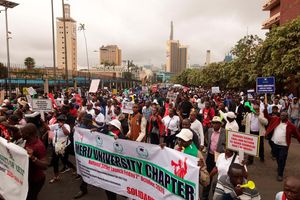
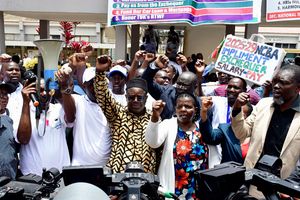
The dispute over university lecturers’ pay has exposed a deep divide between the government and staff unions over the cost of remunerating academic workers, as negotiations are stuck on figures that reflect vastly different positions on salaries and benefits.
On Monday, an inter-ministerial committee that has been working to resolve the dispute that has seen learning in public universities paralysed presented a Sh11,958,504,776 offer that the three unions representing academic and non-academic staff promptly rejected.
Officials later said they want to negotiate for an itemised 2025-2029 collective bargaining agreement (CBA) and then work out its cost later.
The Nation has seen a letter by Higher Education Principal Secretary Dr Beatrice Inyangala to her counterpart at the National Treasury, Dr Chris Kiptoo, dated October 23 2026, requesting a review of the budgetary commitment of Sh9.76 billion earlier rejected by lecturers to the new offer.
Parents urge the government to urgently end lecturers’ strike
The three unions, Universities Academic Staff Union (UASU), Kenya Universities Staff Union (KUSU) and the Kenya Union of Domestic, Hotels, Educational Institutions, Hospitals and Allied Workers (KUDHEIHA) say they were not involved in the process of settling on the figure. They also want the government to commit to funding their remuneration through the National Exchequer and not through the respective universities.
However, the government side argues that the demanded pay raise by the universities’ workers would cost the government Sh98 billion, something they say is unsustainable.
The differing figures mark the latest turn in negotiations that began with an initial government proposal of Sh9.76 billion for a new CBA.
“What happened to the Sh12 billion they tabled two weeks ago? Today, they came back with Sh11 billion, a reduced counter-offer,” Dr Wasonga said.
He said that the overall total fails to explain what the government is prepared to pay for individual salary scales and allowances, or which elements of the unions’ proposal would be excluded.
The employers’ proposal, presented through the Inter-Public Universities Consultative Forum (IPUCCF), recommends a cumulative salary adjustment of 8.25 per cent over four years, based on annual increases of two per cent. An alternative scenario based on annual increases of three per cent would result in a cumulative adjustment of 12.56 per cent.
The unions say the government’s offer translates to an increase of about three per cent in basic salaries, which they consider inadequate compared with their demands.
For illustration, a three per cent increase applied to the current maximum basic salary of a professor, Sh345,816, would add about Sh10,374 a month, taking the basic salary to approximately Sh356,190.
The employers’ proposal, presented through the Inter-Public Universities Consultative Forum, recommends a cumulative salary adjustment of 8.25 per cent over four years, based on annual increases of two per cent. An alternative scenario based on annual increases of three per cent would result in a cumulative adjustment of 12.56 per cent.
“This is an abuse of workers, given the current high cost of living, where even fuel prices have increased by more than 20 percent. What does a three percent basic salary increment mean under these circumstances?" he posed.
The unions say the government’s offer translates to an increase of about three per cent in basic salaries, which they consider inadequate compared with their demands.
For illustration, a three per cent increase applied to the current maximum basic salary of a professor, Sh345,816, would add about Sh10,374 a month, taking the basic salary to approximately Sh356,190.
UASU is seeking basic salary increases ranging from 36 per cent to 68 per cent, depending on staff grade, alongside a 57 per cent increase in house allowances.
Under the union’s proposal, the maximum monthly basic salary for a professor would rise from Sh345,816 to Sh580,144 by the final year of the agreement in 2028/29. This would add Sh234,328 to the monthly basic salary, an increase of approximately 67.8 per cent.
Why lecturers and university staff are on strike again
For a senior lecturer, the proposed maximum basic salary would rise from Sh238,221 to Sh399,644, a monthly increase of Sh161,423.
The proposed changes would also affect housing allowances. A professor’s monthly house allowance would increase from Sh73,715 to Sh116,028, a rise of Sh42,313. For a senior lecturer, it would rise from Sh58,972 to Sh92,822, an increase of Sh33,850.
The union is also seeking commuter allowances of up to Sh60,000 a month for eligible grades, a professorial allowance of Sh80,000, annual book allowances of between Sh65,000 and Sh90,000, and annual leave allowances ranging from Sh50,000 to Sh70,000.
The comparison highlights the distance between the union’s proposed maximum professor’s salary of Sh580,144 and the illustrative figure of Sh356,190 after a three per cent adjustment. However, the figures are not directly equivalent: the union’s proposal is a phased salary structure extending to 2028/29, while the government’s detailed salary-by-salary terms remain unclear.
The government’s Sh11.96 billion offer amounts to about 12.2 per cent of the unions’ Sh98 billion demand. The difference is approximately Sh86.04 billion, but this should not automatically be treated as a confirmed funding shortfall. That would require evidence that both figures cover the same employees, period, salary adjustments and employment benefits.
The unions have also asked Parliament to intervene over Sh7.9 billion in outstanding arrears under previous agreements, including the 2017–2021 CBA. Those arrears are separate from the proposed cost of the new agreement and should not be added to the Sh98 billion demand without establishing how the figures relate.
The negotiations follow a return-to-work formula signed in November 2025, which required the parties to fast-track talks on the 2025–2029 CBA and conclude them within 30 days. The unions say that deadline was not honoured.
KUSU secretary-general Charles Mukhwaya noted there was a lack of goodwill from the government and the employers' side to bring the dispute to a close.
“Today, they called us for another meeting and came with Sh11 billion, which is less than the previous Sh12 billion. To us, this means the government wants the strike to continue, and we are ready," he said during a media briefing after the talks collapsed.
He scoffed at revelations by the National Treasury that vice chancellors under the Inter-Public Universities Councils Consultative Forum (IPUCCF) were negotiating on behalf of the unions.
"When one party decides what unions should receive, it sidelines the unions' right to negotiate,” he said.