On the outskirts of Machakos Town, where dry winds sweep across open land and herds of livestock graze undisturbed, a bold dream was born in 2013.
It was a dream of glass towers and modern highways, of investors streaming in from across the world, and of a county stepping out of Nairobi’s shadow to claim its place on the global map.
Highways would cut across the terrain, linking a modern urban hub to global markets. Investors would stream in, drawn by incentives and ambition. Machakos, long overshadowed by Nairobi, would step forward as a city of the future.
The project was christened New Machakos City , a sprawling development planned across 4,000 acres and projected to attract trillions of shillings in investment. It was a vision that captured imaginations and stirred debate in equal measure.
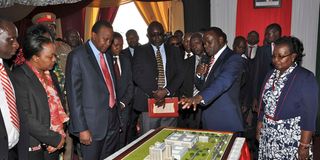
President Uhuru Kenyatta is taken on a tour of the proposed New Machakos Recreation Park by Governor Alfred Mutua during the official launch of the City and Investment Programme in Machakos County.
Photo credit: PSCU
Then Governor Alfred Mutua pitched the city as a transformative leap for the county, a chance to redefine its economic trajectory. Investors were promised opportunity, growth and, most enticingly, access to land reportedly offered as a catalyst for development.
But even as the vision gathered momentum in boardrooms and public rallies, a quieter, more consequential process was unfolding.
In courtrooms far removed from the optimism of investor pitches, a legal challenge was taking shape, one that would eventually stall the dream before it could take root.
The challenge came from then Machakos Senator Johnstone Muthama. His petition did not merely question the politics of the project; it struck at its legal foundation. At issue was land, who owned it, who controlled it, and whether it could be offered to investors in the manner proposed.
In submissions before the High Court, Muthama argued that the county government lacked the authority to allocate or promise land as an incentive.
“The Respondent, has offered free land as an incentive to attract investors,” he stated. But, he added, “there is no known concept as free land that is capable of being dished to investors.”
According to the petition, the land earmarked for the city was neither vacant nor uncontested. A significant portion, he said, belonged to the national government, specifically the Machakos Veterinary Farm, a 1,420-acre property with a long institutional history.
Court records painted the farm as more than idle land. It functioned as a holding ground for cattle, a training centre for farmers, and a site for veterinary research, including drug trials. It also played a role in drought mitigation through hay production, an asset in a region frequently touched by dry spells.
Officials from the Ministry of Agriculture supported this position, maintaining that the land had never been transferred to the county.
“The Interested Party( the ministry of Agriculture) has not agreed, to take over any of its land,” the court was told, reinforcing the assertion that the property remained under national control.
Beneath the surface lay older land allocation conflicts dating back decades, cases that had never been conclusively resolved but continued to cast a long shadow.
One such voice was that of Nzilani Muteti, a Machakos resident who had been allocated land in the 1990s. Like many others, she had paid the required fees and received an allotment letter, only to find herself locked out of possession due to a court case filed in 1998 challenging those allocations.
For nearly two decades, she and others existed in a state of legal limbo.
“I was surprised to learn that the Respondent had invited investors and was offering them free land,” she told the court. The land in question, she said, overlapped with parcels tied up in the unresolved dispute.
“Having been a resident for forty-eight years, I was ready to develop the plot allocated to me, only to learn that even I had no right to it,” she added.
Her testimony captured a broader anxiety among residents, that development was being pursued in ways that risked sidelining existing claims and long-standing grievances.
Machakos County Government rejected these accusations. In its defence, it argued that the land identified for the project—LR No 1491/R—was distinct from the parcels claimed by both the national government and private individuals.
“The application is misconceived, malicious and made in bad faith,” the county submitted, insisting that it had been properly allocated the land through the National Land Commission (NLC).
Machakos County Governor Dr Alfred Mutua addresses a press conference outside his office on April 29,2015.
Photo credit: Pool
It further downplayed the weight of its investor outreach, arguing that no binding commitments had been made.
“The print advertisement is only an invitation to launch, and not a decision,” the court was told, suggesting the project was still at a preliminary stage.
Beyond the legal arguments, the county framed the case as a threat to economic progress.
“The orders sought are intended to frustrate a programme worth over one and a half trillion shillings,” it argued, warning that continued litigation risked scaring away investors and undermining development prospects.
In a pointed rebuttal, it described Muthama as “a sworn political rival” dragging political battles into the courtroom.
As the case unfolded, it became clear that the dispute transcended local politics. At its core lay fundamental questions about governance under Kenya’s devolved system, questions about the limits of county authority and the role of national institutions in managing public resources.
Central to this legal puzzle was the National Land Commission, the constitutional body mandated to oversee public land.
Justice George Odunga approached the matter with a focus on the law’s architecture and the balance of power it envisions.
“The Commission is entrusted with the responsibility of protecting and overseeing the public’s rights and interest,” he observed, underscoring the centrality of the NLC in land matters.
Crucially, he made it clear that county governments could not act unilaterally.
“In effect, the Respondent cannot unilaterally alienate public land without the input of the National Land Commission,” he ruled.
The judgment also highlighted inconsistencies in the county’s position. At one point, it claimed to have already been allocated the land. At another, it suggested the allocation process was still ongoing.
“From the above inconsistent positions one cannot state with certainty the stand taken by the Respondent,” the judge noted, pointing to uncertainty at the heart of the project.
Yet in a twist that would shape the case’s outcome, the court found that there was no concrete decision before it capable of being quashed.
“The Court cannot find that there exists a decision which ought to be quashed,” Justice Odunga ruled.
Justice George Odunga.
Photo credit: File | Nation Media Group
It was a technical determination, but one with far-reaching consequences.
Without a formal decision to invalidate, the court could not cancel the project outright.
Turning to another legal remedy, the court issued an order of prohibition, an instrument designed not to undo the past, but to restrain future action.
“Prohibition looks to the future,” the judge explained. “If a tribunal or authority were to announce in advance that it intends to proceed in contravention of the laws, the High Court would be obliged to prohibit it.”
With that reasoning, the court effectively froze the project.
Machakos County was barred from alienating or dealing with the land until all constitutional and legal requirements were met, including public participation and adherence to due process.
Without clear legal authority over the land, the county could not proceed. Investors, wary of uncertainty, held back. Momentum that had once driven the project began to dissipate.
Today, the site where the New Machakos City was to rise remains largely unchanged—open land under vast skies, its future uncertain.
“We expected much, but politicians did their thing,” says 35 year old Peter Makau.
For Makau, the stalled project represents a lost opportunity a chance for jobs, growth and transformation that never materialised.