The Lamu Port in Kililana has emerged as one of the preferred and crucial alternatives for cargo initially destined for the Middle East during the ongoing conflicts targeting the Gulf region.
The widespread violence in the Middle East, attributed to the ongoing regional war involving the United States and Israel against Iran, has seen Lamu Port receive major vessels in the last two weeks, with more expected in the coming weeks.
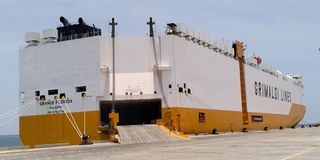
The latest to dock at the port is the MV Grande Florida Palermo from Yokohama, Japan, which made a maiden call at the Port of Lamu on Wednesday. Operated by Grimaldi Lines, the ship docked at the facility laden with 3,800 motor vehicle units and assorted spare parts.
Some of the vehicles discharged at Lamu Port. They were initially destined for Middle East countries.
Photo credit: Kalume Kazungu | Nation Media Group
Last Tuesday, another 9,000-capacity Pure Car Carrier (PCC) vessel, MV Grande Auckland, also made a maiden call at Lamu Port, where it discharged 469 brand new, high-end European-manufactured vehicles.
The vehicles in both vessels were initially scheduled for discharge at the Port of Jebel Ali, the biggest and busiest port in the Middle East, but the ships were diverted to Lamu as the conflict escalated.
But why are ships destined for Dubai and other countries in the Persian Gulf diverting to Lamu Port?
Global shipping operators and the Kenya Ports Authority (KPA) management cited Lamu’s proximity to the Middle East as one of the key factors making the facility increasingly sought-after.
Chartering and Business Development Manager, Africa, for Nisomar Group, Mr Munir Minas Hussein said that after leaving Europe a month ago, they had to divert MV Grande Auckland to Lamu Port instead of heading to its initial destination in the Middle East to save costs due to the security instability. Nisomar Group is the official agent for Grimaldi Shipping Line in East Africa.
The vessel had a total of 1,200 units, of which 469 were discharged at Lamu Port. The rest of the units were ferried to Mumbai in India and other destinations.
According to shipping route estimates based on maritime data, Lamu Port is one of East Africa’s closest deep-water gateways to the Middle East, located about 3,300–3,600 km from Dubai and roughly 3,400 km from Jebel Ali.
It is also nearer to key routes like the Strait of Hormuz compared to regional ports such as Mombasa and Dar es Salaam. This shorter distance reduces sailing time and fuel costs. Its direct Indian Ocean access further enhances efficiency.
“As an agency, we managed to convince the vehicle owners to divert and bring the vessel to Lamu Port, which has substantial economic advantages compared to other countries and ports within the Indian Ocean,” said Mr Minas.
Mr Minas noted that the Port of Lamu ranked highest in security considerations, especially for brand new motor vehicles. At the port, high-end vehicles are securely parked inside the warehouses while the rest are safely parked at the yard.
Lamu Port General Manager Abdulaziz Mzee explained that some experienced drivers were brought from Mombasa to train local youth on how to safely offload vehicles from ships. The more experienced drivers were mandated to handle larger vehicles and those with manual gears.
With a contingent of security personnel from different state agencies, including the Kenya Defence Forces, the port management assured investors that their goods are secured round the clock.
"The facility is well guarded to ensure safety of all cargo, ships and other assorted items coming our way. It's at Lamu Port where shipping line agents also have the right and the choice to hire private security companies to come here and reinforce safety and security of their cargo," said Captain Mzee.
The vehicles will remain at the port until such a time when the agents are convinced that the security situation in the Middle East is favourable. They may then return to transport the cargo to the intended destination, or contract another shipping agency.
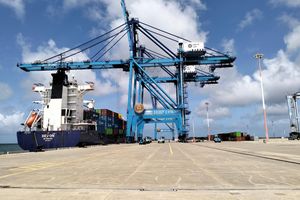
During a press briefing in Lamu shortly after receiving the MV Grande Florida Palermo on Wednesday, KPA Managing Director, Captain William Ruto, said one factor behind Lamu Port being selected for vessels diverted from the Middle East is its deep-water stature, attracting major shipping lines handling large vessels. The port has 17.5-metre depth that favours docking of large vessels and secure, and 400-meter quay lengths.
On the other hand, Mombasa Port's berths are 15-meter deep and 300 meters in length.
Quay lengths determine how large a vessel can be accommodated at the port at a time. Lamu Port is, therefore, designed for larger vessels of up to 12,000 twenty-foot equivalent units (TEUs) while Mombasa Port handles smaller ships of up to 10,000 TEUs.
Lamu Port general manager also cited the availability of high-quality mobile harbour cranes, rubber-tyred gantry cranes, and modern terminal trailers as part of the reasons behind the port being selected as a preferred option for roll-on/roll-off vessels. These are vessels designed to carry wheeled cargo such as vehicles and trucks.
With more vessels expected at the port in the coming days, the Lamu port sees an opportunity to market the facility as it also earns more revenue. The port management puts the revenues so far in “hundreds of millions”.
The KPA MD revealed that the port is expecting another car carrier to discharge 5,000 motor vehicle units next week. This will be a test to the port’s efficiency, as it gets busier than usual.
Some shipping lines that made a maiden call at the facility have already expressed interest to do business with Kenya in the future. However, incomplete infrastructure such as highways heading to South Sudan and Ethiopia from Lamu are still a setback.
Kenya Ports Authority (KPA) Managing Director Capt William Ruto at the Lamu Port site in Kililana, Lamu West on Wednesday, March 18,2026.
Photo credit: Kalume Kazungu | Nation Media Group
“We’re happy to have made a maiden call to Lamu Port as a roll-on/roll-off vessel. We hope more will follow suit. Once the hinterland infrastructure of East Africa is well built and lit, we will be able to discharge more vehicle cargo and other goods destined for Kenya and neighbouring countries like Ethiopia and South Sudan,” Mr Minas said.
According to KPA statistics, Lamu Port has received 74 vessels between January and March this year alone.
In terms of performance, the port posted a total cargo throughput of 799,161 metric tonnes last year, compared to 74,380 metric tonnes recorded in 2024, mainly driven by containerised cargo. The increased throughput last year was mostly as a result of post election chaos in Tanzania, which affected operations at the Dar es Salaam port.
“We’re welcoming more shipping lines to Lamu Port. For the business community, let them know that opportunities are now at the Port of Lamu,” said Mr Mzee.