Kenya’s strategic position on the Indian Ocean coast has assumed fresh significance as Britain and France prepare for a possible multinational operation to restore freedom of navigation through the Strait of Hormuz, one of the world’s most important maritime trade routes.
The renewed attention follows photographs and videos circulating online showing increased naval activity at the port. The presence of two British naval vessels at the Port of Mombasa has highlighted the role of Kenya’s coastline as a logistical and maintenance hub for international maritime security operations, even as London insists the ships are not being deployed from Kenya to take part in combat operations.
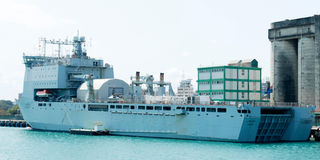
The Royal Fleet Auxiliary vessel RFA Lyme Bay is currently at Mbaraki Wharf, having arrived in Mombasa for maintenance and resupply after a period of training and operations. HMS Dragon , a Type 45 air-defence destroyer, is also part of Britain’s wider regional deployment.
The UK Ministry of Defence has said the proposed mission is defensive and intended to support commercial shipping and, where conditions permit, conduct mine-clearance operations.
176m Long Royal Fleet Auxiliary Lyme Bay, a Landing Ship of the British Naval which docked at the Mbaraki Wharf within the Port of Mombasa in this photo taken on August 7, 2026.The Royal Navy Ships is in Mombasa to Provide UK Armed Forces with Additional Options for Joint Mission to Open up the street of Hormuz
Photo credit: Kevin Odit | Nation
“HMS Dragon and RFA Lyme Bay have been pre-positioned in the region to provide the UK Armed Forces with additional options for a potential multinational mission jointly led by the UK and France to open up the Strait of Hormuz, which benefits Kenya as well as the global economy,” the ministry said.
The statement is significant for Kenya because the country’s economy and wider regional trade depend heavily on secure sea lanes linking the Indian Ocean to the Middle East, Europe and Asia.
The Strait of Hormuz is a particularly critical chokepoint. Britain says about a fifth of the world’s oil passes through the waterway, meaning prolonged disruption can affect fuel prices, shipping costs, insurance premiums and supply chains far beyond the Gulf.
For Kenya, which imports petroleum products and relies on the Port of Mombasa as a gateway for its own economy and several landlocked neighbours, disruption to major international shipping routes can have direct economic consequences.
Mombasa’s role in the unfolding security situation, however, is primarily logistical rather than operational. The port provides a location where naval vessels can replenish supplies, undertake maintenance and prepare for further deployment without necessarily implying Kenyan participation in military operations in the Gulf.
RFA Lyme Bay is particularly important to the planned mission because it has been transformed into a mothership for advanced mine-hunting equipment.
The vessel has been equipped with autonomous and remotely operated systems designed to detect, identify and, where necessary, destroy mines and underwater explosive devices. More than 100 Royal Navy mine warfare and diving specialists have been involved in the deployment.
The ship arrived in the Middle East in June after sailing through the Red Sea alongside German vessels and under the protection of HMS Dragon . The Royal Navy said Lyme Bay had been prepared to support a multinational effort to make the Strait safe for merchant vessels.
HMS Dragon provides a different but complementary capability. The destroyer is equipped with the Sea Viper air-defence system and has been deployed to protect British and allied assets from aerial and missile threats.
The warship initially sailed to the Eastern Mediterranean in March to help protect Cyprus before moving east of the Suez Canal. It subsequently worked with the French carrier strike group led by FS Charles de Gaulle in the Arabian Sea.
The British deployment forms part of a wider international plan. Britain and France have secured political support from dozens of countries for an independent, strictly defensive multinational mission focused on freedom of navigation, reassurance of commercial shipping and mine clearance.
The two countries have stressed that any operation would only begin when conditions are permissive and in accordance with international law and national constitutional requirements.
in recent interview, Kenya Coast Guard Service (KCGS) Director General Bruno Shioso said Kenya is on alert and is sharing key information with international organisations in the marine security to avert any other attacks more so on piracy within Kenyan waters though any such incident has not been reported.
“Kenya partners with international security on a number of issues including sharing of information," said Mr Shioso.
Kenya and international maritime security organs are examining ways to strengthen maritime resilience through improved information sharing, coordinated responses and enhanced surveillance systems.
Central to these discussions is the Indo-Pacific Regional Information Sharing (IORIS) Platform, a secure digital system that enables maritime agencies across different countries to exchange information in real time, coordinate operations and respond to security incidents.
In July, British Prime Minister Keir Starmer and French President Emmanuel Macron said they remained ready to deploy the wider multinational mission while working with Oman to ensure that its territorial waters were safe for navigation.
This makes the presence of the British ships in Mombasa a matter of strategic interest rather than evidence that Kenya has joined the conflict.
For Nairobi, the situation also presents an opportunity to underline the importance of the western Indian Ocean in global maritime security. Kenya has long sought to position Mombasa as a major regional maritime and logistics centre, and visits by sophisticated foreign naval vessels demonstrate the port’s relevance to international operations.
The distance from Mombasa to the Strait of Hormuz also means RFA Lyme Bay would require a substantial sailing period to reach the Gulf. At roughly 2,200 nautical miles, the journey could take about a week under favourable conditions.
A British Royal Navy ship (back R) patrols near supertanker Grace 1, suspected of carrying crude oil to Syria in violation of EU sanctions, after it was detained off the coast of Gibraltar on July 4, 2019. PHOTO | JORGE GUERRERO | AFP
That makes immediate involvement in mine-clearance operations unlikely while the vessel remains in Mombasa. Its current presence is better understood as part of a broader readiness posture, allowing Britain to maintain operational options while using Mombasa for logistics and support.
For Kenya, the developments offer a reminder that security in the Middle East is not geographically confined to the Gulf. Any prolonged closure of Hormuz would reverberate through the Indian Ocean, affecting shipping schedules, energy markets and the cost of imported goods.
As Britain and France continue efforts to restore safe navigation, Mombasa’s importance lies in its ability to support the wider maritime security architecture without necessarily becoming a participant in the hostilities.
The port therefore sits at the intersection of Kenya’s economic interests, international shipping security and the growing strategic importance of the Indian Ocean.