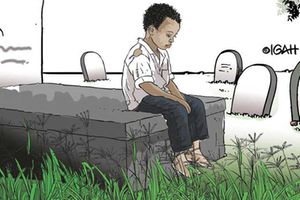
A man has lost control of his late father’s estate after a court revoked an inheritance grant he obtained 30 years ago for failing to disclose the existence of his stepbrother.
Murang’a Senior Resident Magistrate Grace Waithĩra revoked the grant issued to James Mwangi Kang’ethe in January 1996, finding that the succession process was based on incomplete information about the deceased’s surviving children.
The court also cancelled transactions involving a disputed parcel of land in Makuyu, Murang’a County, and ordered that the property revert to the name of James’s late father, Joseph Kang’ethe Gachunga.
The grant was issued on January 19, 1996 and confirmed in August the same year.
But his stepbrother, Muiruri Kang’ethe, later challenged the process, saying he had been deliberately left out despite being one of the deceased’s children.
Muiruri told the court that their father had three children — James, Jane, Wairimu Kang’ethe and himself.
According to the court, however, James presented himself as the deceased’s only son when applying to administer the estate.
The court found that although Jane and Samson Mwangi Muiruri were later mentioned in documents filed during confirmation of the grant, Muiruri Kangethe’s existence was not disclosed.
The magistrate found that James’s failure to disclose his stepbrother was serious enough to warrant cancellation of the grant.
“There is no doubt that the applicant herein is the administrator’s stepbrother. The administrator did not reveal the existence of the applicant and thus concealed a material fact from the court,” Ms Waithĩra said.
Samson, who appeared in the case as an interested party, told the court that he had bought the property for Sh92,500 and invested heavily in it.
He said the land, together with developments on it, was worth more than Sh20 million by November 2025.
Samson argued that he should be protected because he had bought and developed the property, despite the succession dispute emerging years after the original grant was issued.
The court, however, found that the circumstances surrounding the purchase did not give him a valid claim to the land.
Evidence before the court showed that the first payment for the property was made on December 7, 1995.
James obtained the grant on January 19, 1996, meaning the sale was entered into before he had obtained authority to administer his father’s estate.
The magistrate therefore found that James had no authority to sell the property at the time of the transaction.
The court further noted that Samson had been identified in the succession documents as an uncle of the deceased and should have been aware of the circumstances surrounding the family estate.
As a result, the court ordered the property to revert to Joseph Kang’ethe Gachunga’s name before the estate is distributed afresh.
The magistrate said Samson’s remedy, if he suffered a loss, lay against James.
“If there is any party who is to compensate him for any loss emanating therefrom, it would be the administrator, who sold to him the subject parcel of land without a legal basis,” the court said in a ruling delivered on August 6.
In 2001, Muiruri and Jane challenged the sale of another parcel before the Maragua Land Disputes Tribunal.
The tribunal resolved the dispute by dividing the property among the parties, and its decision was later adopted by the Murang’a court.
The disputed portion was subsequently subdivided, with part of it transferred to another interested party.
Muiruri later sought to reopen that dispute as part of his challenge to the administration of his father’s estate.
The magistrate declined, finding that the matter had already been dealt with through the tribunal and subsequent court proceedings.
The court limited its intervention to the succession process and the Makuyu parcel affected by the improper administration of the estate.
With James’s grant revoked, the administration of Joseph Kang’ethe Gachunga’s estate will now begin afresh.
Muiruri Kangethe was issued with a fresh grant, allowing him to take over the administration of the estate.
The ruling brings to a close one chapter of a family dispute that has lasted decades, while paving the way for the deceased’s estate to be redistributed under a fresh administration process.