Despite promises by Nairobi Governor Johnson Sakaja to transform the capital into one of Africa’s cleanest cities, rubbish continues to pile up across estates and in the Central Business District (CBD), casting doubt on his administration's ability to deliver on its promises.
When he took office in 2022, Mr Sakaja pledged to elevate Nairobi to the ranks of cleaner cities like Kigali, Port Louis and Gaborone. Nearly two years later, however, and despite billions invested in waste management, the city remains overwhelmed by filth.
Heaps of uncollected rubbish are stinking up even central areas such as Muthurwa Market, where traders say they feel abandoned by the county’s environment department.
“We only see the Chief Officer for Environment Geoffrey Mosiria on TikTok. Tell him to come and see the situation on the ground,” lamented Margaret Moraa, a trader.
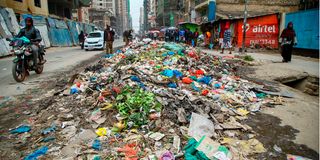
A heap of waste dumped along Jogoo Road, Nairobi in this photo taken on July 23, 2025.
Photo credit: Wilfred Nyangaresi | Nation
The traders say that the rubbish has attracted pigs and cows, which now roam the market freely, creating health risks. This is despite the fact that traders continue to pay market cess and other taxes to the county government without receiving basic services in return.
A similar situation can be seen along Jogoo Road near City Stadium, as well as in parts of Kirinyaga and Juja Roads, and it is spreading into residential areas such as the Huruma, Kariobangi and Mukuru slums. In these neighbourhoods, mountains of trash are encroaching on roads and playgrounds, endangering children and exposing residents to disease.
Earlier this year, Governor Sakaja launched 24 new refuse compactor trucks, promising that they would improve waste collection in the Central Business District (CBD) and city markets.
“These 24 trucks will play a critical role in ensuring efficient garbage collection. Our residents demand service delivery and we cannot afford to fail. Let’s make use of these resources to maintain a clean and healthy environment,” he said at the time.
Uncollected garbage and stagnant water in Pipeline Estate, Nairobi County in this photo taken on July 27, 2025.
Photo credit: Dennis Onsongo | Nation
However, Nairobi residents say they have seen little improvement.
Adding to the controversy is Green Nairobi Limited, a waste management company established under Mr Sakaja’s leadership that is currently under scrutiny. While the governor claims that the company is intended to streamline the management of the city's waste, critics are questioning its effectiveness and transparency.
According to the World Bank, plastic makes up 20 percent of Nairobi's waste, yet only 45 percent of total waste is recycled or reused. Most solid waste originates from households (54.2 percent), followed by markets (16.7 percent) and institutions (15 percent).
The predominant disposal methods are landfill (66.7 percent), composting (16.7 percent), and incineration (8.3 percent).
Nairobi’s solid waste generation is on the rise. According to the Kenya National Bureau of Statistics, 730,000 tonnes of waste were produced in 2018, but only 345,600 tonnes were collected. By 2024, the city had generated 1.14 million tonnes of waste, but only 509,600 tonnes had been collected — less than half.
Waste collection in residential areas is largely privatised and becoming more expensive. Residents of Jamhuri and Woodley pay up to Sh400 per month, while those in Donholm, Roysambu and Kahawa Sukari pay around Sh200. In Karen, charges soar to Sh1,000. In areas such as Kariobangi South, fees have risen from Sh50 in 2019 to Sh150 today.
A man urinates against a wall along Juja Road, Nairobi, on July 23, 2025.
Photo credit: Wilfred Nyangaresi | Nation
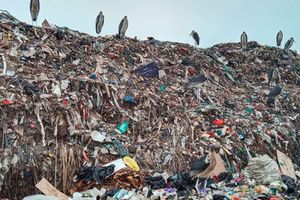
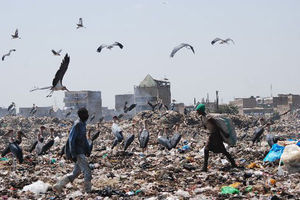
One of the most alarming waste hotspots is along Likoni Road, where an illegal dumpsite, reportedly run by cartels, has swallowed large portions of tarmac, endangering motorists, nearby businesses, and residents.
Considered one of Nairobi’s largest illegal waste disposal areas, the dumpsite was once intersected by three roads, which are now buried beneath mounds of waste. Over 500 informal traders and eateries operate there undeterred by the stench.
“It’s difficult to stop activities at the site since there’s a cartel involved, including senior government officials,” said a senior Starehe sub-county administrator who spoke to the Nation on condition of anonymity. The official was later transferred to North Eastern Kenya after attempting to close the dumpsite.
Similar efforts by former governors Evans Kidero and Mike Sonko also failed, and Governor Sakaja's administration has not succeeded either.
Nearby schools are suffering, too. The Mukuru Promotion Centre (MPC), which runs St Bakhita Primary School, St Michael’s Secondary School, and a vocational training centre serving over 2,000 students, has reported serious health issues caused by smoke and waste emissions.
“Our children, teachers, and support staff have been diagnosed with chronic respiratory problems linked to the dumpsite,” the centre said in a statement.
Garbage dumped along Juja Road, Nairobi in this photo taken on July 23, 2025.
Photo credit: Wilfred Nyangaresi | Nation
In response, Starehe Deputy County Commissioner John Kisang convened a security meeting at the centre with representatives from local schools, mosques, housing estates, and companies, in order to address the crisis.
On Monday, Mr Mosiria said that people were paying youths Sh50 to illegally dump waste in estates, along the road reserves and in the CBD.
“One thing that people of Nairobi need to understand is that the responsibility of dumping garbage lies with them. They pay people Sh50 to dump along roads reserves during the night. We are supposed to clean road reserves and collect garbage in markets and across the CBD. The garbage that is generated from the estates is supposed to be collected by licensed companies, not the people who are being paid at night,” Mr Mosiria said.
Regarding the illegal dump sites, the Chief Officer stated that the county had closed the sites on Likoni Road and Gitanga Road, but they are still operating due to cartels.
“On Likoni illegal dumping site, we closed it down. People are not allowed to dump there. Right now, if there is someone dumping there, it is illegal. We are trying to reach out to the owner of that land. We will carry out another enforcement to arrest those who are operating it and dumping there.”