What do you do with the open space inside a large roundabout? Some areas hold just vegetation and little else. Some become public parks. Others are taken over by corporates for branding purposes.
But at one roundabout on Waiyaki Way in Uthiru, at the border of Nairobi and Kiambu counties, that space is enough to have tens of churches, residences and small businesses.
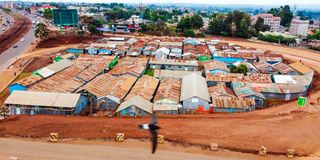
Welcome to Makanisani, also known as Kosovo, which – as per our calculations using Google Maps – occupies up to 7,088 square metres or 1.75 acres of roundabout “island” space.
Viewed from a vantage point, it creates the impression of an island made of iron sheet structures and cut from the rest of the world by a road, which is currently being expanded.
Through aerial maps, Makanisani cuts the figure of a slum, characterised by its rusty roofs, whereas the surrounding areas of Uthiru have posh houses with tiled roofs.
Some people have known this roundabout as their only home for years. Children have been born and raised there, and we were told of families that have three generations living there.
Dwellings are, however, not the main attraction here. It is the churches. At least 50 churches have their places of worship on this island, which contains about 135 structures in total. When we visited the area on November 11, we learnt that the structures were bound to get fewer as some had been marked for demolition to create enough wayleave for an expanded road round it.
Churches here are tightly squeezed. For instance, the gap between God’s Glory Revelation and the church next to it is barely a centimetre. The two structures stand so close that it is difficult to tell whether they share a wall.
At one passageway, it is difficult to tell where one church begins and the other ends. A narrow path cuts between the structures, leading to rows of iron-sheet churches with rusted or painted rooftops.
Kosovo, a settlement along Waiyaki Way on the Nairobi-Kiambu County border, popularly known as Makanisani, or “the village of churches” b, pictured on November 11, 2026.
In our mid-morning visit, children are playing outside the structures. A few residents are doing laundry, others are tending to ducks, while some small shops are already open.
Inside God’s Glory Revelation, a small congregation appears to be attending a midweek service. A few women standing near the entrance watch as visitors approach.
The church is modestly furnished, with plastic chairs arranged in the small room. A few old Bibles, their covers worn and torn, leather drums and cooking utensils, including a charcoal stove, are tucked towards the back.
The floor is finished in red oxide, while shawls cover the walls. The room can accommodate approximately 30 people. It has two doors, one used by congregants and another leading to the vestry, which also appears to provide additional ventilation.
Despite the open windows, it is hot inside. Outside, the churches display flags, each with a different arrangement of colours and patterns, distinguishing one denomination from another.
A reconstruction of the area using Google Earth and other remote sensing tools shows that Makanisani was already densely populated in the early 2000s. However, the surroundings were different, with trees around the central island roundabout and fewer visible structures. Today, the roundabout is crammed with structures.
Mr Josh Adom, who has lived in the settlement since 1986, remembers when there were few churches and much of the surrounding land was still open.
“When I came here, the churches were few. The rest was like a shamba, like a forest,” he says.
He recalls that Hebron Church of Africa, associated with the Akorino, was the first to be established in the area.
Mr Adom says that when he briefly left for Mombasa and returned, he found that the government had started putting up market-like structures.
The buildings, he explains, had wire mesh between them and were intended for the proposed Uthiru market. But traders never occupied them.
“Later, a few people came, covered the wire mesh and started residing in them. The county later made them residential houses, and some had tenants. The remaining spaces started sprouting churches,” he says.
Mzee Anthony Wafula, a grandfather and worshipper at Bethel Holy Spirit Church, has a slightly different recollection of how people came to occupy the area.
He says the settlement began during the tenure of former President Daniel arap Moi, when people were moved from a nearby market and headed to the area.
“We were here at the time (Mwai) Kibaki was in power. In fact, this area began during the Moi time. People were removed from the nearby market and headed here,” he says.
Mr Wafula says the land belongs to the government, a fact residents and church leaders are aware of.
“Everyone knows this is government land and that at any time, we can be ejected,” he says.
The concentration of churches poses the challenge of noise pollution, particularly on Sundays.
For Mr Adom, who attends Mwangaza Church – where he has been a member since 2015 – noise is one of the biggest problems residents face.
“There are several churches here that make a lot of noise, especially on Sundays. The churches that have invested heavily in their sound systems want to outshine the others. The amount of noise here is deafening,” he says.
His own church has a single speaker, which they use to play choir songs. They currently do not have a piano and have stopped using drums.
“We used to beat the drum, but after purchasing our first speaker, we stopped,” he says.
For Mr Wafula, however, noise is part of the worship experience, particularly for the Roho (Pentecostal) congregations.
“We, as the ‘Roho’ worshippers, need some noise while worshipping on Sundays. If there is no electricity, the drums are used,” he says.
Mr Wafula says his church has electricity, as do other structures in the settlement. Mr Adom recalls that when he first moved there, the area had no electricity. He says a few men in government helped bring power to the settlement.
Pastor Geoffrey Lugaka, the founder of Restoration and Revival Church that is domiciled at Makanisani, says congregations have to find ways of accommodating their neighbours, especially those without expensive musical instruments.
Rev. Geoffrey Lugaka speaks during an interview in Kosovo settlement along Waiyaki Way on the Nairobi-Kiambu County border, on November 11, 2026.
Photo credit: Bonface Bogita | Nation Media Group
“Here, we have an agreement. You have to coexist with your neighbour who doesn’t have amplification instruments. So, you won’t talk at a very loud volume as you pray,” he says.
Rev Lugaka says some churches also use their offerings to help people in need, rather than spending money on musical equipment.
“During these times, money is scarce, and instruments are expensive. At times, you use the offerings to help others because there are a lot of people who are suffering,” he says.
There are, however, rules governing some of the worship sessions.
Ms Evelyne Mwende, a Nyumba Kumi elder, says she received written regulations from the Kiambu County Commissioner during the Covid-19 period and distributed them to churches.
She says the regulations require churches intending to hold overnight prayer meetings to obtain clearance through the local administration.
Nyumba Kumi representative Evelyne Mwende in Kosovo settlement, popularly known as Makanisani, along Waiyaki Way on the Nairobi-Kiambu County border, on November 11, 2026.
Photo credit: Bonface Bogita | Nation Media Group
According to Ms Mwende, noise is prohibited beyond 10pm.
“If I hear noise, I go and order them to turn it down,” she says, adding that during daytime worship on Sundays, churches are not subject to the same restrictions.
Mr Wafula says the different congregations have generally learnt to accommodate one another. Asked whether worshippers have problems with how other churches conduct their services, he says “no”, explaining that in his church, speakers may be used when singing but not during preaching.
The settlement’s central road also serves another purpose during worship sessions. Mr Wafula says it is used as parking space for congregants, with vehicles occupying the middle stretch.
“Kuna masonko (We even have wealthy people coming here),” he says, referring to the churches’ ability to attract worshippers from different backgrounds.
Not everyone living in Kosovo attends church there, however. Mr Morris Bright, 39, is Catholic. Born in Kenya to Rwandese parents, he settled in Kosovo in 2017, starting a business there. He pays Sh2,000 in rent, which he considers relatively affordable. However, Sundays are not always easy for him.
“The noises from the churches are a bit overboard,” he says.
He notes the overnight prayer sessions are not as noisy as they used to be, but Sunday worship remains a challenge.
Beyond the noise, residents contend with limited sanitation facilities and access to water.
Mr Adom says some of the pit latrines previously used by residents have been destroyed, leaving the remaining facility almost full. The bathrooms are also shared by many people.
Residents pay Sh10 to use the bathrooms, he says, because of the cost of water and the person responsible for cleaning them.
Mr Bright says the available pit latrines are few, and residents have to carry their own water when using them.
Water is another daily challenge. Residents previously bought water from a nearby carwash at Sh10 for a 20-litre jerrycan. Mr Bright says the carwash is no longer there, and residents now buy water from a nearby bar.
The settlement has no school nearby, according to Mr Wafula, adding that the nearest one is at the Kabete Vet Lab premises.
Security has also been a concern, particularly in the narrow corridors between the structures.
Ms Mwende says a floodlight was installed in the area through an arrangement involving the two counties split by Waiyaki Way.
“This light was installed from the Nairobi side, but the power comes from Kiambu County,” she says.
“It helps us because in the corridors, criminals used to be on the prowl. The floodlight helped us by driving away the criminals and helping the guards,” she says.
The churches have guards, she adds. Some of them are Maasai men who sell belts during the day before returning to stand guard at night. Others also run small businesses in the settlement.
Rev Lugaka, who has lived in the area for about 20 years, remembers a time when insecurity was much worse.
He says the area was once known as “Kichinjio cha Watu (People’s Slaughterhouse)”, owing to the murders that happened here. He recalled that it was initially a market, though traders were reluctant to come because of insecurity.
Rev Lugaka, a former security guard, recalls that women were attacked and killed there and that the police regularly collected bodies from the area.
“When structures started coming up, the area started being safe,” he says.
He also recalls that during the tenure of Nairobi’s first governor, Evans Kidero, Kitisuru Ward representative Alvin Olando Palapala allowed residents to put up structures there. He says this was about 15 years ago.
“They come from as far as Kibera. Others come from the sides of Mlolongo. It’s because they got help earlier, and they try their hardest to come to fellowship here,” he says.
At times, he says, he gives someone Sh100 or Sh200 to buy food. Rev Lugaka has also constructed a toilet, which he said residents can use without paying. However, the facility is among those facing possible demolition because of the road expansion.
Another church leader whose activities extend beyond Sunday worship is Pastor Irene Mwachi of Mwangaza Ministry Church of God.
Rev. Irene Mwachi of Mwangaza Ministry Church of God during an interview at the church in Kosovo settlement on November 11, 2026.
Photo credit: Bonface Bogita | Nation Media Group
Rev Mwachi does not live in Kosovo, but her church is based there. When we meet her, she is buying foodstuffs to prepare a meal for children.
“That’s what I do, alongside giving out clothes,” she says.
Rev Mwachi holds worship sessions at different times on Sundays, sometimes in the morning, around 12.30pm and in the evening.
Cyrus Pentecostal Church and Pentecostal Church of Deliverance, Uthiru, in Kosovo settlement, popularly known as Makanisani, or “the village of churches,” along the Nairobi-Kiambu county border, pictured on November 11, 2026.
Photo credit: Bonface Bogita | Nation Media Group
“However, my most important issue is the children,” she says.
For some of the residents and church leaders, these activities could be disrupted by the road expansion now under way.
Excavation and resurfacing works around the roundabout have reduced the already limited walking space. Following a notice issued at a meeting with locals, some churches and residences have until December to either demolish or reduce the size of their structures.
Mr Adom says Hebron Church of Africa is among those facing demolition because of its proximity to the road.
Mr Bright says residents recently met government officials, whom he believes were from the Kenya National Highways Authority (KenHA). Some buildings were marked, and occupants were informed that they would have to move.
“They made markings on the affected buildings. The message was that those on the road should move. They wanted them moved for safety,” he says, adding that they were given until December.
Ms Mwende says the markings will affect both churches and residents, leaving some without places to stay.
She says the community is not opposed to leaving if the government requires them to do so, but residents would like an alternative place to settle.
“We won’t refuse to leave, but the government should give us an alternative settlement,” she says.
Mr Wafula says residents are aware that the land belongs to the government and cannot insist on remaining there if they are asked to leave.
“If they ever come demanding that we leave, they should give us time to leave. You know, you can’t refuse to leave government property,” he says.
He says an alternative parcel of land could be preferable to remaining in a place where residents know they may be asked to move.
“Getting another parcel out there could be better, because this one is clearly government property,” he says.
He also recalls an earlier demolition threat during which an earthmover cut through a house where a woman was giving birth.
Rev Lugaka lamented that the initial instruction to remove structures five metres from the road was later revised to 10 metres, a change that will cause more damage.
As excavation continues around the roundabout, residents and church leaders say they are waiting to establish which structures will remain and where those affected will go.