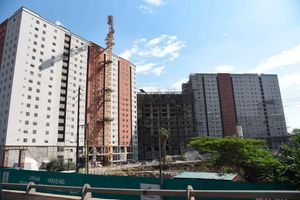
Nairobi Governor Johnson Sakaja says the Jeevanjee affordable housing project is complete, but hundreds of buyers who committed millions of shillings to the development say they are still waiting for the houses they were promised more than seven years ago, raising questions about the project's status and the fate of their savings.
Appearing before the Senate Standing Committee on Roads, Transportation and Housing, Mr Sakaja said the county had intervened to revive the stalled Jeevanjee and Pangani housing projects, describing Jeevanjee as almost complete before declaring that “it is done.”
“There is a letter that I had to send last week for off-take to affordable housing as well. Because people bought, people paid. But it is left. So, I have allotted those two; Jeevanjee is almost complete. It is done. I even took the mayor of Paris there,” Mr Sakaja told senators.
But buyers who appeared before the Nairobi City County Assembly Planning and Housing Committee last week painted a contrasting picture of pain and lost savings, saying the houses they paid for remain unfinished, leaving them fearing that their investments, estimated at Sh600 million, could be at risk.
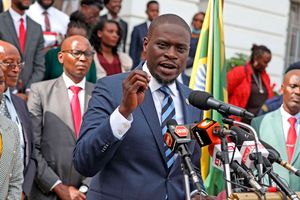
Nairobi City County Governor Johnson Sakaja appears before the Senate Roads, Transportation and Housing Committee, chaired by Senator Hamida Kibwana, at Bunge Tower in Nairobi on Tuesday, October 13, 2026.
Photo credit: Dennis Onsongo | Nation
The buyers, many of whom invested their savings through savings and credit cooperative societies (Saccos), say repeated completion deadlines have passed without the promised handover.
Takwa Sacco, which contracted to acquire 200 two- and three-bedroom apartments for its members, told the county assembly committee that it had remitted about Sh387 million of the agreed Sh600 million for the units before suspending further payments after construction stalled.
The Sacco's chief executive Dunia Abdi said the organisation had acted as an intermediary for members who invested their savings in the project and were now seeking accountability.
"For many of the beneficiaries, the investment represents years of savings and, in some cases, money borrowed specifically to secure a home. It is panful that they are servicing loans, paying rent at the same time yet they do not have houses," Ms Abdi said.
For some beneficiaries, the money represents years of savings or loans taken specifically to secure a home. The prolonged delay has left them demanding written assurances that their payments remain intact and a clear plan for completing and handing over the units.
Members of Taqwa Sacco follow proceedings during a Nairobi County Planning Committee sitting on the stalled Jeevanjee Housing Project at City Hall, Nairobi, on October 6, 2026.
Photo credit: Wilfred Nyangaresi | Nation
Imani Hamisi, a beneficiary and secretary of the Jeevanjee Housing Project buyers, told the assembly committee that investors had received several completion dates, including October 2022, August and October 2024, May and June 2025, November 2025 and April 2026, without taking possession of their houses.
Buyers said they had been given various explanations for the delays including disruptions caused by the Covid-19 pandemic and difficulties obtaining finishing materials such as doors and windows.
Mr Sakaja told senators that the responsibility for resolving the stalled projects rested with his administration, adding that he had moved to allocate the Jeevanjee and Pangani developments for further action.
He said the Pangani contractor was back on site and that he had written to facilitate the offtake of Jeevanjee units under the affordable housing programme.
“But the City Council houses are there. Our houses that are there. Once you do urban renewal, you will get your house. All you will be paying is service charge. It is wrong for me to come charge you again. It is a case of the back stops with me. The first governors had no reference to compare. So, I don't blame the first governor,” Mr Sakaja added.
The conflicting accounts have put the spotlight on the county government's handling of a project that was launched in 2019 but stalled in 2022, with buyers now demanding answers on what has been completed, where their money went and when they will receive their homes.
The project is part of the county government’s affordable housing programme, but its implementation has come under scrutiny over the transfer of public property, the structure of the joint venture and the financing of the stalled development.
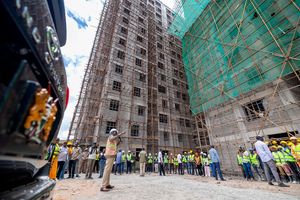
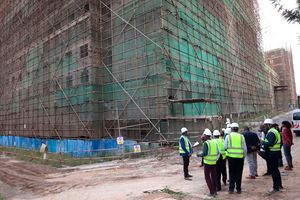
Housing construction at Jabavu Village Limited and the Nairobi Bachelors Jeevanjee Estate Project in Ngara, Nairobi.
Photo credit: File | Nation
National Bank of Kenya last year told the Nairobi County Assembly’s Planning Committee that it approved a Sh1.9 billion construction facility for a private developer in December 2022, using the title deed for the property registered in the name of Nairobi Bachelors Jevanjee Estate Ltd as security.
The bank said it had disbursed Sh505 million based on two interim architect’s certificates, with the last payment made on March 15, 2024. Despite the disbursements, the project is yet to be completed by the developer.