Hello

Your subscription is almost coming to an end. Don’t miss out on the great content on Nation.Africa

Ready to continue your informative journey with us?

Hello

Your premium access has ended, but the best of Nation.Africa is still within reach. Renew now to unlock exclusive stories and in-depth features.

Reclaim your full access. Click below to renew.

Caption for the landscape image:

Why Busia farmers are abandoning sugarcane for sorghum and soybean

Scroll down to read the article

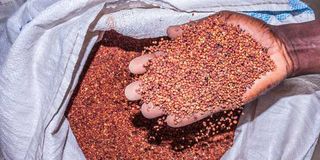
Harvested sorgum.

Photo credit: George Odiwuor| Nation Media Group

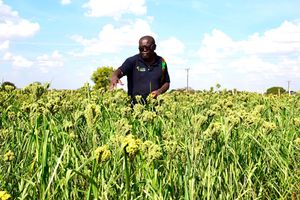
Ephraim Matano surveys his 10-acre sorghum farm in Bukesa Village, on the outskirts of Busia town, and smiles.

In a few weeks, he will harvest the crop and take it to market.

About three years ago, the same farm had sugarcane. Sometimes he would grow maize. But he was not as happy then as he is now.

This is because he discovered that sorghum provides him with instant cash, unlike sugarcane, which has delayed payments.

Maize, on the other hand, is affected by climate change, which can reduce yields.
Most farmers in the village use the Seredo red sorghum variety because it adapts well to different conditions and matures within four months.

Matano says that if he follows good agronomic practices, he can harvest up to eight tonnes of sorghum.

The current market price for sorghum in the region is 40 Kenyan shillings per kilogram.

Harvested sorgum.

Photo credit: George Odiwuor| Nation Media Group

“I expect to make a profit of up to Sh320,000 before expenses this season. This is a profit of Sh100,000 after expenses such as tractor hire and labour costs,” says the farmer.

His story is echoed throughout the village, where residents are relying on sorghum and soybeans to increase their income and food security.

The region, which was once covered in sugarcane plantations that formed the backbone of the livelihoods of thousands of families in Busia County, is now dotted with patches of these two food crops.

In the past, vast sugarcane plantations stretched across Butula, Matayos, Nambale, Teso South and Teso North, painting a picture of prosperity supported by the presence of sugar millers in the region.

However, the sector has faced growing challenges over time.

These included frequent factory shutdowns, such as at Busia Sugar Industry Limited and West Kenya Sugar Company; delayed payments to farmers; cane poaching; premature harvesting; shrinking land sizes; and uncertainty surrounding proposed zoning regulations. 

All of these factors left many farmers struggling to stay in business. However, most people did not lose hope in crop production.

Instead, they transitioned to growing sorghum and soybeans, which have since become the region's signature crops.

Some said these crops are reliable alternatives that promise better returns.
Matano says that both crops promote good soil health.

A sorghum plantation in Thome Village, Laikipia County on March 6, 2025.

Photo credit: Waikwa Maina I Nation Media Group

“Production costs are also lower than for sugarcane, which takes longer to mature and is more expensive to produce,” he says.

For many, the shift is not just about survival; it is also about building resilience in the face of climate change and evolving market demands.

Historically, sorghum was a staple food crop across Africa, but maize gradually took over.

Today, however, the crop is making a strong comeback as consumers become more aware of the importance of healthy eating and the risks of relying too heavily on a single staple grain, such as maize. 

Farmers and agricultural experts also see sorghum as a promising crop for biofuel production, including ethanol. Unlike sugarcane, sorghum requires less water and thrives in the hotter, drier regions of Busia County. 

Meanwhile, soybean is gaining popularity due to its ability to restore soil fertility. As a nitrogen-fixing legume, it replenishes the nutrients that have been depleted by years of continuous sugarcane farming.

Health experts say soybeans are very nutritious as they contain all the three macro-nutrients — protein, carbohydrate and fat — as well as vitamins and minerals, including calcium, folic acid and iron. FILE PHOTO

Matano says that maize farming was challenging due to harsh climatic conditions.

“I decided to stop growing maize due to the harsh effects of climate change, which sometimes reduce yields,” he says.

Growing interest in sorghum farming in the region is attributed to the availability of a ready market, among other factors.

East African Breweries Limited (EABL) is one of the crop's biggest buyers.

The County Government of Busia facilitates market linkages through which EABL buys the crops from GreenWells Agriculture Enterprise. 

This agribusiness empowers smallholder farmers by focusing on sustainable agricultural value chains involving soy, sorghum and poultry.

The organisation also provides training and distributes certified seeds.
Matano recalls a time when many farmers planted the Gadam white sorghum variety, which was highly susceptible to bird attacks and often resulted in significant losses.

However, ongoing research and improved seed varieties are helping farmers to overcome such challenges.

He is now encouraging more young people to venture into agribusiness.

“You don't need to start with a huge farm. Even half an acre can help you start your sorghum farming journey if you follow the right farming practices,” he shares.

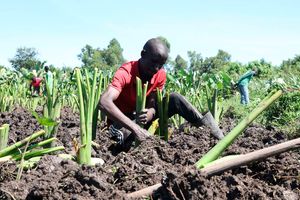
Farmer

 A farmer harvests sorghum at Napool Irrigation Scheme in Turkwel, Turkana County, on February 14, 2026.

Photo credit: Jared Nyataya I Nation Media Group

While Matano specialises in sorghum, Rose Jeptarus is one of over 12,000 farmers in Kemodo, Teso South, who have embraced soybean farming to boost their household incomes.

The most popular soybean varieties in the region include Saga and SB-19.

“I started soybean farming on a small scale for subsistence purposes in 2024. After receiving training in proper farming practices, I expanded to four acres. I am now expecting to harvest around four tonnes,” she says.

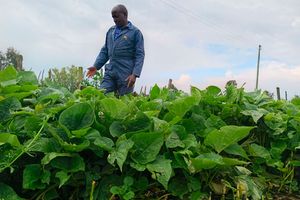
Jeptarus adds that she has insured her entire farm with Acre Africa to protect herself against potential losses due to climate change. Eric Ndenga from Butula echoes her sentiments. He quit his driving job to venture into soybean farming after attending agricultural training.

“The training opened my eyes to the potential profits in soybean farming. I have since leased four acres, and I expect to reap the benefits of a bumper harvest within the next month,” he notes.

Despite this optimism, farmers say that the high cost of foliar feeds and other farming supplies remains a major challenge.

‘We can access seeds and some farm inputs, but foliar feeds are still too expensive for many farmers. We are appealing to the government and other stakeholders to subsidise them so that farmers can achieve better yields,” says Ndenga.

According to Bernard Juma, the co-founder and chief executive officer of GreenWells Agriculture, the organisation currently supports over 12,000 smallholder farmers in Busia, Bungoma, Siaya, Homa Bay and Migori counties.

Juma says the organisation focuses on linking farmers to markets, providing training, and ensuring transparent trade systems.

“We provide farmers with real-time guidance on disease prevention, stock management and cost tracking to improve productivity and profitability,” he explains.

The company operates through a village-based agent model that recruits and trains young people and women in good agricultural practices.

These agents are also provided with storage facilities, aggregation centres, digital weighing scales and moisture meters to support efficient production and post-harvest handling.

“At the end of every season, we collect produce from farmers and deliver it directly to processors. Farmers then receive timely payments through their mobile wallets,” adds Juma.

He notes that this has significantly improved farmers’ livelihoods while ensuring that processors receive quality produce in a timely and traceable manner.

“We offer competitive prices and protect farmers from exploitative brokers who use manipulated weighing scales and misleading measurements to swindle them,” he says.

Juma adds that, with support from partners such as Acre Africa, farmers are increasingly protected from in-season and post-harvest losses through crop insurance, especially after recent devastating droughts.

As Busia’s farmers continue to adapt to changing economic and climatic realities, soybean and sorghum farming are emerging as not just alternatives to sugarcane, but also as pathways to a more sustainable and food-secure future.

Follow our WhatsApp channel for breaking news updates and more stories like this.