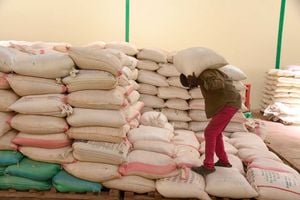
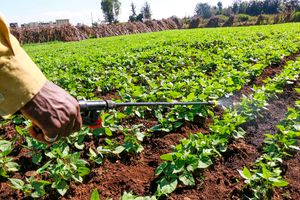
Maize traders have flocked to markets in the North Rift region — the country’s food basket — to purchase and stockpile grain amid an anticipated shortage that has pushed up prices.
Farm-gate prices have risen to Sh3,250 per 90kg bag, driven by stiff competition between private traders and the National Cereals and Produce Board (NCPB), which is offering Sh3,500 per 90kg bag.
Trucks loaded with maize queuing to deliver the produce to the National Cereals and Produce Board Eldoret depot in Uasin Gishu County on February 2, 2023.
Photo credit: File | Nation Media Group
“There is high demand for maize with traders from as far as Nairobi and Kitui pitching camp in the region and offering attractive prices to farmers. While the profitable prices are sweet music to farmers who are earning better returns, it is pain to consumers who will pay more for the commodity that is the main source of food for most households,” said David Maina, a miller in Eldoret.
Kenya expects to harvest 70 million bags of maize this season, up from 44 million bags in 2022 and 67 million bags last season.
“This year alone, we delivered 7 million bags of fertilizer and 35 million kilos of certified seed. In 2026 we will distribute 12.5 million bags across all 1,450 wards,” President William Ruto said during the State of the Nation Address.
Farmers have been cautioned against selling maize on credit to traders who then close shop without paying, leading to huge losses.
“Many farmers have in the past suffered mental anguish after being conned by unscrupulous traders of produce worth millions. Some issue bouncing cheques while others disappear with the maize altogether — an issue we will not accept,” he said.
Several suspects were arrested and arraigned last year for swindling farmers in Uasin Gishu and Trans Nzoia of maize worth millions.
Harvesting is ongoing in parts of the North Rift, with the country projected to realise 70 million bags against an annual consumption of approximately 45 million bags.
Farmer Ikal Nakuro dries her maize in Elelea village, West Pokot County.
Photo credit: Sammy Lutta | Nation
Maize production stood at 42.1 million bags in 2020, rising to 44 million in 2022 and 67 million this year. Kenya’s maize flour production over the past five years has averaged 2.8 million tonnes annually.
According to the Kenya National Bureau of Statistics, the country has imported an average of 295,092 tonnes of maize annually over the last five years.
Trans Nzoia County produced an estimated 5.3 million bags last year while consuming about 2 million bags, leaving roughly 3.3 million bags for the market.
The NCPB targets to purchase up to 2 million bags at Sh3,500 per 90kg, amounting to Sh7 billion for the National Strategic Food Reserve.
“Delivery to our buying centres is slow but steady, and we urge farmers to take advantage of our attractive prices,” said NCPB Corporate Communications Manager Titus Maiyo, noting that the board has so far purchased about 100,000 50kg bags.
Kenya’s annual maize requirement stands at 52 million bags — covering human consumption, livestock feed manufacturing, seed multiplication and other uses.
Tanzania remains the major exporter of maize and rice to Kenya and other East African countries, including eastern DR Congo, Burundi and South Sudan.