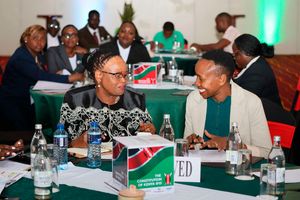
The devolution of key health functions—planning, budgeting and financial management, human resources and the provision of emergency medicines and medical supplies—has seen the growth of a critical sector, with key score in infrastructure set-up, but with questions on the use of the billions in the sector over the years.
As it is, counties manage and run hospitals from the dispensary (Level 2), health centres (Level 3), sub-county hospitals (Level 4), and county referral hospitals (Level 5).
Under the 2010 Constitution, the national government is responsible for health policy and capacity building, and for the three national referral hospitals: Kenyatta National Hospital in Nairobi, Moi Teaching and Referral Hospital in Eldoret, and Jaramogi Oginga Odinga Teaching and Referral Hospital in Kisumu, as well as the other national referral institutions, including the psychiatric facilities and the National Spinal Injury Hospital.
This has been under nine ministers since 2010, including those tasked with setting up the initial planning stages. These are Beth Mugo, Professor Anyang Nyong'o, James Macharia, Dr Cleopa Mailu, Sicily Kariuki, Mutahi Kagwe, Dr Susan Nakhumicha, Dr Deborah Barasa and Aden Duale currently being at the helm of the Ministry of Health (MoH).
Beatrice Kairu, a health economist, says the health dream in the counties faced serious threat with the very first consideration: the budgeting.
“There has been persistently low government budget allocation to healthcare in Kenya, further indicating that insufficient healthcare financing has been exacerbated by inadequate use of data-driven, evidence-based decision-making on domestic health financing.
“Kenya’s budget allocation to health is below 15 percent of the national budget, which also equates to below 5 percent of the recommended share of the health budget to Gross Domestic Product (GDP).
“This is against the collective commitment made by Africa’s heads of
Ms Kairu has further told the Nation that health spending in Kenya is skewed toward secondary and tertiary curative care.
Curative care is more expensive in comparison to preventive care. Thus the government should focus its funds more on primary healthcare services (PHC) and emergency care services. But looking at the recent allocation of funds by the national government to the primary healthcare funds and emergency critical and chronic illness funds (ECCF), which are under SHA, the government only allocated Sh4.1 billion against the required Sh50 billion for PHC. This is a meagre 8.2 percent while it allocated Sh2 billion for ECCF against a required Sh75 billion, equating to meagre 3 percent.
This shows that the government fiscal space for healthcare is greatly reduced. While the SHIF fund—where the government targets Sh148 billion to be collected from contributors—will focus more on the secondary and tertiary as evidenced by the benefits package.
Nerima Wako-Ojiwa, a political analyst and the executive director at Siasa Place, is of the view that Kenya’s healthcare system is hanging by a thread.
“Not because we lack skilled professionals or resilient citizens, but because bad governance and reckless policies are choking it at every level,” she told Nation in an interview.
Siasa Place is a youth led organisation that educates people about the Constitution, governance and electoral processes through community engagements.
Their youth-led campaigns, she says, have pressed county governments on delayed health budgets, insisted on visible service charters, flagged stalled hospital projects, and demanded action on policies that leave rural areas completely neglected.
“Healthcare is not a privilege; it’s a constitutional right. But unless leaders fix the policies and prioritise service delivery over self-interest, that right will remain a cruel illusion for millions,” she told the Nation .
For Ms Kairu, the health economist, the more things change, the more they remain the same.
“There are many factors that contribute to the high cost of healthcare in the country including wasteful systems, rising drug costs, medical professional salaries, profit-driven private sector health facilities, types of medical practices, health-related pricing, health infrastructure and the distance to health facilities which affect supply and access to healthcare,” said Ms Kairu.
“Most of the costs involved in the Kenyan healthcare system are dependent on market forces and this results in high, unregulated prescription drug costs and higher healthcare providers' salaries in contrast to other African nations because government involvement in regulating prices is very minimal.”
The economist also points out that data and evidence are critical components that should inform how the health sector is resourced.
“Generation and use of data in domestic health financing in the country remains a major challenge despite the enormous benefits that result from using reliable data and evidence to guide resource allocation in the health sector. These major challenges include weak data management systems at both national and county levels and lack of willingness by state officials to make the data accessible for researchers to analyse and provide evidence to support the government in decision-making,” Ms Kairu told the Nation .
“The government asks for more money from the pay slips of employed Kenyans, yet it doesn’t have the data and evidence that can tell it exactly how much ‘more’ money it needs so as to ensure every Kenyan has access to healthcare.”
The health economist is very much concerned that underutilised production capacity and the lack of price control policies threaten the country’s ability to provide affordable, locally-produced medicines, which drives the cost of healthcare up as Kenya relies majorly on imports.
This, she says, increases the access gap and quality of healthcare provided.
“Fluctuations in the international prices ripple throughout Kenya’s entire health system and market, impacting the cost-of-service delivery for both public and private sectors.
“Due to Kenya's heavy dependence on imported Health Products and Technologies (HPTs), the healthcare system is susceptible to price fluctuations as only 30 percent of HPT needs are being met by local manufacturing as acknowledged within the Health Products and Technologies Supply Chain Strategy 2020-2025 and therefore, the industry is vulnerable to the fluctuations in the international market, ”she said while explaining why healthcare providers and local pharmaceutical distributors are forced to adjust their prices, potentially affecting affordability for patients.
Council of Governors (CoG) chairperson Ahmed Abdullahi says that devolving the health function has had the most profound success.
Photo credit: File | Nation
But the Council of Governors, through its current chairman Ahmed Abdullahi and former office holder Anne Waiguru, believe the county health story and that of how it has been under devolution, has not been told as the full story it is.
Ms Waiguru said Universal Health Coverage (UHC) is a golden baby that has changed Kenya’s healthcare system tremendously in the last 15 years but there’s still room for improvement.
“Today, counties have built and operationalised hundreds of health facilities across the country, enabling most Kenyans to live within a 5km of health services. Counties have significantly expanded the scope of services available to citizens. For instance, renal dialysis for patients with renal failure previously only available in a few national hospitals is now provided at county level while specialised surgeries, cardiology services, neurology are just but a few specialised services that counties have scaled up,” Ms Waiguru told the Nation .
Mr Abdullahi said that devolving the health function has had the most profound success, including a rise in antenatal care and skilled birth deliveries, reflecting expanded access to skilled birth attendance.
He told the ninth devolution conference in Homa Bay that there were 8,466 health centres and dispensaries across the country at the onset of devolution in 2013. However, robust and intentional health investments by counties, in collaboration with the national government and the private sector, have resulted in 14,710 operational health facilities – both public and private.
The CoG boss said that 45 percent of them are public facilities, while the rest are private facilities.
Governor Abdullahi added that in 2013 the health sector had a workforce of 874 medical doctors and 6,620 nurses. The number now stands at 34,220 nurses, 4,651 medical doctors, 7,877 clinical officers, 4,686 laboratory technicians and technologists, and 1,942 nutritionists.
“This represents more than a four-fold growth in human resources, underscoring the significant county level investment in health personnel,” he said.
At the community level, he said there are 107,831 Community Health Promoters (CHPs) strengthening health care and improving grassroots linkages.
According to Ms Waiguru, one of the biggest successes of devolving health is the workforce.
“In the last 15 years, county governments have hired a large number of health workers, making the total health workforce to more than double compared to pre-devolution numbers,” she said, noting that even northern eastern counties now have health workers.
“For example, between 2016 and 2021 alone, the total number of health workers in counties improved by 61 percent from 59,726 to 96,453.”
Ms Waiguru added that, “Today, counties in hard-to-reach areas have significantly more health workers compared to the pre-devolution period. For example, Turkana County had less than 10 medical officers before devolution, a number that has increased six-fold to 61 doctors in 2023 – and this is a similar story in most many counties.”
She said that by supporting health workers to take further studies, county governments have driven a rapid emergence of health specialists, even in areas where there were none before, which fosters a better skill mix.
“This has allowed counties to provide a wide range of specialised health services even in areas where these services were not available before devolution. Fifteen years ago, before devolution, opportunities for health workers to undertake further training were limited,” she told the Nation .
Although financing health is a key priority for county governments, with most counties allocating more than 30 percent of their total budget to health, Governor Waiguru says that there has been a disproportionate allocation of health funds between the two levels of government. This is despite the national government now having significantly fewer healthcare responsibilities than county governments.
“For instance, in the financial year 2022/23, the government allocated Sh146.8 billion to the health ministry while all counties together received an estimated Sh102 billion for health, given that the total equitable share for counties was Sh340 billion. Kenya’s investments in health are below 15 percent in line with the Abuja Declaration, thus there is a need to both devolve more funds for health to follow functions, but also increase resource allocation to the health sector,” Ms Waiguru said.
The other challenge is the presence of key staff. For example, according to the Kenya Psychiatric Association, at least 17 counties do not have at least one psychiatrist to attend to millions of Kenyans.
Dr Chitayi Murabula, the president of the association, said the counties are Busia, Garissa, Homa Bay, Isiolo, Kirinyaga, Lamu, Marsabit, Migori, Nandi, Narok, Nyamira, Nyandarua, Samburu, Taita Taveta, Tana River, Turkana and Uasin Gishu.