My name is Vincent Mwangi.
There was one time I was stuck on one sale for a while, and my colleagues started making fun of me, calling me OneDown. The name stuck.
Real estate became a much bigger part of my life than I expected.
For a while, I also worked as a teller at Barclays Bank, now Absa, to pay my school fees. I was missing so many of my classes that I would attend my Master’s classes in the evening after work just to catch up, because some of the modules were similar.
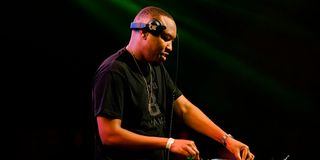
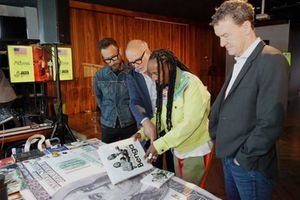
Vincent Mwangi goes by the artiste name OneDown, a prominent Nairobi-based deejay, producer, and the founder of Aduma Records and Aduma Presents.
Photo credit: Pool
My story with music had started long before I knew it could become anything.
My parents separated around 2005 or 2006, and we moved to Thika with my mother around 2007.
One of the first times I consciously encountered electronic music was through a Nokia 1110i that my mother bought in 2006. I was in Class Six and obsessed with technology, so although the phone belonged to my mother, I spent most of my time with it. I loved two ringtones, “Destiny” and “Everlasting”. I didn’t know they were electronic music. I just knew I liked how they sounded. I would even fight with my mother because she wanted a polite ringtone, something like a full song, while I kept changing it.
In boarding school, I had a little Palito radio. It cost about Sh150. Friday nights were special because I could listen to Dance Republic on Capital FM with DJ Protégé, and Club Kiss with DJ Hypnotiq and Mr Drew. They were house music shows, and I could not miss them.
When we eventually got a phone with internet, I would take my mother’s phone and go to Waptrick to download songs. I knew what house music was. From Form Two to Form Four, I basically had a phone for listening to music.
Vincent Mwangi goes by the artiste name OneDown, a prominent Nairobi-based deejay, producer, and the founder of Aduma Records and Aduma Presents.
Photo credit: Pool
I completed high school in 2012.
I don’t think I initially wanted to become a deejay. I just thought the decks looked beautiful. In fact, I used to draw decks at the back of my high school books. In 2014, I finally told my mother that I wanted to deejay. She didn’t acknowledge it. So I decided I would find my own way.
DJ Mmarik allowed me to hang around and taught me a few things. He was a sound guy for weddings and wakes, but I kept playing house music, which they called “mangoma za Vini”.
He had Numark decks, while Club Legend in Thika, where he also played, had Pioneer decks. He started letting me practise on the Pioneer decks before his sets. Eventually, I got good enough that he could arrive later because he knew I could hold things down.
The problem was that I was still living under my mother’s roof, and she did not approve. One night, DJ Mmarik took longer to come back. I arrived home at 11pm and found the gate locked. I knocked until my mother woke up. She came to the gate and told me, “I’m not your wife. Go back to where you came from.”
I had to find somewhere to sleep that night. By 2015, I had moved out.
At the time, I had two jobs and was still attending university full-time. By the time my mother heard about my deejaying again, I was already a contracted guest deejay in 2016, doing guest sets on Dance Republic.
My interest in production had also started taking shape.
DJ Fita eventually gave me a copy of Fruity Loops, FL Studio and a lot of tutorials. That was how my journey as a producer started.
Vincent Mwangi goes by the artiste name OneDown, a prominent Nairobi-based deejay, producer, and the founder of Aduma Records and Aduma Presents.
Photo credit: Pool
In early 2016, I moved to Oloitoktok with a mattress and a gas cooker.
I started Aduma while I was living there. That is also where the Maasai influence in the name came from. Adumu is the Maasai jump, although I am not Maasai. By the time I learnt the actual word was Adumu, the company was already called Aduma. I was also learning something important: there was not much space for black people in the electronic music scene.
That bothered me. I kept asking myself why people assumed we did not understand this music when it was all I listened to.
I started making mixes on Virtual DJ.
I opened my own Mixcloud account and started posting my mixes every month. I eventually started a radio show called African Moves, which by the middle of 2016 was picked up by Trance Radio in London. Suddenly, I had a consistent channel through which I could put out music.
People knew me online, although I had never really performed anywhere.
I was still shy. Before 2020, I would perform wearing a cap. I would travel all the way from Oloitoktok to Nairobi for deejaying opportunities, while still surviving on money from real estate.
I had no idea where this was going. But I was obsessed with the music. I had also become closely connected with South African DJs and producers. I first heard Amapiano around 2015 through friends connected to MFR Souls. At one point, we even had to bring South Africans to teach us how to produce Afro House because the sound was still new.
Afro Tech emerged around 2017, developing from tribal house and incorporating European techno sounds into African music. At the time, I felt Kenyans were among the people paying particular attention to South African music beyond the big hits.
In October 2018, a friend asked me to perform at Captain’s Terrace.
Captain’s was a restaurant rather than a club, so we had to finish by 11pm. We wanted to create something different.
Foreigners would sometimes come to Kenya, record Samburu and Maasai chants and sell the vocals. We thought: why not do something similar with Kikuyu? Oloitoktok gave me the free time to learn production, and Aduma slowly became a space where we could experiment.
Vincent Mwangi goes by the artiste name OneDown, a prominent Nairobi-based deejay, producer, and the founder of Aduma Records and Aduma Presents.
Photo credit: Pool
In 2019, we held our first anniversary and brought South African DJ Prince Kaybee.
For the monthly events, the venue had no sound or decks. We made the posters, promoted the events online and were sometimes given only Sh25,000. Deck rental alone could cost Sh10,000.
Kevin, the person behind Ngemi, understood what we were trying to build. He would provide what we needed and take the entire Sh25,000.
I also became involved with 6AM and eventually got opportunities to work on event organisation, security and artiste management. They would throw you into the deep end and make you figure things out.
During Covid, I sold my property management business.
It was a painful decision, but it freed me to focus on music. I booked MFR Souls, and through agent networks we eventually connected with people managing Major League DJs. On January 30, 2021, we held the show at Carnivore Grounds, with about 2,500 people attending.
Aduma and 6AM were among the first to bring Amapiano artistes to Kenya. Major League also did their first Balcony Mix outside South Africa at Park Inn by Radisson.
Kabza De Small had replaced Major League because Kenya was still on the Covid red list. The night before the show, I saw Kabza live on Instagram, still in the studio in South Africa. At 4am, I received a message that he had been involved in an accident.
We managed to get MFR Souls to perform instead, but the event was already carrying enormous costs. The curfew had also been brought forward from 10pm to 9pm.
We lost Sh6 million, with problems with the bar adding to the losses.
The secret was not the artiste. The secret was the Kenyan crowd.
After that, we focused more on residency and talent development.
In 2022, our relationship with Melanin Club became shaky, so I started doing a club tour. By 2024, there was hardly a club in Nairobi that we had not filled.
But I also realised that we were dividing the same 2,000 people among 10 events in Westlands. Nobody was bringing new audiences into the scene.
So I started moving Aduma to different places, including Vineyard, to make it easier for people from different parts of Nairobi and Kiambu to attend.
That worked. People who might never have gone to Westlands started coming to the events. I remember seeing older people singing along to oontz because they could hear some Kikuyu in the music.
Sofiya Nzau performed at Vineyard before she became widely known. Today, I look at how many deejays have emerged from the scene — Big Nyagz, Tina Ardor and others — and I am proud of that ripple effect.
In 2023, I parted ways with Kori-K, and Aduma Events Kenya became Aduma Entertainment.
The word “oontz” itself came from how I described the music.
I’m a big lover of “Family Guy”. There is an episode where the character Peter Griffith starts a church called the Church of Fonzie, and they have this greeting: “May the Fonzie be with you”, “And also with you”. That’s where “May the oontz be with you” came from, and it became the Aduma tagline.
Today, I am also focused on building a Kenyan presence within that sound.
I have a song with Sofiya Nzau called “Othaya”.
There was also Nes Mburu, a vocalist I had known from school. His family is Mokorino, so he already had a distinctive sound.
Before the popularity came, these vocalists were making money selling vocal packs online. But I realised there was a danger in putting too much of their voices on the internet. Someone could buy a sample, put it on a song and use it without paying or crediting the vocalist properly.
That is why, with Aduma Record Label, our goal became bigger than simply releasing music.
So we became involved in the writing and how the music was presented. We wanted it to be simple and accessible. And I told Nes not to keep putting his voice into sample packs where people could take it and manipulate it without him.
Today, he can charge upwards of $500 (Sh64,745) for a song and can do six or 10 songs in a day.
When I look back, the journey from that boy in Thika drawing decks at the back of his schoolbooks to where I am now makes sense.
I did not know where the music would take me. I realised that perhaps the goal was never simply to become a deejay. It was to create a space where someone else could see themselves belonging.