Apart from his family, the Bible tells us that Noah took only animals on his Ark when the floods came. Perhaps like the American poet, Walt Whitman, he thought he could turn and live with animals.
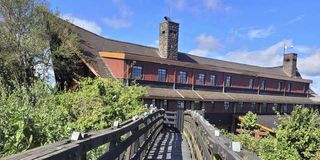
‘They are so placid and self-contained,’ Whitman wrote. ’I stand and look at them long and long.’ I know what he means. And he couldn’t have found a better place for looking at animals long and long than the Ark in our Aberdare Range of mountains.
I was at our Ark a couple of weeks ago with my nephew and his wife on holiday from the UK. They had been there many years ago, and they were keen to go again. So we took them there. They found the Ark smarter and neater than when they were there before – but the animals that came to the saltlick and waterhole were less – two families of elephants, a lone buffalo, a lone bushbuck, and some hyenas on the far side of the waterhole.
I was reminded of something the ‘white hunter’, Jamie, said to me some time ago. As a guide here,’ he said. ‘I feel like the director of a theatre who each evening doesn’t know which actors will turn up.’ He also told me about the American tourist who asked him what time the rhinos would be there.
‘Maybe about 9.30,’ Jamie suggested. And one, by luck, did turn up about that time. ‘I told you, Muriel,’ the tourist said to his wife, ‘they have the big animals in cages and let them out when things go slack.’ ‘Ah, you have rumbled us,’ Jamie retorted. ‘It’s true, but it’s a hell of a job getting them back in their cages.’
Another of Jamie’s stories was of an elderly lady who spent two nights at the Ark. Usually, the process is lunch at the Aberdare Country Club, by bus up to the Ark, again by bus, after an early breakfast, back to the Club and straight on to the next camp, lodge or hotel. The lady had been sitting most of her time at the small and comfy glass-fronted lounge, the top-most of the three viewing decks. Before she left on the second day, Jamie asked her whether she had enjoyed herself. ‘Yes, very much, she said ‘And doesn’t that young giraffe love that acacia tree?’ Jamie was puzzled. When she had gone. Jamie went to the lounge where she had been sitting. The lady’s young giraffe was a dead branch leaning against the acacia tree.
I suppose, after 40 years visiting a lot of game parks and seeing many of the same animals, I have become more interested in the more challenging spotting of birds. And I also have been paying more attention to people watching. One of my favourite stories is about a man who came out of the bar – it was actually not at the Ark but at Treetops – and who looked around and said, ‘Nothing happening!’
What, in fact, was happening was an amazing drama between some hyenas and a giant forest hog family – father, mother and their young one. The hyenas had been closing in on the youngster when the male hog suddenly collapsed. ‘He’s had a heart attack,’ said a young doctor who was sitting next to me. But when the female and her youngster were safely away, the male sprang to his feet and outstared the hyenas. A wonderful example of the playing dead ruse.
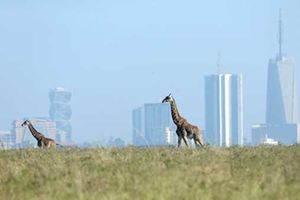
I suppose the man who said that nothing was happening was interested only in ticking off one of the so-called Big Five animals – elephant, lion, leopard, rhino and buffalo. The name was first coined in the late 19th century. It has nothing to do with rarity or size; it referred to the five animals that were the most difficult and most dangerous to hunt – and valued as trophies to hang on a wall. That’s why the name ignored the lithe and beautiful cheetah and the large and graceful giraffe.
When Jamie was the guide at the Ark, as well as telling great stories, he was good at giving advice about respecting the game viewing etiquette. He even warned that if people were too noisy, then they could be asked to leave. I wish he had been there on this last visit. In the evening, a group of Argentinians who were sitting in the corner of the most popular of the viewing lounges seemed interested only in one another – and their chatter was too loud, and their laughter was too raucous.
There must have been about 60 of us at the Ark. And it was a very mixed group – as well as the Argentinians, there were Chinese, Americans, Canadians, Swiss, Dutch, Brits, plus others I didn’t meet or identify. What surprised me was that, about an hour or so after dinner, there wasn’t any distracting noise because most people had gone to bed. I can only assume that they were tourists on a fairly tight itinerary involving a number of game parks and perhaps a beach.
I assume they had not briefed themselves well enough and they were treating the Ark like any other of their hotels rather than enjoying what it is: a place for a close-up viewing of animals and for an unusually long time – and especially for watching the nightlife of animals. So I was not surprised when I heard people complaining that the bedrooms were small. I suppose that most people switched off the bell that is rung in the bedrooms when an interesting animal appears on the saltlick. When, before midnight, the bell rang an alert that a second family of elephants had arrived, only a handful of people went out of their rooms to see them.
The Ark is set in a mountain forest – not in the usual savannah grassland where most game viewing is done. It is a very special place, where you can watch animals long and long.