Hello

Your subscription is almost coming to an end. Don’t miss out on the great content on Nation.Africa

Ready to continue your informative journey with us?

Hello

Your premium access has ended, but the best of Nation.Africa is still within reach. Renew now to unlock exclusive stories and in-depth features.

Reclaim your full access. Click below to renew.

Wamuyu Ndarathi
Caption for the landscape image:

Wamuyu Ndarathi’s journey to self-discovery

Scroll down to read the article

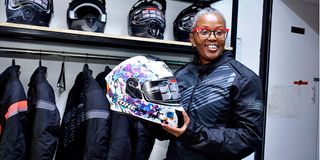
Wamuyu Ndarathi, the founder of Throttle Wear, at her shop on May 05, 2026.
 

Photo credit: Francis Nderitu | Nation Media Group

They say that life begins at 40, and for Wamuyu Ndarathi, a mother of two adult children aged 26 and 23, this saying is certainly true.

In October 2015, she decided to take up motorcycling. She was 41 and had never been on a bike before.

“I was going through a midlife crisis. I needed to figure things out, and that's why I bought a bike,” she quips. 

Growing up, Wamuyu had dreamed of becoming a rally driver. She even trained with rally driver Azhar Anwar, but that dream stalled due to the high costs involved, such as purchasing gear and signing up for motorsport events.

"During that period of self-discovery, I came across motorcycles and thought, 'With this, I don't even have to wait for a season. I can use it on the road daily, and it will still give me the fulfilment I was looking for in motorsports.”

Although her children were teenagers, Wamuyu wasn’t too worried about spending a lot of time on the road away from them. She had separated from the children's father earlier on, and she was the parent with visiting rights.

"I haven't lived with my children for a long time. I was the parent with visitation rights, and their father was the one living with them. We had a healthy co-parenting arrangement that worked for all of us,” she says, adding that her children understand her adventurous spirit because they grew up watching it.

“They’ve always seen me as an open-minded and outgoing person, so when I told them about my plans to ride my motorcycles around the world, they weren’t at all surprised.”

To date, she has ridden her motorcycles across 20 countries, crossed continents, established a motorcycle safety movement in Kenya and travelled the world in search of freedom, purpose and adrenaline. Having made up her mind, Wamuyu enrolled at a riding school in 2015 and bought a motorcycle on her second day of training.

“The first thing any good trainer will ask you is why you want to learn, they want to understand your mindset, since riding can be dangerous.”

Wamuyu Ndarathi

Wamuyu Ndarathi founder of Throttle Wear holds up a Balaclava mounted on a mannequin at her shop on May 05, 2026.
 

Photo credit: Francis Nderitu | Nation Media Group

The day after she mentioned that she was looking for a motorcycle, one of the trainer’s former students called to say that she was selling her beginner bike because she was upgrading.

“I bought it for around Sh220,000,” says Wamuyu.

The seller delivered the bike to Wamuyu’s office car park and left her riding jacket, helmet and gloves behind. Then reality hit.

"After she left, I realised that I didn’t know how to ride it."

She laughs at the memory.

"There I was, with a car in the parking lot and my newly-bought motorcycle."

Fortunately, after she posted in a Facebook riders' group asking for help, someone volunteered to ride the bike home for her; the motorcycle community came through for Wamuyu on that day.

“That’s how I started my journey, and I have never looked back,” says Wamuyu, the CEO of Throttle Wear KE, a company that specialises in motorcycle safety gear.

Less than a year later, she attempted something that most beginner riders would never dare to do: a 3,100-kilometre solo trip across Tanzania.

Ride around the world

“I woke up and just decided to ride 3,100 kilometres in seven days,” she says.

She rode from Nairobi to Kigoma via Namanga, travelled across Tanzania and returned via Mwanza, re-entering Kenya at Sirare. At the time, Wamuyu had barely used the motorcycle for anything other than commuting to work. That risky trip to Tanzania became her initiation into adventure riding.

“I had no idea what to expect, so I learned a lot from the trip: I learned how to deal with weeds, navigate rough terrain and read maps,” she says.

In 2018, she made the big decision to quit her job and ride around the world. The idea came from her partner and sounded like something from a romantic movie.

“He told me, ‘Let’s take our time and travel.’ I didn’t ask him where, I just said yes. Later, I found out that we were going to travel the world on our motorcycles.”

Wamuyu was thrilled by the idea.

"I used to work in the petroleum industry. The last job I had was as general manager of a small start-up petroleum company," she says.

However, corporate success no longer felt fulfilling to the adventure rider.

"I wanted to get out. I knew I wanted to travel. I knew I needed a break.” 

In less than a month, she had quit her job. Her partner turned down a job offer that would have doubled his salary, and they both quit their jobs to take the trip.

For two years, planning consumed their lives. They had maps covering their walls and spreadsheets tracking embassies, visas, routes, distances, and weather patterns.

"We still have lots of Excel spreadsheets about embassies, routes, weather and distances between destinations. We put a lot of time into the planning,' she says.

Their world tour began in East Africa. They rode from Kenya into Uganda, Rwanda and Tanzania before crossing to Zanzibar. They then continued south through Malawi, Zambia, Botswana and Namibia. Then came South Africa.

“We spent three months in South Africa and did the entire Garden Route.”

Wamuyu Ndarathi

Wamuyu Ndarathi during her motorcycle tour in South Africa.

Photo credit: Pool

However, they ended up staying in South Africa for a long time due to numerous logistical challenges. Their motorcycles had Kenyan number plates, which complicated international shipping. They also needed visas for South America, including Argentina. Nevertheless, the road kept calling.

One of the highlights, says Wamuyu, was conquering the famous Sani Pass, located between South Africa and Lesotho and known as a notoriously difficult mountain route for most riders. Eventually, they crossed into South America and rode north from Argentina all the way to Nicaragua in Central America.

"It's the most amazing thing I've ever done in my life! You know that song by Mariah Carey? If I were standing at the front of the line and God asked me what I had done with my life, I would tell Him that I had ridden around the world on a motorcycle,” she says.

Their riding world tour lasted about two and a half years. “We left in July 2018 and returned in September 2020, although we spent the last six months in lockdown,” she says.

Wamuyu admits that returning to an ordinary life after years on the road was not easy. However, rather than becoming frustrated, Wamuyu found her purpose in community work. She launched a road safety initiative called I Ride For Helmets, targeting commercial motorcycle riders.

“I would ask my friends if they had an old, accident-free helmet that was still in good condition and not being used,” she says.

She would then ride around, meeting boda boda riders and talking to them about road safety and the importance of helmets.

“The helmet is the most important piece of equipment for a rider. You can treat any injury below the neck, but you cannot treat a head injury,” she explains.

Currently, Wamuyu rides a Royal Enfield Classic 350 — an old-school machine that she affectionately describes as 'built like a gun'.

“It’s old-fashioned, so it has a carburettor and no EFI. I don't have much on my dashboard, so I can't see how much fuel I have left. I only have neutral gear and the RPM cushion,” she laughs.

Wamuyu Ndarathi

Wamuyu Ndarathi, the founder of Throttle Wear, at her shop on May 05, 2026.

Photo credit: Francis Nderitu | Nation Media Group

She bought the bike in 2021 after selling her larger adventure motorcycle when she returned to Kenya. Despite newer, flashier motorcycles entering the market, she has remained loyal to her Royal Enfield.

"The Royal Enfield is the third bike I’ve ridden, and I’ve fallen in love with it. I bought it before the dollar did anything. I paid about Sh450,000,” she says.

Wamuyu also talks about the growing number of women taking up riding in Kenya.

“When I first started riding in 2015, there were only a few of us,” she says, pointing out that motorcycles are now more accessible to women, as manufacturers have introduced lighter, lower and more beginner-friendly models.

“More people can now afford a motorcycle that fits them well.”

Training schools have also become more accessible, helping to create safe entry points into riding culture.

“Women don’t take chances; we get trained before hitting the road. There are also clubs specifically for women, although many activities are not gender-designated.”

Wamuyu’s children share her love of adventure. Her son rides motorcycles, but her daughter prefers cars.

“Our daughter is not into motorcycles at all; she’s into cars.”

Follow our WhatsApp channel for breaking news updates and more stories like this.