Kenyan celebrities and influencers have been busy lately, filling social media feeds with updates on their most recent cosmetic surgeries. First it was weight loss; everyone suddenly on Ozempic or Mounjaro, losing inches by the week. Then came the BBLs and tummy tucks.
Now the list keeps growing: breast lifts, arm reduction, even "smile upgrades." Some go live and pinch at fat that barely exists, promising followers they're about to fix it under the knife.
Watching it all unfold raises an uncomfortable question. Is this body dysmorphia playing out in public, or have Kenyan women developed a taste, maybe even a habit, for cosmetic surgery?
Plastic surgeons say what's happening in Kenya is part of a much bigger, global shift, one where social media and celebrity culture have made going under the knife feel almost routine.
Dr Ferdinand Nangole, president of the Kenya Society of Plastic, Reconstructive and Aesthetic Surgeons, points out that Kenya now has a growing pool of trained plastic surgeons. That means procedures people once had to fly abroad for are increasingly available at home.
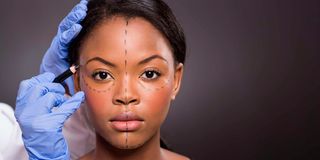
A young woman with correction marks for plastic surgery.
Photo credit: Shuttlestock
The numbers back up how big this industry has become. The International Society of Aesthetic Plastic Surgery (ISAPS) reported nearly 38 million surgical and non-surgical aesthetic procedures worldwide in 2024, a jump of 40 per cent since 2020. Liposuction remains one of the most popular surgical procedures, while non-surgical treatments continue climbing too.
But numbers don't answer the harder question: what happens when fixing one part of the body isn't enough, and the desire moves on to the next?
For Dr Nangole, that's exactly what surgeons need to consider carefully before proceeding with surgery.
"The operating team also needs to discuss with the patient and find out why this patient needs so many procedures," he says.
Not every patient, he adds, is actually a good candidate for repeat surgeries.
"Some of them may be having psychological issues, and therefore you need to have the patient well evaluated. If the patient requires some psychological input from a psychiatrist, then that is also in order, so that you are just sure that the patient has realistic expectations."
We asked Dr Reuben Kamundi, a plastic, reconstructive and aesthetic surgeon based in Nairobi, whether Kenyan women were getting addicted to surgery.
“I wouldn’t call it an addiction,” he says, adding that patients who return for more than one procedure have already overcome the fear of surgery.
"Before you do surgery for the first time, there's always that fear. You fear you might not be in good hands. You fear waking up, not wanting to go for anaesthesia, imagining you're under anaesthesia for four, five hours. It's scary," he says. "Even for us medics, when we need to attend first surgery, it's scary."
That fear tends to fade once a patient has actually lived through the process: the surgery, the anaesthesia, the recovery, the follow-up appointments, and coming out the other side without complications. Suddenly the unknown isn't unknown anymore.
"You know that even with another procedure, you will pull through without any issues," Dr Kamundi says.
He says patients space out their procedures for practical reasons rather than doing everything at once. Someone who wants a tummy tuck, breast lift and BBL might not qualify to have all three in a single operation; maybe their haemoglobin levels aren't high enough, or they'd rather avoid a blood transfusion altogether. In those cases, surgeons stage the work.
"You do a tummy tuck, you recover, then you come back, you do a breast lift, you recover," he explains.
Additionally, paying for several major surgeries at once is expensive, and recovery itself comes with real costs, especially time away from work.
Brazilian butt lift, popularly known as BBL is gaining popularity in Kenya.
Photo credit: Shutterstock
"Our population, most working women, prefer to stage these procedures because of the recovery period. They need time off, and not many can afford the luxury of staying home an entire month or more," he explains.
Dr Kamundi describes a patient who had a breast reduction last May because her heavy breasts were causing back and shoulder pain and throwing off her posture. She's now preparing for a tummy tuck, an entirely separate goal, not a continuation of the same fixation.
“Pregnancy, weight changes and simple ageing can also undo earlier results. A woman who had a breast lift years ago might need another after having children, or after gravity has done its work.”
"Someone had a target in mind, this is how big I want my butt to be, but I can't achieve that in one surgery, so they come for another cycle", Dr Kamundi says.
The same logic applies to fat transfer breast enlargement, where the first round might produce a modest change, with a second procedure adding more volume later.
Still, Dr Kamundi draws a clear line between staged surgery working toward a defined, realistic goal, and someone chasing procedure after procedure with nothing left to fix.
"What worries us most is now someone is doing a repeat surgery with a different surgeon. They do not have clear reasons why they've changed surgeons. That is probably a red flag…" he says.
Dr Kamundia says that when a new surgeon takes on a patient like that, the job is to slow things down: figure out what the patient wants, why they want it, and whether it's actually warranted. Sometimes that means saying no if the procedure could put the patient in danger.
"If I feel that whatever you're asking for is not warranted, then I should tell you: I don't think you need it as of now," he says.
Psychological screening matters most here, particularly with patients who have unrealistic expectations or may be dealing with body dysmorphic disorder.
Dr Kamundi remembers one particularly telling case: a patient whose boyfriend wanted her to get one litre breast implants in each breast, despite her already having a fairly substantial natural size.
"That means breast on top of what she already had. I asked her to think about what could happen when she broke up with her boyfriend," he says.
When asked if celebrities and influencers are causing more women to go under the knife, Dr Nangole says they too are entitled to get cosmetic work done, and there's little anyone can do to stop them from talking about it publicly. What actually matters, he says, is the honesty of the message.
"The most important is the kind of message that they're passing out there. Is it factual? Is it honest? Is it truthful? And is it out of their own consent that they want to share, that they're not being coerced by anybody to share that information?"
That question becomes especially tricky when an influencer says a procedure was done for free. It blurs the line between a genuine personal experience and what is, essentially, an ad. There aren't strict rules governing those arrangements between surgeons and influencers, Dr Nangole notes, pointing out that doctors already do plenty of reconstructive work for free. So why not aesthetic procedures too?
Consent still has to be front and centre, though.
"For whoever is concerned, there must be consent. The patient must have given the consent to say that yes, this is what he or she wants to be done."
Social media is brilliant at compressing an entire surgical journey into two side-by-side photos. What followers see is the transformation. What they don't see is everything that happened in between: the consultations, the medical tests, the decision on whether someone is even fit for surgery, the anaesthesia, the weeks of recovery, and the real possibility that something could go wrong.
There's no universal rule dictating how long someone has to wait between procedures, according to Dr Nangole.
Once the fear of surgery is conquered, some patients will go on to have more procedures done on different parts of their bodies.
Photo credit: Shutterstock
"As long as the patient has fully healed and is assessed by the doctor who wants to do the procedure, if the patient is comfortable for another procedure, then the patient should be allowed to have the procedure."
That doesn't mean jumping from one operating table to the next carries no risk, though.
"Many factors determine the risk of complication: is it a major or minor procedure? Does the patient have pre-existing conditions? What’s their age, weight, et cetera? So, yes, doing repeat surgeries could increase the risk. The patient needs to be evaluated very well."
Carole Grace* used to describes herself as thick and beautiful. On social media, she followed women who looked like her and studied how they dressed and how they moved through the world comfortably in their own skin.
Then, one by one, those women started changing. They came back online with slimmer waists, flatter stomachs, entirely different body shapes.
For Carole, the effect wasn't inspiring. It made her question whether she, too, was supposed to alter her body to feel good in it.
Counselling psychologist Cleopa Njiru says that reaction makes sense once you understand self-concept.
"How someone feels about their body will also affect how they see themselves, their self-image, how they see themselves in relationships," he says.
For many people, how they feel about their appearance becomes tangled up with how they value themselves as a whole. Some of that, Mr Njiru explains, traces back to experiences that started far earlier in life, long before Instagram ever entered the picture.
"They may need to first of all talk about the underlying issues; Is there childhood trauma that needs to be addressed? How were they raised? That's where counselling comes in.”
He also points to the broader cultural messaging at play, ideas about what it means to be attractive, successful, or even likeable, that get reinforced constantly by what people see, hear and consume.
That pressure, Mr Njiru suggests, may partly explain why some people move from one cosmetic procedure straight into planning the next. Like the surgeons, he resists the word addiction. Instead, he frames repeated procedures as a signal, tied to self-esteem, self-worth and body image.
That said, Njiru is careful not to paint every patient with the same brush. Plenty of women genuinely do it for themselves, not for a partner, not for followers, not for anyone's approval but their own.
Many Kenyan women appear to have developed a taste for cosmetic surgery.
Photo credit: Shutterstock
Changing your appearance can be a completely valid way to feel better in your own body. The real concern, he says, is when your sense of worth becomes entirely dependent on how that body looks.
"They may attach their value, their esteem, their confidence to how their body looks," he says.
That's the blurry line to look out for: the difference between wanting to look different and believing you have to look different to matter.
Ultimately, Njiru says, there's no single story that explains why someone keeps returning for more procedures. He warns against slapping a body dysmorphic disorder label on anyone simply because they want more work done on their bodies.
“Some people are working through real, unresolved psychological experiences. Others know exactly what they want, and go after it. The two aren't always easy to tell apart, and maybe that's the whole point,” he concludes.