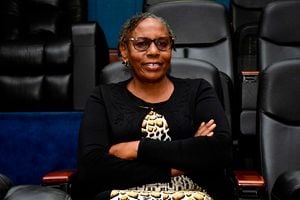
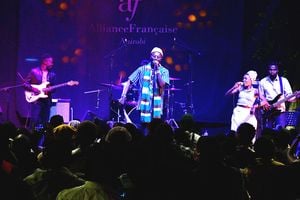
Twelve years is a long time for a song to haunt a country. It is a longer time for it to haunt the person who wrote it. I learnt this on Tuesday, July 15, 2025, when I sat for a chat with Juliani, one of Kenya’s leading hip-hop artists. We reflected on what it meant to write the anthem that shook the nation, and how a single song became the soundtrack of a revolution, gained mainstream traction, and brought him both fame and fragility.
As he talked, his trademark dreadlocks moved this way and that, in momentary jigs, like in his music videos when he does that characteristic dreadlock shake, as if the music is too much for one body to hold and must spill out, fighting its way into the world.
His Utawala hit song was released in the run-up to the 2013 general elections. However, even today, it still commands attention, the lyrics echoing — sweet and lush and overpowering — floating in falsetto, moaning low and soaring high: “Niko njaa hata siezi karanga… Hohehahe shaghala baghala… Niko tayari, kulipa gharama… Sitasimama maovu yakitawala/ (I’m so hungry but I can’t even afford roast groundnuts… I am poor with chaos and confusion all around… I’m ready to pay the price… I won’t stand by while evil rules)”.
Hip hop Artist Juliani
Photo credit: FRANCIS NDERITU| NATION MEDIA GROUP
Utawala was a call to reimagine Kenya. Even if maybe it’s true that music is the only ideal country we have left. One that cannot be stolen or auctioned to the highest bidder. And maybe, in that country, the artist’s job is to keep singing even after the world has lost its voice.
And Juliani has kept singing. He is pushed by something deeper than lyrics. He remembers one thing about Dandora, where he grew up in Phase 4: the fear. And 15 years after leaving Dandora, he still has nightmares about it. The dreams have the same plot—back in Dandora. In the dream, he is always nine, probably barefoot in the corridor, dust and burnt plastic curling up his nose. Someone was running, always. Sometimes it was himself.
He remembers the powerlessness, the lack of agency. Utawala was a song to give himself that power back. And to give others their power. It’s a call to action.
Kenyan musician Eric Wainaina during past live performance in Nairobi.
Photo credit: File | Nation Media Group
Right now, the hottest song online (on TikTok and other platforms) is the Risasi ya Mguu /Shoot the Leg song, a satirical track that went viral following President William Ruto’s directive for police to shoot violent protesters in the legs rather than kill them. The song is a youth–driven musical response to the directive, blending humour, bitter satire and protest, featuring a limping dance routine, mimicking someone who’s been shot in the leg.
The song became part of a broader meme wave making fun of the directive, with hashtags like #OneLege and #WheelchairEconomy trending online. Risasi ya Mguu is a good example of political commentary wrapped in a song.
Music has played various roles in the Kenyan political scene. Firstly, music can play the role of a historical anchor, reminding people of the country’s history and struggles. Joseph Kamaru used Kikuyu benga to critique leadership, for instance, in his song J.M. Kariuki that mourned the slain MP and condemned impunity. Eric Wainaina’s Nchi ya Kitu Kidogo became a national call against corruption in the early 2000s.
Hip Hop duo Gidi Gidi and Maji Maji.
Photo credit: Pool | Nation
Secondly, music can be used for political mobilisation. A good example is the Unbwogable song by Gidi Gidi Maji Maji that rallied youth and voters in 2002, helping usher in President Kibaki’s National Rainbow Coalition (NARC) into power. The song Sipangwingwi was used by then Deputy President William Ruto in his 2022 presidential campaign, to searing effect. Dr Ruto adopted the Gengetone hit by Exray Taniua featuring Trio Mio as the unofficial anthem of his “hustler” movement.
It’s now time for Risasi ya Mguu and other newer songs. As I shook hands with Juliani that day after our chat, I came away feeling that a song, once released into the world, stops belonging to the person who made it. It belongs to whoever needs it most. And sometimes, the people who need it most don’t have a platform.
Sometimes they just have a roasted maize cob for supper and a street corner and a head full of dreams someone else keeps trying to auction off. “Lau twapangwa mafungu, huijui hisabuye (if we are being auctioned in portions, we don’t know at what price),” writes the Zanzibari-born writer Mohammed Khelef Ghassani in his collection of poems, N’na Kwetu (I Have a Home).
Juliani and other musicians of our time are not only prophets but also witnesses. Or maybe mirrors. May we use the messages from our musicians, especially on social justice, to reimagine a better Kenya.