“Mimi ndio Sifuna” (I am the Sifuna) is usually said with utmost self‑assurance — in bountiful heaps, sloppy gobs and spilling surplus — with the fierce determination of a wartime general in supreme command, one who has come to fight, not to plead.
His words — from pointed barbs to poisoned darts to clipped quips and sarcastic derision — carry the weight of a wunderkind with a set jaw and a stare so penetrating that when he blinks, it is only to reload, each syllable enunciated with defiant, almost hostile precision — to devastating political effect.
ODM Secretary General Edwin Sifuna speaks during celebrations marking what would have been the 81st birthday of former Prime Minister the late Raila Odinga at his home in Karen, Nairobi, on January 7, 2025.
Photo credit: Bonface Bogita | Nation Media Group
With the exasperated expression of an exiled prince, buffeted by contrary blistering and boisterous political winds, Edwin Sifuna has upped the ante since his ouster as ODM Secretary‑General, before the move was halted by the Political Parties Disputes Tribunal.
Fast and furious, made large and mysterious by the attempted expulsion — a prophet, a rebel, with a downward slide into martyrdom — he is enjoying a new kind of power.
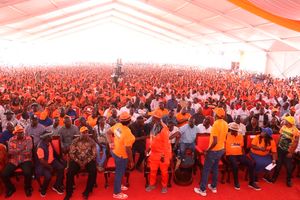
On Sunday, February 15, 2026, Sifuna, alongside James Orengo and Babu Owino, held a political rally in Kitengela that shook the Kenyan political landscape. As the late afternoon sun sent a beam through the crowd to where Sifuna stood, the knives of the resultant shadows cutting across his throat as if severing head from torso, the peculiar light made a halo, evoking a certain mystery and something increasingly fascinating.
Fascinating, indeed. With a black cap atop his head bearing the word ‘Sifuna’, he was clad in a white T‑shirt with Raila’s mural on the front and the words, “Who has told you?”
As the crowd erupted in “Sifuna Usilale” (Sifuna, don’t sleep), he stood at the centre of it, no longer just secretary‑general but elevated by his very dispossession into something more potent: a symbol.
Siaya Governor James Orengo (right) and ODM Edwin Sifuna address residents of Ugunja town during a public rally by Linda Mwananchi faction on February 8, 2026.
Photo credit: Alex Odhiambo | Nation Media Group
It is as a symbol that Sifuna rises as a metaphor in literature, comparable with other rebels who challenged the status quo. In Shakespeare’s Julius Caesar, Edwin Sifuna could be compared to Brutus.
427 years after Shakespeare wrote that play, Sifuna finds himself cast out by his own party for what he insists are principled actions. His crime, Sifuna claims, is opposing President Ruto's regime .
The similarity between Brutus and Sifuna is riveting. Both men claim to act from principle rather than ambition. Both find themselves at odds with their political establishments. Both insist their cause is public interest and not personal power. And both discover that in politics, noble intentions do not guarantee automatic support.
In Shakespeare’s Julius Caesar, Brutus is a model of the principled political rebel and a cautionary tale about the costs of ideological purity in a world of messy political realities.
Brutus claims that he is not against Caesar but that his action is pre‑emptive, based not on what Caesar has done but on what he might do. Brutus kills Caesar to save the Republic from a potential tyrant — a tyrant Caesar is yet to become.
This is the logic of Brutus: act now to prevent future corruption. But it is also, for him, a miscalculation that ends in tragedy. He is noble, yes, but also naïve. His tragedy is that his conviction leads him to commit an act (murder) that destroys what he most values (the Republic).
ODM Edwin Sifuna during a public rally by Linda Mwananchi faction of the ODM at Busia Stadium in Busia County on February 8, 2026.
Photo credit: Alex Odhiambo | Nation Media Group
There are interesting parallels between Sifuna and Brutus. Both are insiders who rebel: Brutus is Caesar’s friend; Sifuna has served as ODM Secretary‑General for several years.
Most tellingly, both men frame their opposition as a pre‑emptive defence of what they believe to be the truth. Just as Brutus kills Caesar not for what he has done but for what he might do, Sifuna opposes the UDA regime not because it has necessarily already corrupted ODM but because he believes it will inevitably do so. Both men act to prevent a feared future rather than respond to a present reality.
Like Brutus, Sifuna appeals to basic principles. Brutus invokes Roman republican tradition; Sifuna invokes ODM’s founding commitment to democracy, freedom and reform. Both men present themselves as defending institutional integrity against those who would corrupt it for short‑term gain.
Ousted ODM Secretary General Edwin Sifuna(centre) flanked by EALA MP Winnie Odinga (3rd left), Siaya Governor James Orengo (3rd right), Embakasi East MP Babu Owino and other leaders address journalists at Sarova Panafric hotel in Nairobi on February 12, 2025.
Photo credit: Billy Ogada | Nation
And like Brutus, Sifuna may be making strategic miscalculations born of idealism. Granted, Sifuna’s potential miscalculations remain to be seen, but some are already apparent.
First, he may have underestimated the ODM party leadership’s resolve to kick him out. Maybe he thought he was untouchable. In the same way Brutus underestimated his detractors, Sifuna may have underestimated Oburu Odinga’s determination to enforce party discipline.
Second, like Brutus trusting the Roman mob to choose principle over anything else, Sifuna trusts ODM’s grassroots to support him over the Oburu Oginga faction. His “Linda Mwananchi ” rallies appeal directly to the people, banking on the fact that they will support his cause. On this, Shakespeare sounds a sharp warning: the people who cheer Brutus one moment can be turned against him the next. Political loyalty can change as quickly as the wind changes direction.
From left: Embakasi East MP Babu Owino, Nairobi Senator Edwin Sifuna and Saboti MP Caleb Amisi during the World Teachers Day Celebrations at Kenya Science Campus, Nairobi on October 5, 2025.
Photo credit: Lucy Wanjiru | Nation Media Group
The warning for Sifuna is that in Julius Caesar, Shakespeare cautions that political narrative matters more than political facts. Brutus assumed that Romans would understand why Caesar had to be assassinated. The crowds did not buy it automatically, no matter how righteous the deed. Unfortunately, in politics, the one who tells the story more persuasively may matter more than who acts more nobly.
The question Shakespeare poses through Brutus is whether political idealism can survive political reality. Can a principled rebel achieve his stated goals, or does the very act of rebellion create chaos that destroys what the rebel sought to preserve? That question is hard to answer. Whereas the arc of tragedy in Shakespeare bends inevitably towards catastrophe, the arc of Kenyan politics is less certain.
Sifuna’s political fate — and ODM’s future — remain unresolved like an unfinished play still being written. We wait for the next scene with bated breath. Maybe Sifuna will be vindicated, after all. Maybe not.